
Mirna Fahmy
For over two decades, Russia has been receiving several terror attacks from immigrants attached to religious extremist’ organizations.
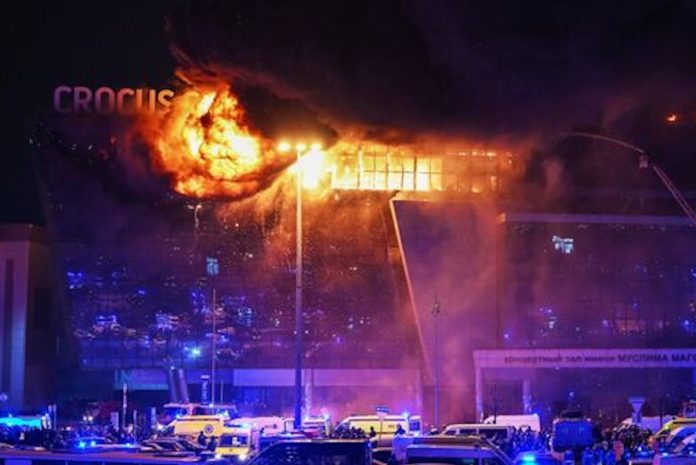
The murderers who carried out the most recent deadly attack, which was the Crocus City Hall attack in Russia, have been identified and arrested by Russia’s Federal Security Service (FBS).
They are citizens of Tajikistan, a landlocked country located in central Asia, who moved to Russia in search of a better life related to work. Their names were revealed by the Russian authorities as Dalerdzhon Mirzoyev (32), Saidakrami Murodali Rachabalizoda (30), Shamsidin Fariduni (25), and Muhammadsobir Fayzov (19).
Around 14 hours after the attack, the FBS captured the four suspects in the Bryansk region, heading towards the Ukrainian border with Russia. They were tortured to confess who instigated them to kill around 144 and severely injure more than 100. They were brought into the courtroom for further interrogation and trial on Sunday, March 24, two days after the attack.
Later, ten other people were arrested in Russia suspected of aiding the attack, including two from Tajikistan and one from Kyrgyzstan on Monday afternoon, March 25, per the BBC.
There were videos of the suspects getting beaten by the Russian forces roaming the social media, especially X. An attacker had his ear cut, another had a swollen face, a third was tormented with electric shocks, and a fourth was brought to the court in a wheelchair.
In a video leaked by Russian security forces, Shamsidin Fariduni said that he received a message on Telegram from a Turkish Islamist cleric whom he follows to carry out this attack, and he would be rewarded with one million rubles ($10,000). He was paid half the amount, which is 500,000 rubles ($5000), as an advance payment, and he shall be given the rest after the attack.
Most of the four were investigated either carrying or drawing the Islamic State (IS) flag that were found with them by the Russian forces. It was later confirmed they are from IS Khorasan group which belonged to the Afghan wing of the Islamic State and was aimed at an audience in Tajikistan. The suspects were following “The Voice of Khorasan” telegram group through which they received the urges of the attack.
In response, Tajikistan retracted their attachment to what those murderers did and that they don’t represent their country for the horrific act they committed.
Though IS announced their responsibility for the attack, Russia’s President Vladimir Putin put the blame on Ukraine and the United States for triggering the attack in a press conference after the incident.
“We know that the crime was committed by radical Islamists, an ideology that the Islamic world has been fighting against for centuries.,” he added.
“We know by whom these atrocities were perpetrated against Russia and its people.”
Russia now demands the handover of Ukraine Security Service Chief Vasyl Maliuk ensuring that they found proof that the concert hall gunmen were linked to “Ukrainian nationalists” including Maliuk. The Investigative Committee of Russia stated that “the investigation has confirmed data that the perpetrators of the terrorist attack received significant amounts of money and cryptocurrency from Ukraine , which were used in preparing the crime.” However, Kyiv denies any connection.
History of previous terror attacks:
This isn’t the first time Russia has witnessed a terror attack killing hundreds of its people, either within the country’s territory or abroad, by the IS group. In 2015, the IS claimed the bombing of a Russian aircraft taking off from Sharm El Sheikh’s airport in Egypt with 224 people on board, most of them Russian citizens. It also claimed a 2017 bomb attack on the St. Petersburg metro, which killed 15 people.
Since 1999, when Putin rose to Russia’s presidency, a series of terror attacks have struck in from immigrants connected to religious groups.
In September 1999, a series of explosions hit four apartment blocks in the Russian cities of Buynaksk, Moscow, and Volgodonsk, killing more than 300 people and injuring more than 1,000. The bombings, together with the invasion of Dagestan, triggered the Second Chechen War as officials blamed militants from the separatist region of Chechnya.
The Moscow theatre hostage crisis in 2002 was the seizure of the crowded Dubrovka Theatre in Moscow by Chechen militants on October 23, 2002, resulting in the taking of 912 hostages. The attackers, led by Movsar Barayev, claimed allegiance to the Islamist separatist movement in Chechnya.
The Beslan school siege was a terrorist attack that started on September 1, 2004, lasted three days, involved the imprisonment of more than 1,100 people as hostages, and ended with the deaths of 334 people, 186 of them children, as well as 31 of the attackers. It is considered the deadliest school shooting in history by Chechen rebels.
The 2006 Moscow market bombing occurred on August 21, 2006, when a self-made bomb with a power of more than 1 kg of TNT exploded at Moscow’s Cherkizovsky Market, frequented by foreign merchants. The Saviour, a militant national organisation, took the credit and was sentenced in 2008.
The 2010 Moscow Metro bombings were suicide bombings carried out by two female Islamic terrorists from the Islamist Caucasus Emirate group during the morning rush hour of March 29, 2010, at two stations of the Moscow Metro (Lubyanka and Park Kultury), with roughly 40 minutes in between. At least 40 people were killed, and over 100 were injured.
The Domodedovo International Airport bombing was a suicide bombing in the international arrival hall of Moscow’s Domodedovo International, in Domodedovsky District, Moscow Oblast, on January 24, 2011. The bombing killed 37 people and injured 173 others. Russia’s Federal Investigative Committee later identified the suicide bomber as a 20-year-old from the North Caucasus.
In December 2013, two separate suicide bombings a day apart targeted mass transportation in the city of Volgograd, in the Volgograd Oblast of Southern Russia, killing 34 people overall, including both perpetrators. The attacks followed a bus bombing carried out in the same city two months earlier.
The Gronzy clashes took place on December 4, 2014. A group of armed militants of the jihadist organisation Caucasus Emirate attacked a traffic police checkpoint outside the city of Grozny, Chechnya, Russia. The militants then entered the city and occupied the “Press House” building in the city centre and a nearby school.
On April, 3, 2017, a terrorist attack using an explosive device took place on the Saint Petersburg Metro between Sennaya Ploshchad and Tekhnologichesky Institut stations killing 15.
On April, 2, 2023, a bombing occurred in the Street Food Bar No.1 café on Universitetskaya Embankment in Saint Petersburg, Russia. Russian military blogger Vladlen Tatarsky, real name Maxim Fomin, died as a result of the explosion and 42 people were injured.
Despite the tigtened tensions between Chechen and Russia in the early 2000s, the two countries’ leaders Ramzan Kadyrov and Putin have strengthened their bilateral relationship in the last decade. Chechen even aided Russia in sending fighters in its war against Ukraine.
Russia’s immigration crackdown intensifies:
Since the Crocus attack, authorities in St. Petersburg have been deporting migrants en masse in the week, the legal rights group Perviy Otdel stated. More than 64 foreigners were deported from the city’s Vyborgsky district on Thursday March 28, according to Moscow Times. They were headed to St. Petersburg’s Pulkovo International Airport on the following Friday afternoon. The countries they are sent to aren’t yet specified. Those migrants are labor individuals whose origins are from poor Central Asian countries.
Russia hosts nearly four million migrants from Central Asia, according to statistics tallied by the University of Central Asia. Experts say many others are likely in the country working illegally. They are mainly from Tajikistan, Kyrgyzstan, Kazakhstan and Uzbekistan. Entries from the Central Asian countries to Russia demonstrate an increase in 2022 by 50% compared to 2021.
Though Russia heavily relies on migrants to fill in the construction industry and service sector, advocates argue that the population is already marginalised and suffers from anti-immigrant sentiment that has increased since the massacre.