
Mthobeli Jiwulane
South Africa is on the brink of installing a government of national unity (GNU) comprising the ruling African National Congress and a group of opposition parties.
This is the second time that the country, situated on the southern tip of Africa, is governed by a collection of multi-ideological parties. At independence in 1994, icon Nelson Mandela led a similar GNU that was strategically crafted to accommodate the former white apartheid regime under the National Party (NP) and the traditionalist Zulu-based Inkatha Freedom Party, then ally of the white NP.
While the ANC is a centre-left party and believed in mixed economic system, the NP and the IFP were on the centre-right of the country’s spectrum. The NP espoused the Afrikaner nationalism based on apartheid (discriminatory) policies that relegated the black population into second class citizens with the majority of them confined to ethnic homelands.
The IFP followed a strongly Zulu-based nationalism and tribal traditional system, which sustained the party since its inception in the early 70s by its late founder, prince Mangosuthu Buthulezi.
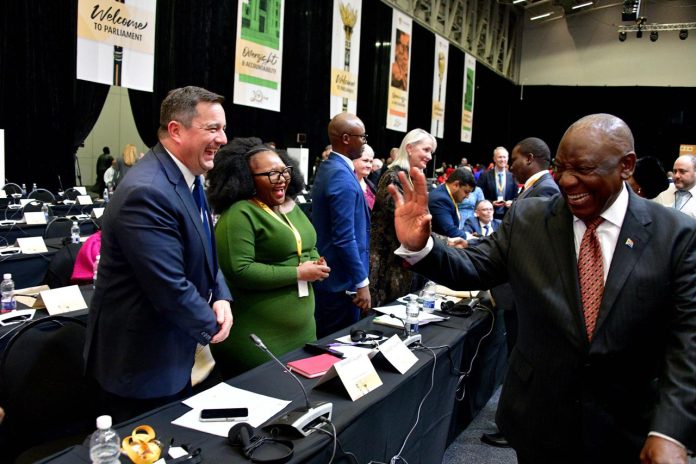
The newly inaugurated President Cyril Ramaphosa was expected to announced a new multi-party cabinet soon. The President was inaugurated on Wednesday for a second term of office during a ceremony attended by, among others, mainly African heads of state and Prime Ministers and a large contingent of foreign diplomats and international representatives sent by their countries.
The GNU was not what the ANC would have liked, but it was forced to accept it by the electoral outcomes where the ANC lost its parliamentary majority at to 40% in last May national and provincial elections down from 57.5% in the 2019. The results obliged the ruling party to seek an all-encompassing partnership with other parties to establish a national coalition, now called the GNU. This arrangement was expected to be replicated in provinces where the ANC also lost majority such as economical hub of Gauteng and east coast-situated KwaZulu-Natal.
But the way to the GNU has proven to be rocky and filled with many potholes. The parties that intend to join the GNU had to sign a Statement of Intent (SOI) to indicated their willingness to participate in the partnership before being admitted. The ANC, the main opposition DA, the IFP and the Patriotic Alliance (PA) were the first to endorse the ANC-initiated deal, hardly an hour after Ramaphosa’s re-election in Parliament on June 14.
In what some regarded as a bad omen, the first squabble ensued this week when the DA challenged the ANC for inviting the PA into the deal without first seeking consensus from other members. The DA targeted the PA, led by reformed ex-convict, Gayton McKenzie, who has become a vociferous and straight-talking activist.
DA federal council chair, Helen Zille, a veteran politician, claims the ANC was not authorised by her party and the IFP which were the founding parties along with ANC, on the GNU to include the PA. She says the ANC breached the SOI agreement which provided for the original members to be consulted before any new member was brought in. The disagreement is threatening to collapse the GNU before it could even start and matter was set to go to the court if not resolved peacefully among the parties or mediated by a neutral party.
Commentators see the squabble as a bad start that symbolises what lies ahead for the GNU. They cite ideological differences as the underlying cause of the tensions. But others trace it to a political enmity between the DA and the PA that were fighting over the coloured population votes in the Western Cape province, which had been governed by the DA since 2009.
“The DA and the PA fish from the same pond,” says independent political analyst Goodenough Mashego. He was referring to the coloured constituency which the DA monopolised since its formation from the merger of the neoliberal and free market-oriented Democratic Party and the apartheid advocating NP.
There are two main camps with opposing attitudes towards the GNU – those for and those against it. The ANC and other parties that signed the SOI deal, favour the GNU whose membership now stands at ten and growing. The structure currently comprised the centre-left ANC, centre-right DA and IFP, the non-ideological PA and Good party, the left socialist Pan Africanist Congress (PAC), the right-wing nationalist Freedom Front Plus and social democratic United Democratic Movement (UDM), Islamic-faith based leftist Al Jamaah and Rise Mzansi, a new centre-right neoliberal outfit led by former newspaper editor, Zongezo Zibi.
The core of opponents to the GNU comprised the former President Jacob Zuma’s newly formed Umkhonto Wesizwe which is a new breakaway from the ANC, the radically left Economic Freedom Fighters and few other smaller left parties. The PAC, UDM and Al Jamaah were initially part of this group, known informally as the Progressive caucus, but broke ranks to join the GNU.
The operational format of the GNU is based on ‘scratch-my-back-and-I-scratch-your back’ principle. The ANC and the DA came together to close the space to the leftwing group especially MK and EFF that are strongly opposed to the GNU which they regard as a “sellout” mechanism imposed by the West and the white monopoly capital to influence the country’s political direction in their favour.
The two main pro-GNU protagonists, the ANC and DA, agreed to co-operate at all levels – national, provincial and local governments. Their co-operation also entails exchanging positions and avoiding opposing each other as a matter of principle. The ANC would also offer the DA senior cabinet positions including chairing particular oversight parliamentary portfolio committees.
The governing party had already offered the former official opposition the Deputy Speaker of Parliament post. This arrangement was to be replicated at the lower levels and the two parties would back each other and fight on the same side “in the interest of South Africa”. A similar set-up was agreed with the IFP, which would get Ministerial positions and in exchange the IFP appointed ANC and DA members to its coalition provincial cabinet in KwaZulu-Natal, which it governs post the May election.
In an interesting development, the right-leaning Freedom Front Plus assisted the ANC gain power by voting for the ANC’s Zamani Saul to become the premier of the centrally-situated Northern Cape province for a second term. For the party’s goodwill, a Freedom Front Plus member of the provincial legislature was offered a position as chair of crucial portfolio committee on co-operative governance, traditional affairs and human settlements in the legislative house.
In addition to this and as a historic compromise, the ANC acceded to the Freedom Front Plus’ request for the ANC government to recognise the self-made Afrikaner ethnic enclave, Orania, situated in the Northern Cape. The ANC agreement led to the two parties unprecedented co-operation.
ANC opponents see the decision as a dangerous precedent-setting as other provinces could follow suit and demand to secede and establish their own independent “ethnic republics” within South Africa. There were already ongoing calls for the Western Cape province, currently governed by the DA and KwaZulu-Natal, to secede from the South Africa. The two provinces have their own provincial constitutions which other provinces do not have.
The opponents to the idea further argue that such a compromise would open flood-gates for a return to the apartheid-styled Bantustan system in which tribal-based ethnic homelands for black people to practice political power separately were established, away from the mainline white politics.
The left-leaning MK and EFF criticise the GNU and accuse Ramaphosa and the ANC of “selling out” the black population to the neoliberal agenda and the move would reverse the gains of the 1994 democracy and freedom. According to them the new GNU was a precursor to the return to the white-dominated old-styled apartheid rule that deprived the black population of their South African citizenship and better economic opportunities that were reserved for the white population.
The EFF, closely aligned to MKP, espouses more radical socialist policies that includes land expropriation without compensation on those who currently own the land (the white farmers and the rich). The party, which has a huge youth following, wants a wholesale nationalisation of mines and the country’s central bank, the South African Reserve Bank. These are positions that analysts say would definitely scare off investors.
On the other hand, the markets and the West in particular appeared satisfied with incoming mainly ANC-DA-IFP coalition as it was guaranteed to pursue a neoliberal agenda including privatisation and private-public partnership development. The new arrangement would see an implementation of diluted leftist policies such as healthcare and other social services in favour of the poor in line with current ANC policies. The ANC espoused mixed economy and the implementation of a developmental state that must be combined mainly with the DA’s neoliberal policies.
Pundits believe the new system would attract foreign investors who were wary to deploy their monies in an uncertain and unstable political environment during the ANC-only period. The ruling party is aligned to the highly leftist South African Communist Party and the Congress of South African Trade Unions, that both pursue a Marxism.
Besides, analysts concur that the GNU is good for racial reconciliation and nation-building after 300 years of colonial and apartheid devastation of the country. Inside South Africa there is general feeling that a combination of the ANC and DA policies would also help to fast-track service delivery to the poor and facilitate the minimisation of widespread corruption and nepotism, among others. The DA is known for its watch-dog role against graft and state inefficiency and many hope the DA’s experience in efficient governance in the Western Cape, would become a norm under the new GNU administration.
For the last 15 years at least, there had been widespread concern about low economic growth under the ANC. The highest level of growth ranging between 4% and 6% was last seen during the decade-long reign of former President Thabo Mbeki, a Mandela understudy who succeeded him in 1999. But all that progress dropped dramatically since Zuma took over from Mbeki from 2009 to early 2018 with massive corruption that included corporate state capture by an Indian migrant family. There had been no recovery neither during the current Ramaphosa administration. The economic growth consistently hovered at 1% and hardly exceeded 2% since the Zuma years with official unemployment rate at over 32% and 42% when extended to include those who gave up on job seeking.
On the GNU cabinet, Ramaphosa is expected to give some of the economic and social services positions to ANC’s GNU partners but definitely not the strategic departments such as Justice, Foreign Affairs, Defence, Intelligence, Communications and Digital Technologies and Finance. The tension again arose when the DA demanded to be given the Deputy President and deputy Finance Minister positions among several others but the ANC refused and the matter was not resolved at the time of publishing this article and Ramaphosa was expected to announced the new Cabinet on Sunday evening or late in the week.
The ANC accused the DA of bullying it as if it had won an election when it was in fact an opposition party.
The deputy president post was reserved for incumbent Paul Mashatile, who automatically succeeds Ramaphosa as president at the next election, if the ANC won outright or led the GNU again.
The ANC might give away police and sports arts and culture portfolios, which were already vacant because the incumbent Police Minister Bheki Cele has not returned to Parliament while the sports and culture Minister, Zizi Kodwa, resigned recently amid corruption charges he faces in court. Other departments up for grabs are post and telecommunication, public works and infrastructure, agriculture, forestry and fisheries and low-key tourism and environmental affairs, small business development, among others.
There were rumours that a very senior position had been earmarked for the leader of the IFP, Velenkosini Hlabisa. As a leader of a traditionalist party and a former mayor in his own right, Hlabisa could head the Department of Co-operative Governance and Traditional Affairs. The earlier reports that he might appointed as Ramaphosa’s deputy are regarded as far distant and almost impossible.
But the DA, although it preferred to only head the portfolio committee in Parliament to strength oversight of the executive, as a senior partner in the GNU, it was likely to get several senior Cabinet posts especially those in which the ANC failed dismally to deliver. Some ANC members said the DA was specifically brought in to assist fast-track service delivery and plug the gaps where the ANC failed in the last 30 years of its governance.
The ANC would be wary to give the DA foreign affairs because they differ marked on their approaches to foreign policy. The ANC pursues a neutral foreign policy but is often accused by the West and the opposition of being pro-Russia and an ally of China while the DA is surely West aligned and publicly supports Israel in its ongoing bombings in Gaza. Contrary the ANC backs Palestine and had taken Israel to the Internation Court of Justice in the Hague on allegations of genocide in Gaza.