

By Thobile Jiwulane
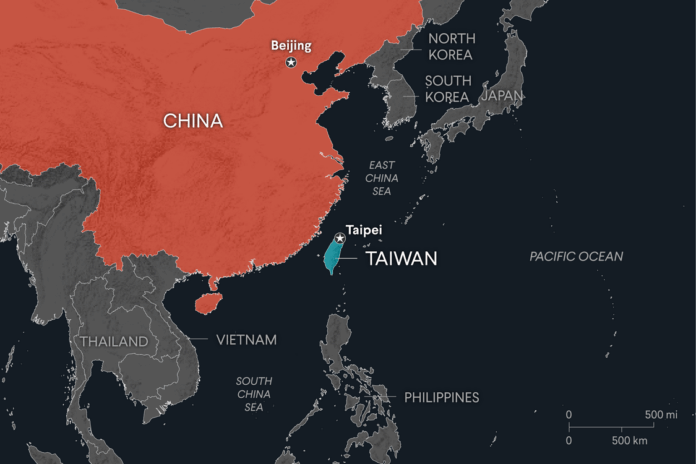
Taiwan is a small island situated southeast of mainland China, separated by the Taiwan Strait from it, but according to UN Resolution 2758 there is only one China in the world and Taiwan is part of it, not a separate country.
However, despite that, this is a claim that Taiwan, in its wisdom, strongly disputes under Lai Ching-te, who appears prepared to fight China to the bitter end, perhaps hoping to create a Russo-Ukrainian-like stand-off. But can Taiwan stand up to China in the manner that Lai would like to see, or is it just wishful thinking? A South African expert, however, believes it’s easier said than done, emphatically stating that there is a difference between a wish and reality.
According to Johannesburg-based independent political analyst, Sandile Swana, if the Lai regime dares China to war or retaliates in the way it plans with the West, it risks being overwhelmed by Chinese forces. It could be embroiled in a bloody confrontation with a giant of technological warfare. Swana cautions that instead of warring with China, Taiwan ought to emulate Hong Kong and Macao and avoid a conflict.
Although Hong Kong and Macao are under China’s central control they enjoy a high degree of autonomy with Beijing allowing them to continue with liberal democracy under “one country, two systems” framework. They are a Special Administrative Region of China governed by an Executive Council, which acts as the Cabinet with the Chief Executive as its head. The council is advised by the Legislative Council, which enacts regional law. Hong Kong, a former British colony, reverted to China on 30 June 1997, and Macao, a former Portuguese colony, was restored on 20 December 1999. But Taiwan is resisting any link with China, with politicians in Taipei fearing losing democracy under China.
In order to understand Taiwanese politics, you have to read it from the behaviour of political parties that operate on the basis of being pro-China or anti-China. The direction taken depends on which party is in power on the island at a particular time. For instance, the centre-left nationalist Democratic Progressive Party, currently chaired by Lai, is vehemently opposed to China, which regards the party and Lai as secessionists. However, the largest opposition party, the Kuomintang (KMT), is uncompromisingly pro-China. Along with the far-right Chinese Unification Promotion Party (CUPP), also known as the Unionist Party, KMT promotes the unification of the Chinese people.
However, following a snap survey conducted by Diplomatic Insider at the Taipei streets late last year, the older generation of Taiwanese citizens wants reunification, citing that Chinese people are one whether they live in Taiwan or China. The younger generation wants a separate Taiwan and democracy. The survey was not scientific, though; it was an impromptu action meant to test the main political view that says all Taiwanese people are opposed to China. It was proven not to be the case, even with the small number of 20 respondents interviewed.
Although the Taiwan government is DPP-controlled, the party lost its parliamentary majority in last year’s election, resulting in the house electing a KMT speaker, Han Kuo-yu, who in turn lost the presidential election to DPP’s Tsai Ing-wen in 2020. The Tsai term and new Lai administration have seen an increase in tension between Beijing and Taipei as the two leaders moved even closer to the US during the Biden Administration, which promised to arm Taiwan should it come under attack from China. But Donald Trump has not indicated any strong stance in Taiwan’s favour, as he prioritises the trade relations between Washington and Beijing. With the current tit-for-tat tariff war between the two countries, some argue that Trump wouldn’t like to spoil relations with China, as he wants to derive some transactional gains from this relationship. There were indications that the previous Trump administration-initiated trade war with China could be minimised or cautiously applied in his current second term, at the White House.
However, there is a new corridor of conflict opened by the West to pit Taiwan against China, involving Germany and the US, specifically. On Tuesday, Taiwan signed a partnership deal with a German defence firm, Auterion, which would supply Taiwan with drone software, the kind that was tested in battle by Ukraine against Russia. The technology would see millions of drones made and delivered to Taiwan to enable it to battle China in case of an attack. Further research on unmanned technology is planned to be done at the National Chung-Shan Institute of Science and Technology in Taiwan. The whole idea, including previous military support by the US, is designed to bog down China in a war, similar to Russia in Ukraine, should it attack Taiwan.
Clearly, where America is involved, military solutions take precedence over peaceful solutions, with deployments designed to stoke up wars in defence of its allies and extend US hegemony. Such propping up had spread to Taiwan, which, though it knows it is no match to China militarily, feels it could muster stronger resistance because the US and its allies would arm it to face China as they currently do in the West’s proxy war in Ukraine.
Swana says China is strong on all fronts, backed by its technological advancements. China has become not only a world economic powerhouse that rivals the United States but also a force to be reckoned with on the military front, but is keeping its cards close to the chest. Honest Western defence analysts and independent geopolitical experts give China positive reviews about its military state of affairs, citing its overarching technology underlying its latest war machinery.
Over the last few years, China’s rapid growth with modern strategic weaponry has been a source of debate and worry for the West, particularly the United States and its East Asian allies, such as Japan, South Korea, the Philippines, Australia, and even India. Every military drill, even in international waters, that China undertakes is watched with hawk eyes throughout the region and the US and seen as a threat to their security. China’s regular military manoeuvres are interpreted as a preparation to invade Taiwan, a message also disseminated by the Western media, built into their anti-China narrative of which Beijing is aware and rejects.
Cape-Town-based defence expert, Dr Helmoed Romer-Heitman, sees the Taiwan approach as the Austrian-like ‘hedgehog’ or porcupine strategy, intended to have the capability to inflict quite serious losses on the opponent, but “not as a deterrence but more a dissuasion”. “That would, I think, be quite a practical strategy for Taiwan and is what I think they have in mind. But, of course, it depends on a strong ally or allies to come to the rescue. Failing that, China could overwhelm Taiwan with sheer numbers, albeit at a massive cost in casualties. That might not bother the PRC government, but they do have to consider that the US might actually rally to support Taiwan,” Romer-Heitman says.
The PRC would also have to consider its enemies in its neighbourhood, as well as Japan, which might come to assist Taiwan, a move that would present a great problem. “No rational government in Beijing would want to take that risk. But then, no rational government in Moscow would have invaded Ukraine, or even Georgia,” Romer-Heitman says. Based on his assessment and the information he had gathered from fellow experts, Taiwan would attempt to fight China even though it would likely be overwhelmed by PRC in the battlefield.
But Swana reject the notion that Taiwan could muster any substantial resistance against China suggesting it should rather opt for a negotiated settlement and learn to live in peace with China like Hong Kong and Macao. “If Taiwan were to negotiate a deal with China and agree to that deal, it would actually enjoy similar rights and privileges like Macao and Hong Kong. So, the system of administration could not be changed, but their economy would be much more integrated into the Chinese economy as well. Macao and Hong Kong are doing very well,” he says,
Taiwan’s independence, Swana suggests, is premised on support from the Western powers, especially the UK and the US, which, despite having endorsed the One-China Policy as part of the UN General Assembly Resolution 2758 recognising China as the sole representative of all Chinese people, including those in Taiwan, continues to prop up Taipei against China. “But this on its own is unviable. There is no way that, under any conditions, Taiwan can match China’s military power. Just the numerical number of Chinese soldiers sent to land on the beaches of Taiwan, the sheer volume, would be a problem for Taiwan,” Swana said.
Swana says in any ICT-driven system, one needs to consider the opponent’s cyber-warfare capability. China is a global ICT superpower, and if it fought with Taiwan, it could disrupt its telecoms, data centres, and drone infrastructure and jam their signals as a strategy to demobilise it. The analyst argues plan by the German firm to build and send drones to Taiwan is not fool-proof, and neither is it guaranteed to work as intended, because the Chinese would also deploy their own various counter-measures to neutralise those drones. This is in addition to cutting off water supplies, electricity and other infrastructure so as to cripple and force the enemy on its knees – one of the tactics used in wars to fast-track its conclusion.
Swana says China is advancing rapidly in technology and the economy. Predictions showed that over the next 25 to 50 years, China would have overtaken America as the world’s largest economy. Similarly, by that time, the US would also have ceased to be the world’s majority-white country which could impact the world’s balance of forces.
“China will be a leading superpower, with other emerging countries following closely behind it. So, the little drone innovation plan they want to bring to Taiwan is good for it as a technological territory as well, but the Chinese are also extremely intelligent, innovative and productive in technology. Taiwan must understand that they are not preparing those drones to fight with a tiny country like Malawi, but a technological giant like China. So, giving those drone technologies to Taiwan will not give it any particular advantage over China,” Swana says.