

By Thobile Jiwulane
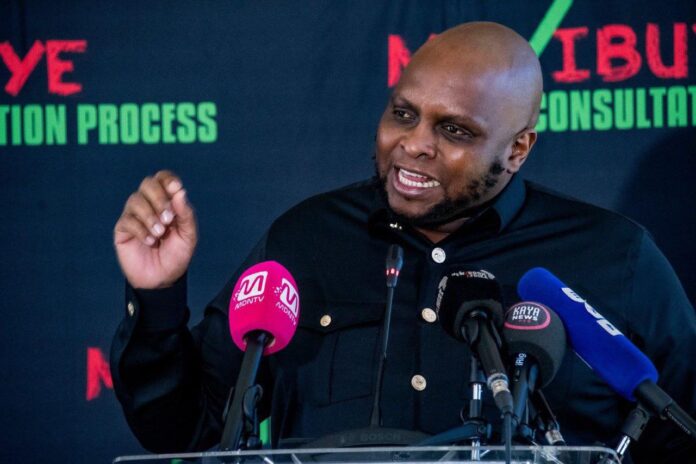
South Africans will soon see the establishment of a new political party with a leftist agenda as Floyd Shivambu, a Marxist, launches a national consultation process to form the party.
However, while pundits respect Shivambu as a stable leader, they all give him very little chance of making a significant impact on the country’s political stage, which they say is oversaturated with multiple players on the left and right of the spectrum. Those include a series of Marxist left parties that have not managed to grow in size beyond initial membership, mainly due to leadership infighting and lack of mass appeal.
Prior to his announcement to launch the party, Shivambu was discreetly removed as secretary-general of the Umkhonto Wesizwe party, led by former South African President Jacob Zuma. Zuma made a public announcement that Shivambu was being shifted from his position in preparation for being sent to Parliament in Cape Town. It turned out this was a red herring and a smart move to boot him out of the party.
Everybody was shocked when Shivambu’s name did not appear on the list of nine members that MKP submitted to the National Assembly for swearing by the House Speaker, Thoko Didiza, as MPs, replenishing the party’s proportional representation list of lawmakers.
Shivambu found himself in a state of political oblivion, prompting him to announce his plan to launch the new party in the future, although he claims to still be a member of the MKP. MKP’s national spokesperson, Nhlamula Ndhlela, confirmed that the young leader was still a member but stated that he might have breached the party’s constitution with his move. However, MKP would not like to rush into taking rash action against him.
Last week, Shivambu called a media conference to announce that he would embark on a consultation process aimed at garnering different views about the need for such a party. However, despite his public humiliation and demotion, the politician was adamant that he remained loyal to MKP and its leader, Jacob Zuma, whom he said he respected.
It’s hardly one year since Shivambu got appointed as secretary-general by Zuma amidst fanfare and public announcement fanfare that shocked the nation. His decision to leave the radical left-wing Economic Freedom Fighters (EFF) was unexpected, despite rumours that he and EFF leader Julius Malema no longer see eye to eye. Until Shivambu’s announcement that he was leaving the party for MKP, the two leaders were close comrades who appeared to be pulling in the same direction, at least in public.
But his removal from the crucial position as SG of MKP became a matter of time. The plight of every MKP member is at the mercy of the leader, Zuma, who runs the party as personal property without elections. The party’s constitution gives him the power to hire and fire members, including senior national executive members or the National High Command, as the top structure is known. He has already dismissed seven secretaries general, a position equivalent to the chief executive officer who run the day-to-day affairs of an organisation.
MKP was the third party Shivambu joined. He had cut his teeth in student politics under the ANC student wing, the South African Students’ Organisation and president of the Students Representative Council at the University of the Witwatersrand. He was to become a prominent leader in the party’s youth league, where he was the closest ally of Malema, the league’s president.
As a loyalist, when Malema was expelled from the ANC, mainly for misconduct and putting the party into disrepute, Shivambu resigned and followed him. Together, along with another former leaguer, Magdeline Moonsamy, they founded the EFF, of which Shivambu was elected as Malema’s deputy president, with Moonsamy as treasurer-general.
South African party politics is known for a culture of break-ups. The ANC itself experienced its first post-democratic election split when Bantu Holomisa, along with Roelf Meyer, who left the National Party, formed the United Democratic Movement.
It was followed by the largest breakaway, led by former Defence Minister Mosioua Lekota, who went on to establish the Congress of the People in early December 2008, in protest at the removal of Thabo Mbeki as the country’s president in September 2008. Although Zuma prevailed over Mbeki at the ANC ructuous conference elections in December 2007, he formed MKP while still an ANC member, a move that propelled the party to expel him.
Factionalism and break-ups occur among all parties in the country. Even the former official opposition party, the Democratic Alliance, experienced two crucial splits in the lead-up to the 2019 national and provincial elections. Then, party federal leader Mmusi Maimane, who was forced to resign after the party’s poor showing in the 2019 elections, established the civil society-inclined Build One South Africa (Bosa).
Prior to that, the influential former Johannesburg mayor and businessman, Herman Mashaba, formed Action-SA. Former Cape Town Mayor Patricia de Lille also left the DA, emerging with the Good party, which derives its votes mainly from coloured voters.
After the 2019 election she was appointed by President Ramaphosa into the Cabinet as Minister of Public Works and Infrastructure, becoming the only opposition member in the executive. In the new term, the veteran politicians serve in the tourism portfolio.
At its inception in 2013, the EFF adopted socialism, accompanied by radical leftist rhetoric, including the nationalisation of land and mines. Shivambu is believed to be the major force behind the party’s Marxist leaning. When he arrived at MKP, he influenced the party to follow similar ideological pattern, imitating the EFF not only rhetorically but also in style such as the use of military ranks to name its structures and describe its leaders.
However, many analysts still argue that MKP is not a left-wing party, with only Shivambu being a left-leaning figure within the party. Zuma himself was not a leftist throughout the years he was an ANC leader; instead, he was an ardent advocate of the ANC’s ideological middle-ground that tilted towards neoliberal economic policies. Zuma only began to use a leftist language as a strategy to win the hearts and minds of the masses after his corruption charges and state capture allegations against him built up, and he subsequently lost state power.
The question that lingered is whether Shivambu would be able to attract support after he had launched his party. Several experts believe he will struggle to get votes because people have had enough of political parties in South Africa. The surge of independent candidates during the election is an indication that voters have lost hope in the political party system in which an elected public representative accounts to the political party rather than to a constituency.
Some say Shivambu’s consultation process is merely a formality, as he has already decided to leave the MKP and establish a new party. In recent years, all political leaders who abandoned or fired from their parties announced a plan to hold consultations to gauge public views about the suitability to form a new party, but none reported that their supporters were uninterested in a political party. Instead, they moved forward with forming the party, claiming to have received backing from supporters and stakeholders to launch it.
Nevertheless, similar to numerous other leaders who chose this path, Shivambu would be able to secure votes and get seats in municipal councils and subsequently in Parliament because even the smallest parties often get elected. The South African proportional representative (PR) system was designed to be generous to parties as any political party that obtains 0.25% or between 40,000 and 45,000 votes is eligible for a Parliamentary seat.
Compared to many parties already represented in municipal councils and parliament, Shivambu has the potential to outperform them, especially since this will be his first election following the breakaway from MKP.
Analysts say there is little room for left-wing parties in the South Africa political landscape. As history shows, none of them had performed well at the polls. The only left party that made a good showing was EFF, of which Shivambu was a founder member along with Malema. Since its establishment in 2013 and contested the 2014 general election, EFF remained at the third largest after the DA and the ANC.
But it was overtaken by MKP in the May 2024 election, which saw the EFF dropping to the fourth position. But experts said Shivambu’s party would fall nowhere near that at this stage. In fact, like all other parties established in recent years, the envisaged party was bound to regress after a few elections.