

By Mirna Fahmy
Though the Assad regime was officially dissolved in December 2024, violence against civilians persists—particularly targeting non-Sunni minorities such as Alawites, Christians, and Druze communities.
One of the most recent and devastating incidents occurred on the evening of Sunday, June 22, 2025, when a suicide bombing struck Saint Elias Church in the predominantly Christian neighborhood of Dweila in Damascus. The attack took place during a Mass service.
According to preliminary reports, the assailant—believed to be affiliated with ISIS—entered the church, opened fire on worshippers, and then detonated an explosive belt. The explosion claimed the lives of between 22 and 25 people, including children, and left 59 to 63 others injured, several critically.
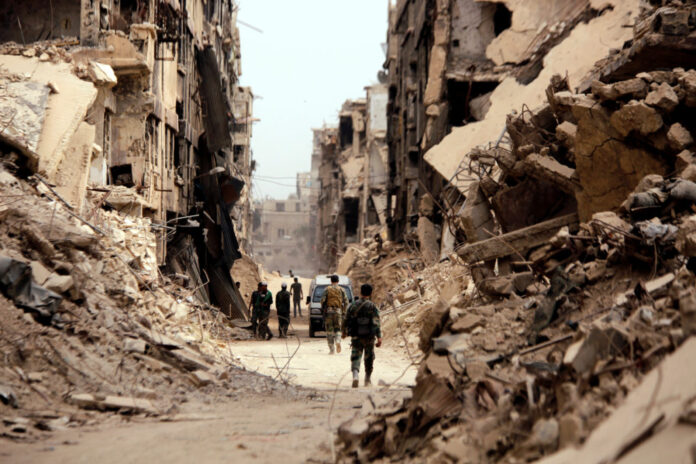
The blast caused significant damage to the church’s structure and nearby buildings. Arabic media compared the attack to previous assaults on churches in Egypt, notably the 2016 bombing of Saint Peter in the Abbasiya Cathedral in Cairo and the 2017 Palm Sunday attacks in Alexandria and Tanta.
While ISIS hasn’t officially claimed responsibility, the Syrian Ministry of Interior stated that the bombing bore the group’s hallmarks.
The incident sparked widespread condemnation and mourning across Damascus and beyond. Syrian citizens and community leaders emphasized that the Christian population is an essential part of the nation’s social fabric, and that any attack on them is an attack on Syria as a whole.
The Greek Orthodox Patriarchate of Antioch and All the East, among other local churches, urged the government to fulfill its responsibilities and protect all citizens, regardless of religion.
In a statement from the Vatican, Pope Leo XIV condemned the bombing, decrying the “satanic ferocity” of ongoing conflicts in the Middle East. He called for adherence to international law and greater protection for places of worship and religious communities.
Patriarch John X Yazigi of the Greek Orthodox Church in Syria emphasized the broader implications of the attack: “This was not an isolated or individual act, but a blatant assault on the entire nation, targeting a core component of Syria’s identity.” Addressing President Ahmad al-Sharaa directly, he added, “This crime is the first of its kind in over a century since this church’s founding, and we hope it will not mark your era.”
President al-Sharaa vowed to bring those responsible to justice and called on Syrians to remain united against threats to national security. The Interior Ministry condemned the bombing as a terrorist crime intended to destabilize Syria’s society and confirmed that evidence collection was underway.
Despite these official statements, many within the Christian community remain deeply unsettled. Critics argue that government actions have fallen short. Notably, President al-Sharaa did not label the victims as “martyrs”—a term traditionally used for those killed because of their faith—nor did he declare a national mourning period. With the exception of Hind Kabawat, Minister of Social Affairs and Labour and the only Christian in the cabinet, no other senior officials visited the site or offered condolences. Kabawat’s visit and strong show of solidarity stood in sharp contrast to the broader government response.
Syria is home to one of the earliest Christian communities in the world outside Jerusalem, with roots tracing back to the first century. It remains a place where Aramaic—the language spoken by Jesus Christ—is still preserved in certain regions.
Persistent Sectarian Violence in Post-Regime Syria
Since the fall of the Assad regime in December 2024 and the subsequent rise of Hay’at Tahrir al-Sham (HTS), sectarian violence in Syria has continued unabated. HTS’s former leader, once known as Abu Mohammad al-Jolani, now governs Syria under the name President Ahmed al-Sharaa.
Following the regime’s collapse, a wave of intensified sectarian violence erupted between March 6 and 17, 2025, primarily targeting Alawite communities. This period saw mass killings driven by deep-rooted sectarian tensions. Various factions—including groups aligned with the interim government and remnants of the Assad-era military—were involved in clashes against Sunni populations, contributing to widespread instability.
A recent Reuters investigation reported that approximately 1,500 people were killed during that two-week span. These findings align with data from the Syrian Observatory for Human Rights (SOHR), which has confirmed the death toll and continues to track ongoing, though now sporadic, killings. SOHR has been regularly updating its figures through its official channels.
In response to public outcry, President al-Sharaa established an investigative committee to examine the Alawite massacres. However, according to Reuters, no concrete action has been taken against those responsible for the atrocities, raising concerns about impunity and the effectiveness of the government’s response.
Further revelations from the investigation indicate that one of the key units implicated in the Alawite killings was the Public Security Apparatus—a body previously responsible for law enforcement in Idlib during HTS’s control, and now operating under Syria’s Ministry of Interior.
Minorities Under Assad and Al-Sharaa:
Prior to the civil war, Christians comprised approximately 10% of Syria’s population—around 1.5 million people in 2011. However, by 2022, that number had plummeted to under 2%, or roughly 300,000. This dramatic decline was largely due to persecution, violence, and widespread emigration.
Although the Syrian war was primarily fought between the Alawite-led regime of Bashar al-Assad and Sunni Islamist factions such as ISIS (Daesh), minority groups—including Christians—faced disproportionate targeting by extremist Sunni militias.
Under Assad’s secular government, religious minorities received a degree of institutional protection, and large-scale attacks against Christians were relatively rare. Nonetheless, Christians still experienced discrimination, restrictions on religious activities, and occasional violence. The situation dramatically worsened with the rise of jihadist groups like ISIS and al-Nusra Front (later HTS), who imposed brutal campaigns of abductions, forced conversions, killings, and the destruction of churches in areas they controlled.
In Aleppo, for instance, the Christian population dropped from 12% pre-war to just 1.4% by 2023. More than 20 churches were damaged. In Idlib, under Islamist control, Christians were almost entirely expelled.
Since President Ahmed al-Sharaa—formerly known as HTS leader Abu Mohammad al-Jolani—took power in December 2024, violence against Christians and other minorities has escalated, according to a Sweden-based Christian human rights organization report.
During that month alone, at least 973 civilians were killed in western Syria, including confirmed Christian casualties. While official reports documented between 4 and 12 Christian deaths, eyewitnesses suggest the real number is likely higher. Entire Christian villages were reportedly raided, looted, and families executed in their homes.
Talking with Syrian Christians whose families are in Syria said that “their homes and churches have been marked with the word Kuffar (Arabic for “infidels”)—signaling future targeting.” Many described the current situation as more dangerous than during Assad’s rule.
These actions bear eerie similarity to ISIS’s persecution of Christians in Iraq, where homes were marked with the Arabic letter “ن” (for Nassara, or “Christian”) to identify families for later execution or enslavement. After the killing of men, women were frequently taken as sex slaves.
While March 2025 was marked by intense violence, persecution began even earlier. In December 2024, Christians in cities including Hama, Homs, and Damascus staged public demonstrations after several high-profile attacks—most notably the burning of a Christmas tree in Suqaylabiyah and vandalism targeting churches and patriarchal buildings.
Protesters carried crosses through the streets, demanding the expulsion of jihadist elements and increased protection for Christians. In the historic Bab Touma district of Damascus, hundreds gathered to chant, “Protect the rights of Christians.”
Dissent intensified in April 2025. In the Christian- and Druze-majority city of Jaramana, large-scale demonstrations erupted against the Sharaa government. Protesters echoed the revolutionary slogan, “The people want to bring down the regime,” directly challenging the new leadership.
International Stance: Support, Silence, and Strategic Shifts
The international response to the recent Saint Elias Church bombing in Damascus was swift in rhetoric but limited in substance. While global political leaders and the European Union (EU) strongly condemned the attack, critics argue that these responses have failed to address the deeper issue: the continued atrocities perpetrated under the new Syrian government—and administration with ties to the former ISIS leadership.
The EU pledged nearly €2.5 billion in aid for Syria for 2025 and 2026, aimed at supporting the country’s transition process, socioeconomic recovery, and urgent humanitarian needs, according to the European Civil Protection and Humanitarian Aid Operations. However, many observers contend that such support risks legitimizing a regime implicated in ongoing human rights violations.
In a striking reversal, the United States—having previously labeled President Ahmed Al-Sharaa’s government a terrorist regime following the mass killings of Alawites in March 2025—is now moving toward lifting the long-standing sanctions imposed on Syria after the civil war began. President Donald Trump, during his 2025 Gulf tour, met with Al-Sharaa in Riyadh and described him as a “good guy, despite being a bit tough.” Trump also announced that Syria would soon join the Abraham Accords to normalize relations with Israel.
According to The Times of Israel, Syria and Israel are currently engaged in “advanced talks” to establish a bilateral agreement aimed at ending hostilities between the two nations.
Despite widespread outrage over the integration of former ISIS fighters into the Syrian army, the US has now reportedly endorsed their participation. This approval has enabled the Syrian government to grant these individuals full citizenship—an act that has drawn sharp criticism from human rights organizations and many Syrians.
More surprisingly, revelations have surfaced indicating that Al-Sharaa’s ascent to power may have received covert international backing. Former U.S. Ambassador to Syria Robert Ford disclosed during a symposium in Baltimore on May 5 that he personally helped prepare Al-Sharaa—formerly known as Abu Mohammad al-Julani—for political leadership.
According to Ford, a British conflict resolution NGO approached him in 2023 seeking assistance in extracting Al-Julani from ISIS and mentoring him for a political transition. With the help of close intermediaries, Ford traveled to Idlib and began training Al-Julani in March 2023—guiding him on political strategy, public speaking, and statecraft. The training reportedly lasted until September of that year.
“I never imagined that this man would one day ascend to the presidency,” Ford recalled. “When I met him again in January, I told him this to his face.” Al-Julani, now President Al-Sharaa, responded: “I really want to surprise you.”
These revelations have fueled further speculation among Arab analysts and media commentators. Many suggest that Al-Sharaa’s presidency is likely a transitional or strategic appointment, serving a specific purpose. Some analysts predict he will not remain in power beyond the end of this year, and that the powers of some countries backing him could face political consequences if they intercepted his removal.