
By Lesedi Sibiya-Diplomatic Insider
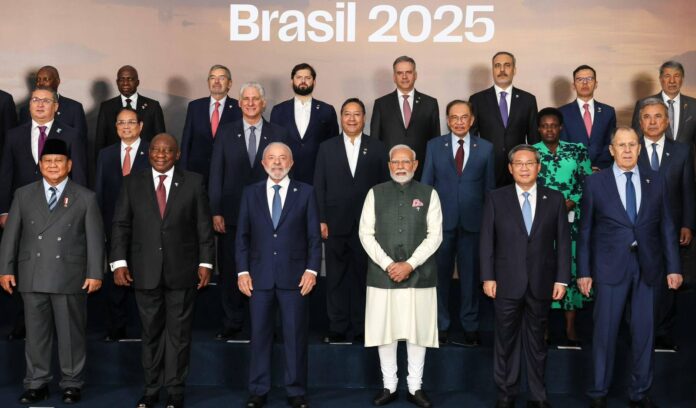
In the wake of the United State’s withdrawal from the international landscape, the global south’s most powerful alliances come together in Rio De Janeiro, Brazil from Sunday 6 July to Monday 7 July for the BRICS leaders summit. This summit serves as a precursor for the UN climate conference in November and to rebuke wealthy countries for cutting aid to developing countries and creating conflicts against marginalised states.
Military tensions seem to be worsening as the United States is already involved with aiding Israel in its attack on Iran which is also a member of BRICS. President of Brazil, Luiz Inacio Lula da Silva has spoken out against these attacks on Iran as well as Israel’s continued attack on Gaza. “It is always easier to invest in war than in Peace…the fear of a nuclear catastrophe has returned.” said the Brazilian President at the BRICS summit.
A new world order seems to be emerging within the BRICS alliance according to Brazilian diplomats, with U.S President Donald Trump pushing the U.S towards a “America First” outlook. This creates an opportunity for BRICS to structure a more equitable and multipolar system of governance around the globe. With 11 of BRICS’s membership accounting for 40% of the world’s population and economy as well as owning more than half of globe’s greenhouse gas emissions, which put this alliance ahead of the G7 which represent the richest countries in the global north.
Despite this potential from the BRICS alliance, it still remains divided and unbalanced, with China having the same GDP and CO2 output as the rest of the BRICS membership combined. When Chinese President Xi Jinping declined to attend the summit, it caused various leaders to be quite disheartened, as it has created doubts over China’s enthusiasm over this alliance especially because there was never a clear explanation for the Chinese President’s absence. “Internal tensions with Brics have increased markedly since 2014…and it has become even more difficult since the Russian invasion of Ukraine.” said Oliver Stuenkel, the Associate Professor at the School of International Relations in Sao Paulo, Brazil.
Russian President Vladimir Putin attended the summit remotely as there is a warrant for his arrest by the International Criminal Court for his war against Ukraine. Other leaders who were not in attendance were Egyptian President Abdel Fattah al-sisi and Iranian President Masoud Pezeshkian, with the latter not being in attendance because of Iran’s current conflict with Israel and the United States.
The Rio De Janeiro Declaration, which is a 31 page outline that was read on Sunday, condemns the attacks on Iran, the attacks on Gaza and the rise in tariffs by America. “We affirm our commitment to the BRICS spirit of mutual respect and understanding,sovereign equality, solidarity, democracy, openness, inclusiveness, collaboration and consensus.” This is stated in the 31 page outlined Declaration as per the BRICS website.; “As we build upon 17 years of BRICS Summits, we further commit ourselves to strengthening cooperation in the expanded BRICS under the three pillars of Political and Security, Economic and Financial, Cultural and People-to-people cooperation.” the declaration further states. The main purpose of the declaration is to reaffirm multilateralism as a means of combating climate change in the global south. In order to ensure accessible and sustainable climate finance within the global south, BRICS emphasized the need for concessional resources that is mainly “to support just transitions, based on nationally determined development priorities that integrate climate action with sustainable development.” as stated in the declaration.
Brazil has also opted to be under the radar in terms of the rise in tariffs as it does not intend on upsetting any leaders before the UN climate conference (Cop30) which is seen as a significant event for Brazil as it can play a crucial role in the conversation around combating climate change.
There has been a lack of accountability and double standards within the BRICS alliance over certain views especially on the front of military attacks, as even though they are very vocal in speaking about the ongoing conflicts in the Middle East, there is a lack of conviction when it comes to accounting for Russia’s invasion of Ukraine, and with Russia being a founding member of BRICS there is an element of contradiction and hypocrisy within this BRICS alliance. Which begs the notion of whether or not BRICS is on a formidable path of structuring a new world order or if it is simply “all talk” from the leaders of BRICS.