By Lesedi Sibiya-Diplomatic Insider
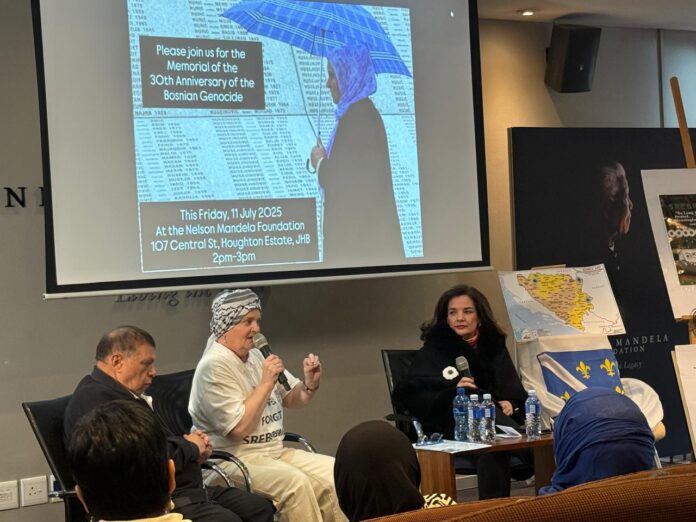
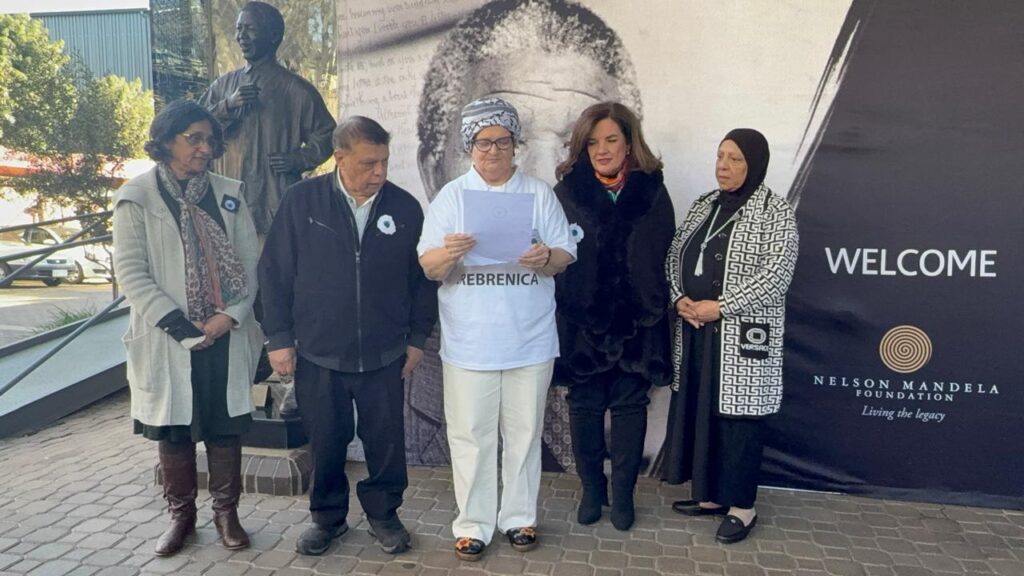
It’s been 30 years since the Srebrenica genocide in Bosnia on 11 July, 1995, where more than 8000 Bosniak Muslim men and boys were murdered in the town during the Bosnian war. On 11 July, 2025, the Nelson Mandela Foundation hosted Jasmina Colic Khan in Houghton as she graciously spoke of the horrific trauma of the Srebrenica genocide 30 years later.
“The genocide started here in a city of Berlina…where they were killing Muslims and shooting them with their heads on the streets and ended Srebrenica when they in two/three days and nights killed over 8,372 boys and men and raped more in that region over 12,000 women and girls.” said Jasmina in her opening statements of her speech at the Nelson Mandela foundation.
Srebrenica, a town in Eastern Bosnia and Herzegovina, had seen the massacre of Bosniak Muslim men and young boys, where in addition to these men being brutally murdered no more than 20,000 civilians evacuated the area which is known as ethnic cleansing. This marked the worst mass murder event since the genocide of the Jewish people during World War II.
This siege upon the people of Bosnia brought attention to Western powers intervening by means of calling for a cease-fire which had ended three-years of brutal warfare on Bosnian territory. However, this cruel and brutal killing of the men of Srebrenica left survivors with deep, scathing trauma which created obstacles in achieving reconciliation among the ethnic groups of Bosnia.
“They sieged the capital of Bosnia, Sarajevo so heavily that the birds couldn’t fly in and out, cut the water and the food and this is the longest sieged city in the history of war.” Jasmina continued in her speech at the Nelson Mandela Foundation.
In May 1993, the International Criminal Tribunal for the Former Yugoslavia (ICTY) was established in order to scrutinize military conduct had concluded that siege upon Srebrenica, had culminated a mass expulsion of Bosnian civilians which was deemed as a genocide. The blame had shifted towards the Bosnian Serb army, although the United Nations (UN) and Western support had also taken some responsibility for failing to protect the Bosnian men, women and children who had been murdered or brutalized in Srebrenica.
“Through error, misjudgment and an inability to recognize the scope of the evil confronting us, we failed to do our part to help save the people of Srebrenica from the Bosnian Serb campaign of mass murder.” said UN Secretary-General Kofi Annan during an internal review.
The Serbian National Assembly in 2010 extended an act of mending the atrocities faced by the town of Srebrenica by formally apologizing for not preventing the killings. In 1992, Bosnian Serb armed forces had exacted warfare upon Srebrenica with the intention of seizing control of a block territory in eastern Bosnia and Herzegovina.
The ultimate goal was to allocate that territory to the republic of Serbia. For them to achieve this they needed murder Bosniak inhabitants who resided in the town, that opposed this tirade for their land. The President of the Bosnian Serb Republic, Radovan Karadzic, had ordered his forces to attack the town by “creating an unbearable situation of total insecurity with no hope of further survival.”
The Bosnian Serb armed forces had prevented food and other supplies which had resulted in Bosniak fighters to leave the area in March 1995. In June 1995, the Bosnian Serb military command was given to execute the operation, which was code named Krivaja 95, which resulted in the genocide. They had commenced on July 6, 1995, with Bosnian Serb armed forces penetrating the south and burning a number of Bosnian homes along the way. Thousands of civilians had been forced to flee Srebrenica to the village of Potocari, where 200 Dutch peacekeepers were stationed to provide aid.
The UN contingent had been outnumbered and were eventually outgunned by the Bosnian Serb military who had caused destruction upon the inhabitants of Potocari, the contingent were ordered not to act with force as a means of defence.
NATO were called upon by the Dutch to deploy air strikes in order to relieve the pressure of Bosnian Serb military forces entering the city. However Bosnian Serb military commanders had threatened the killing of Dutch hostages if they continued the air strikes.
On July 11 the Bosnian Serb Military leader Ratko Mladic had recorded a statement on film by a Serbian journalist stating; “We give this town to the Serb nation…The time has come to take revenge on the Muslims.” 10,000 Bosniak men had managed to reach a forest safely on the night of July 11. The Bosnian Serb forces had used UN equipment in order to falsely claim the security of the Bosniak men in an attempt to get them to surrender, which resulted in thousands of men either being captured or they had given themselves up and many of the men were killed. Bosnian Serb officers had entered Potocari the next day and began to terrorise the town by sexually assaulting and murdering the inhabitants.
“I refused to accept that something like this would happen in my Bosnia, I refused because I didn’t believe, we lived in peace for more than fifty years, yes it was a communist country leaning on Socialism as well, and we had freedom we could pray, they sieged us and I just heard a voice, a loud warning voice ‘run ! run!’ I turned around, I heard again ‘hide the tanks are coming’ I grabbed my baby who was 8 months old and started to run without shoes.” Jasmina continued to account in her speech.
Jasmina spoke to Diplomatic Insider about the genocide as well as relations between Serbian and Turkish leaders. “In terms of the help, Turkey actually helped to rebuild many mosques and madrassas but Turkey is doing more business and economically helping Serbia, they are buying lands there…because of historical ties, because Turkey was present in Serbia and was present in Bosnia too.’ Jasmina told Diplomatic Insider.
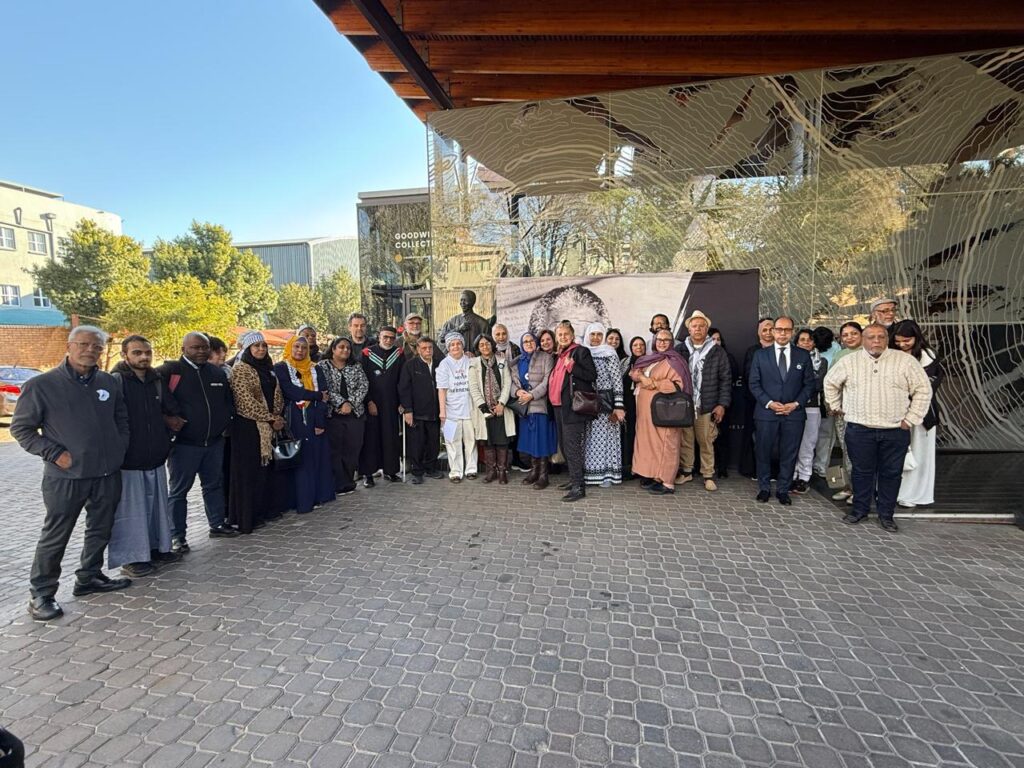
Senior executives of the Nelson Mandela Foundation, Ambassador Ali Achoui, the Ambassador of the Democratic Republic of Algeria to South Africa, Ambassador Ahmad Sharief, Egypt’s Ambassador to Pretoria, former MEC for Roads and Transport in the Gauteng government Ismail Vadi, civil society representatives, and many other distinguished guests were present at the Bosnian genocide memorial.
Shannon Ebrahim, from the Department of International Relations and Cooperation (DIRCO), played a key role in the event by engaging with Jasmina Colic Khan during her testimony, posing insightful questions that further enriched the discussion on the Srebrenica genocide.