

Cumali Önal*
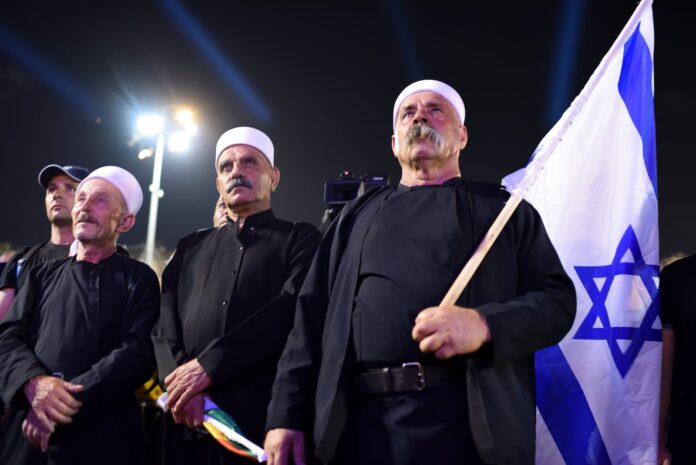
As Syria reels from renewed violence, questions are mounting over Israel’s deepening involvement in the country’s south, particularly in the majority-Druze province of Suwayda. Despite a fragile ceasefire announced following nearly week-long fighting between Druze and Bedouin tribesmen in July, there are reports of renewed clashes, leaving civilians in fear and tensions dangerously high.
The latest escalation came amid longstanding grievances and a growing sense of abandonment among Syria’s Druze minority, who say they face existential threats from both state and non-state actors.
The Druze are a minority community in the region with followers in Syria, Lebanon and Israel. Suwayda province is predominantly Druze, but is also home to Bedouin tribes and the communities have had longstanding tensions over land and other resources.
The situation has fueled speculation that Israel’s recent military actions, including its July 16 airstrikes on Damascus on the pretext of protecting the Druze, may reflect not just security concerns but also a strategic effort to reshape the region under the guise of humanitarian intervention.
A pattern of vulnerability
The Druze community has long endured cycles of violence and displacement, from the Ottoman era to the Lebanese civil war and to the aftermath of Syria’s post-2011 collapse. Today, as government-backed militias and armed factions clash across southern Syria, many Druze believe they are again being targeted because of their identity and faith.
The recent conflict in Suwayda began with localized disputes between Druze and Bedouin tribes but quickly escalated into broader violence following intervention by pro-government forces. Human rights activist Marah Azzam, speaking from Suwayda, told Turkish Minute that more than 120,000 people have been displaced, some to the Damascus countryside, others to Jordan or abroad.
Local monitors estimate that at least 1,000 people have been killed in the fighting. Activists and Druze leaders claim that regime-aligned provocateurs, some reportedly disguised in Bedouin clothing, deliberately inflamed tensions to destabilize the region and undermine Druze resistance.
Israel’s calculated involvement
Against this backdrop, Israel has increased its military and political presence in southern Syria. The Israeli government has framed its recent actions, including airstrikes, as efforts to protect the Druze population, particularly following appeals from Druze citizens of Israel.
However, critics say Israel’s true aim is to establish demilitarized buffer zones in Suwayda, Daraa and Quneitra, regions bordering the Israeli-occupied Golan Heights. The strategy mirrors Israel’s longstanding preference for creating fragmented zones of limited threat rather than facing hostile, well-armed neighbors.
“Israel treats Suwayda as a buffer zone, not a humanitarian issue,” Azzam said. “Its airstrikes are not to protect the Druze, but to protect its borders. If Israel truly wants to help, it should invest in civilian efforts, not only military ones.”
International law expert Vahe Mahshikian added that the crisis has become increasingly international in nature, especially following the Israeli Druze community’s calls for government intervention. “This created a new reality on the ground that demands international oversight,” he said.
Protection or pretext?
Not all voices are skeptical of Israel’s motives. Sheikh Akram Abou Fakher, a respected Druze leader, credited Israel’s involvement with preventing what he described as a looming massacre. “Without Israel’s intervention, Suwayda could have witnessed a historic tragedy,” he said.
But Fakher also acknowledged the uncertainty around Israel’s broader strategy. “No one truly knows what Israel intends,” he said. “What concerns us is securing protection, regardless of whether it comes from the East, the West, or even Mars.”
That sentiment was echoed by Ata Farhat, a Druze journalist based in the Israeli-occupied Golan Heights. “This is not about protecting the Druze,” he said. “Israel wants to ensure there are no heavy weapons or extremist groups near its borders. It’s about Israel’s own fears of another October 7,” referring to Hamas’s attacks on Israel in 2023 that claimed some 1,200 lives and triggered renewed Israeli aggression on Gaza, which has so far led to the killing of at least 60,000 people.
A regional chessboard
The situation has drawn comparisons to earlier proxy conflicts across the Middle East. Chmis Mahfoud, an Alawite activist and legal expert, argued that Israel’s engagement is part of a long-term strategy to secure geopolitical leverage and potentially forge peace agreements on its own terms.
“Israel seeks influence, normalization and control over southern Syria,” Mahfoud said. “Whether that succeeds depends on shifting regional dynamics, but one thing is clear: These interventions risk further fragmentation.”
While some Druze view Israel as a last-resort protector, others see its actions as opportunistic. What remains undeniable is the urgent need for effective international attention, both to prevent further bloodshed and to ensure that protection does not come at the cost of sovereignty.
*Cumali Önal is a freelance journalist based in Germany. He began his journalism career in 1993 on the foreign news desk of Zaman, a now-defunct Turkish daily. Over the years, he has reported from numerous conflict zones across the Middle East and Africa, including Afghanistan, Iraq, Somalia, Sudan and countries affected by the Arab Spring. He also served as a correspondent for Today’s Zaman and Zaman Arabic, both English and Arabic-language affiliates of Zaman.