
By Mirna Fahmy
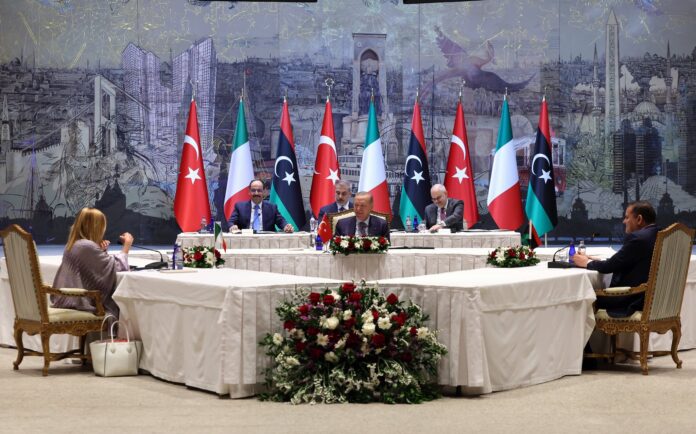
On August 1, 2025, a trilateral summit was held in Istanbul, bringing together Turkish President Recep Tayyip Erdogan, Italian Prime Minister Giorgia Meloni, and Libyan Prime Minister Abdulhamid Dbeibeh. The meeting focused on several key issues, including promoting regional stability, addressing irregular migration, and strengthening economic ties.
Discussions on energy cooperation were a prominent feature of the summit, with an emphasis on joint exploration and development in the Mediterranean, particularly regarding offshore oil and gas reserves. This builds upon a June 2025 agreement between Türkiye and Libya for joint geological and geophysical surveys. This campaign, covering four maritime zones and amounting to 10,000 kilometers of seismic exploration, aims to unlock Libya’s significant but largely untapped hydrocarbon reserves. Italy is considered a crucial downstream partner for these efforts, with existing infrastructure like the Greenstream pipeline already linking Libya to Sicily.
Another critical topic was the issue of irregular migration. The leaders discussed addressing the root causes of migration flows from Libya to Europe and managing the migration routes. Libya remains a primary departure point for migrants seeking to reach the EU, and the approximately 21,000 arrivals in Italy in 2025 show a notable increase from the previous year. The summit participants reached a consensus on the need for sustainable solutions and greater international coordination to effectively tackle this challenge.
The summit also delved into the political stability and security situation in Libya. Discussions centered on advancing the political process to restore stability amid the ongoing conflicts between rival administrations in Tripoli and Benghazi. Prime Minister Dbeibeh highlighted his government’s security operations in Tripoli aimed at dismantling illegal armed groups that undermine state authority. In a move toward enhanced coordination, proposals were made for a four-way ministerial meeting that would include Libya, Türkiye, Italy, and Qatar. The objective of this meeting would be to launch joint projects and combat smuggling and criminal networks. The summit’s outcomes underscore the deep complexities of Libya’s political case and the multifaceted approach required to address its challenges.
Libya’s Complex Political Landscape and Divided Governance
The Istanbul summit highlights the deep-seated political and economic challenges that continue to plague Libya. Since the 2011 civil war and the fall of the Muammar Gaddafi regime that spanned 42 years, the country has been mired in a power struggle between rival authorities. In the west, the internationally recognized Government of National Unity (GNU) in Tripoli, led by Dbeibeh, enjoys the support of the United Nations (UN), Western nations, and Türkiye. This backing stems from the 2011 NATO military intervention, which was authorized by the UN to enforce a no-fly zone, protect civilians, and attack government forces during the Arab Spring.
A parallel government exists in the east. Composed of the House of Representatives in Tobruk and the “Government of National Stability” led by Osama Hamad, this administration is backed by the Libyan National Army (LNA), commanded by Field Marshal Khalifa Haftar, and regional allies such as Egypt, the United Arab Emirates and Russia.
These divisions have created distinct spheres of influence, with the GNU controlling most of the west and Haftar’s forces dominating Benghazi and large parts of the east. This fragmentation has led to ongoing skirmishes between armed factions vying for control, even within Tripoli itself. Prime Minister Dbeibeh’s government is attempting to unify state institutions, but faces significant resistance from various armed groups.
The country’s political divisions are further complicated by the crucial role of its tribes. Libya is home to numerous tribes and clans, with an estimation of 140. The most powerful—such as the Gaddadfa, Warfalla, and Magarha—wield significant historical and political influence. The Warfalla tribe, along with the Qadhadhfa and Magarha, were integral to Gaddafi’s regime. The Warfalla tribe is considered a confederacy of 52 sub-tribes–one of the largest in Libya.
While many tribes desire a unified Libya, their allegiances often shift based on regional interests and security dynamics.
In the east and south, tribes like the Ubaidat, from which the House of Representatives’ speaker Aguila Saleh hails, have been prominent supporters of Haftar. Other key tribes in these regions, including the Hassa, Bara’isa, and Awagir, have also allied with the LNA. Haftar’s forces have also received support from certain Salafist factions and foreign groups, including Sudanese forces and Russian militias. Conversely, in the west, tribes such as the Warfalla, Misrata, and Zintan have largely supported the Tripoli-based government.
However, tribal alliances are not static. For instance, some western tribes have expressed anger over foreign military interventions, prompting them to shift their support away from the Tripoli-based government and towards the LNA. Tribes remain a potential source of long-term stability but often use their alliances as a tool to advance their immediate political interests.
Oil and the Economic Lifeline
At the heart of Libya’s political conflict is its vast energy wealth. Libya ranks as the 14th-largest global exporter of crude petroleum in 2023 and holds the second largest position in Africa. The country currently produces between 1.3 and 1.4 million barrels of oil per day and aims to increase production to more than 2 million barrels per day by 2030.
Despite the political turmoil, international energy giants have continued to operate in the country. Companies such as Italy’s Eni, the UK’s BP, the US’s ExxonMobil, and France’s TotalEnergies have either maintained or resumed operations in Libya since 2011.
These companies work in cooperation with the National Oil Corporation (NOC) in Tripoli, which is the sole internationally recognized authority for managing the country’s energy sector. The NOC is responsible for all agreements and memoranda of understanding with international partners, including the new exploration and development contracts recently signed with companies like Repsol and Sonatrach. The institution strives to remain independent and enjoys broad international support as it works to unify the oil industry.
Libya’s economy, while heavily dependent on oil and gas, shows some signs of improvement, with projected GDP growth of 12.3% in 2025. However, significant challenges remain. Poverty is a widespread problem, affecting nearly a third of the population–40% under the poverty line. The World Bank notes that poverty rates in Libya have risen, especially in the eastern region, and attributed this to high inflation, the collapse of the local currency, the rise in the prices of basic commodities and food, in addition to the rise in the cost of health services and the low level of household income.
In a bid to stabilize the fractured economy, the Central Bank of Libya (CBL) in Tripoli devalued the national currency, the dinar, by 13.3% in June 2025, setting the official exchange rate at 5.5677 to the U.S. dollar. This was the first official devaluation since a similar move in 2020. The decision came amid rising public debt and currency instability, with the central bank projecting that public debt could exceed 330 billion dinars by the end of the year if a unified national budget is not implemented.
The economic crisis is compounded by the existence of parallel currencies. The dinar has faced pressure from both illicitly printed banknotes within Libya and those reportedly printed in Russia and exported to eastern Libya. These notes have been used to fund infrastructure projects and, according to Reuters’ reports, Russian mercenary activities in Libya and the Sahel. The Central Bank of Libya has deemed these banknotes counterfeit, but they continue to circulate on the black market, further undermining the dinar’s value and deepening the country’s economic woes.
As the international community, led by key players like Türkiye and Italy, seeks to forge a path forward, it is clear that Libya’s fate is not an isolated matter. The convergence of energy interests, migration crises, and complex political allegiances places the country at the center of a larger geopolitical chessboard. The real test for the international community and Libya’s leaders will be to navigate these competing interests to build a sustainable peace from within, rather than imposing one from the outside.