
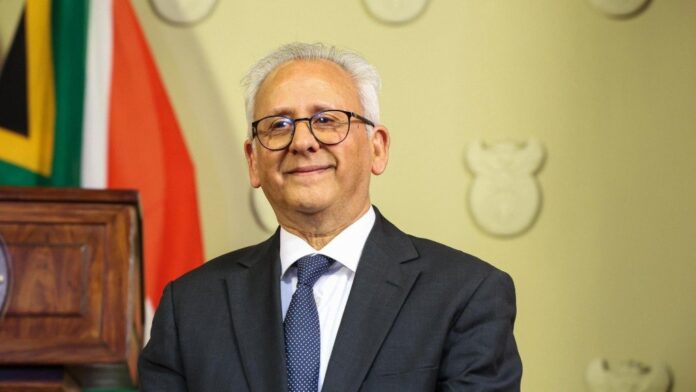
Acting Police Minister, Professor Firoz Cachalia, says transnational organised crime remains one of the most serious threats to peace, stability and development across Africa and beyond.
“Its manifestations are diverse: drug trafficking, human trafficking, illicit firearms, cybercrime, wildlife crime, money laundering, and terrorism, to name but a few of the most threatening,” Cachalia said on Wednesday.
Speaking at the 27th African Regional Interpol Conference underway in Cape Town, Cachalia said these crimes transcend borders, exploit technological advances and undermine the security of people and the integrity of respective States and economies.
“We are all mindful, particularly, that syndicated crime today is not static. The evolving nature of criminal activities, the emergence of new trends and the use of sophisticated technologies by criminal networks compel us to constantly adapt our responses,” Cachalia said.
Cachalia said dealing with these crimes demands a collective, concerted and focused effort.
“It requires robust strategies, and the concrete implementation of agreed actions at national, regional, continental and global levels.
“We are gathered here to generate solutions that are both strategic and pragmatic; solutions that can be implemented effectively within our countries and within the frameworks of our regional and continental organisations.
“Our deliberations will help to shape a more coordinated African response to transnational organised crime, one that strengthens the security of our borders while protecting the rights and wellbeing of our people.”
Cachalia said South Africa’s participation in the conference is firmly rooted in the country’s constitutional values and long-term national vision.
“Our Constitution enshrines the right of every person to safety and security, and it compels the State to protect and uphold these rights.
“Our engagement in regional and global security cooperation is, therefore, not only a matter of international solidarity but also an essential component of our domestic agenda.”
Cachalia said South Africa recognises that transnational organised crime undermines development and corrodes governance.
“By weakening institutions, fuelling corruption, and diverting resources, it impedes our ability to achieve the aspirations of Agenda 2063 of the African Union and the Sustainable Development Goals of the United Nations.”
In his welcoming address, National Police Commissioner, Lieutenant General Fannie Masemola, said the biennial conference is one of INTERPOL’s most significant regional events.
“It offers us the opportunity to assess crime threats and emerging trends, strengthen INTERPOL’s core capabilities, and reinforce the global policing cooperation that links Africa to all 193 member countries of INTERPOL.”
Masemola said transnational organised crime is evolving with alarming speed.
“Whether it is drug trafficking, human trafficking, cybercrime, firearms smuggling, vehicle theft or illegal mining, these crimes exploit borders, weaken governance, fuel corruption and destabilise communities. Behind every crime statistic lies a story of lives shattered, families broken, and communities robbed of their peace.”
The conference is being attended by the President of INTERPOL, Major General Ahmed Naser Al-Raisi; the Secretary General of INTERPOL, Mr Valdecy Urquiza, and Police Chiefs from INTERPOL member countries, amongst others.
The high-level gathering will underscore South Africa’s commitment to regional and international cooperation in combating transnational organised crime, terrorism and other emerging security threats.
It is expected to result in concrete agreements on strengthening regional responses, while also serving as a platform for the exchange of best practices and the deepening of law enforcement partnerships.