
By Mirna Fahmy
The recent meeting between the U.S. President Donald Trump and Russian President Vladimir Putin in Alaska on August 15, 2025, was framed as a high-stakes effort to end the Russian-Ukrainian war. Yet, the summit’s failure to produce a ceasefire or peace agreement came as little surprise to experts who saw a diplomatic exercise built on a foundation of miscommunication and strategic blunders.
“Many people don’t realize that this current effort to make peace started with a miscommunication,” Irina Tsukerman, a New York-based human rights and national security attorney told Diplomatic Insider. She explains that the U.S. Special Envoy, Steve Witkoff, had a pivotal, and ultimately failed, meeting in Moscow prior to the summit. Putin had demanded a “peaceful withdrawal” of Ukrainian forces from the regions of Zaporizhzhia and Kherson—a call for surrender. However, Witkoff mistakenly interpreted this as a willingness by Russia to withdraw its own troops. While the White House, under Trump, denied any misinterpretation, stating that Witkoff “clearly understands all aspects” of the talks, the misunderstanding revealed a dangerous disconnect.
According to Tsukerman, the summit was strategically misguided from the start, handing Putin a propaganda victory before the two leaders even met. This was compounded by two critical, yet ignored, acts of aggression: a Russian cyberattack on U.S. federal courts and, more gravely, the publication of genocidal rhetoric against Ukrainians by official Russian state media. “These actions should have prompted a cancellation,” Tsukerman states, “but instead, the U.S. hosted Putin, a leader wanted by the International Criminal Court (ICC).”
The summit’s disarray extended to its very schedule. It was cut short for an unknown reason, leaving a series of planned events unfulfilled. Putin’s delegation of 50 business leaders left without negotiating any deals, and a planned working lunch and a tour of local sites were canceled. Even a scheduled gift exchange ceremony did not take place. Tsukerman says that it’s unclear whether the gift was presented privately, highlighting the lack of transparency surrounding the event.
The chaotic nature of the summit, with no clear agreements or outcomes, solidified the impression that the U.S. had provided a stage for Putin’s legitimacy without any corresponding concessions.
Despite calls for a ceasefire from the U.S. side, Putin’s actions before, during, and after the summit demonstrated his clear intent to continue the war on his own terms. He violated diplomatic protocol by speaking first at the press conference and continued to launch military and civilian attacks, even as the summit was underway. His forces also attempted air incursions near Alaska, a blatant act of hostility. “He offered no concessions,” Tsukerman notes, “from the return of hundreds of thousands of abducted Ukrainian children to an end to the violence.” This was enabled by a lack of pressure from the U.S. side. Tsukerman suggests Trump used the summit as a political pretext to delay imposing sanctions on Russia, a gamble that proved to be a failure.
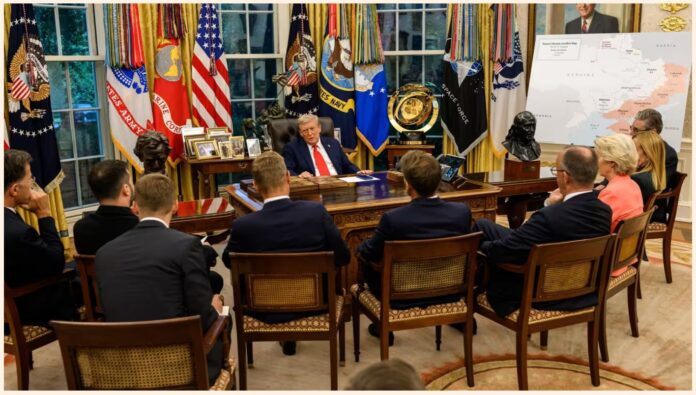
The diplomatic fiasco culminated in a revealing moment: a 40-minute phone call between Trump and Putin that interrupted a meeting with the seven European leaders and Ukrainian President Volodymyr Zelenskyy at the White House on August 18, 2025 that was set up to discuss Russia’s Ukrainian war.
This act, which Tsukerman believes was at Putin’s behest to abruptly end the summit, sent a powerful message. As Tsukerman explains, Putin now believes that “the deal is not with Ukraine. The deal is with the US,” thereby undermining Ukraine’s sovereignty and agency in the conflict. This is a clear indicator, she attests, that the war is a U.S.-Russia proxy conflict, more than a matter of European and Ukrainian self-determination. Russia’s President never showed any interest or agreed to meet Zelenskyy to settle anything.
The path to peace is further complicated by the political realities within Europe. While leaders are united in their demand for a genuine ceasefire, they are hobbled by internal divisions and a lack of will. As Tsukerman argues, Europe possesses the industrial capacity, especially Germany, for rapid military mobilization, citing the speed of production during World War II, but its slow response is a “matter of will power and not capacity.” This hesitancy is rooted in popular opposition to escalation.
That’s why Tsukermen warns that this European hesitation is a strategic mistake. Russia’s one-sided escalation is already happening and will only intensify. She predicts that Russia will expand its recruitment not only from the Russian diaspora but also from poor, uneducated populations in developing countries, and will build “fifth columns” (subversive groups) within European nations by leveraging financial and political influence over far-right and far-left parties, such as the AfD in Germany and Marine Le Pen’s party in France, which received a controversial 9.4 million Euros loan from a Czech-Russian bank in 2014.
Le paine sided with Russia saying that Europe shouldn’t give NATO membership to Ukraine to not make hostilities with Russia.
Also, there are leaders like Orban in Hungary and Fico in Slovakia who are either pro-Russian or are being influenced by Russian efforts.
These leaders, Tsukerman asserts, are simply “repeating a Russian propaganda point” in exchange for political or financial support. This strategy aims to divide and conquer Europe from within, a far more effective use of Russia’s limited economic and military resources than a direct, conventional war.
As Ukraine is open to Europe, Russia wants more than the Soviet Union. Tsukerman adds that Russia is a threat to countries that were part of the Russian Empire before the Soviet Union, which is why Russia was threatening Finland and Sweden. Russia views them as part of their restoration of the biggest territory it ever held at the peak of its territorial influence.
In contrast, Ukraine’s goals are purely defensive. Tsukerman states Ukraine “has no desire to make any claims on Russian territory” and its attacks on Russian soil are limited to military and economic targets, not civilians. The sole purpose of these attacks is to apply pressure to force a Russian withdrawal.
That’s why she urges European governments to take a more decisive stance. They need to be transparent with their populations, telling them, “this is what we need for defense, and you’re going to have to live with that.”
Back in the early days of peace talks in February 2025, France’s President Emmanuel Macron and United Kingdom’s Prime Minister Keir Starmer were very keen to send peace troops to ensure real cease fire between Russia and Ukraine whereas no military would be interfering and Trump wasn’t objecting.
Tsukerman adds that Russia’s aggression is not a new phenomenon tied to NATO expansion; it also started to have other influences in Central Asian countries. She points to Russia’s history of territorial acquisitions, including its war in Chechnya under Boris Yeltsin, and the broken promises of the Budapest Memorandum, which guaranteed Ukraine’s territorial integrity in exchange for its denuclearization. This historical context reveals that Russia has a long history of expansion and deceit, suggesting that any peace deal built on territorial concessions would be both unconstitutional for Ukraine and strategically foolish for Europe.
Amid the talks, history playback was rolling exemplifying France’s emperor Napoleon Bonaparte who was expanding France’s territory and the only country he couldn’t invade was Russia demonstrating how Russia was historically undefeatable. Tsukerman contrasts Napoleon’s mistake of invading Russia with Russia’s current mistake of overstretching its military. While Napoleon’s campaign was a logistical nightmare, Tsukerman argues that Russia is currently in a similar bind.
Despite its ability to sustain the war through a larger population and by “smuggling” weapons, Russia’s military is not in a “great military shape,” according to Tsukerman. Its army is overstretched and its access to top-tier weapons is limited, forcing it to rely on dual-use technology from China and fighters from partners like North Korea.
On the other hand, Tsukerman pinpoints that Ukraine’s success depends on getting more and better equipment, despite its own effective innovation in things like long-range weapons. She emphasised that while Ukraine has been creative, it needs “a lot more of everything” to defeat a more populous enemy. And now it is relying on Europe more than the US because the US will not be delivering the Patriots it promised until spring 2026, supposedly due to the shortage of interceptors, Tsukerman hinted.
The war’s final outcome remains contingent on whether Europe can overcome its internal divisions and commit to a more robust, unified front, as its own national security is increasingly at risk.