
By Mirna Fahmy
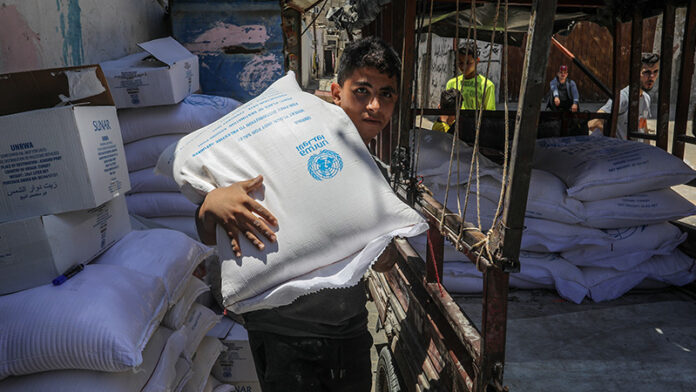
The humanitarian crisis in Gaza has reached a critical point. After nearly two years of conflict between Israel and Hamas, the UN-backed Integrated Food Security Phase Classification (IPC) ) officially declared on August 22, 2025, that famine was occurring in the Gaza Governorate. This designation followed months of warnings and is projected to spread throughout the Gaza Strip. UN officials have described the situation as a “man-made disaster” caused by the prolonged conflict and severe obstruction of humanitarian aid.
The IPC concluded that all three technical thresholds for a famine classification (Phase 5) had been met. It acknowledged, however, that some evidence was limited due to the collapse of local monitoring systems. Israeli forces have claimed that Hamas militants use UNRWA facilities and other civilian infrastructure for military purposes, including storing weapons and building tunnels underneath them.
The IPC’s famine classification is based on three technical thresholds, all of which were found to be met in Gaza. The first is food shortage, with the IPC reporting that over half a million people in the Gaza Governorate were experiencing starvation, destitution, and extreme food deprivation. This was supported by a July 2025 report from the World Food Programme (WFP), which found that over one in three people (39%) were going days at a time without eating.
The second threshold is acute malnutrition, which has increased at an “unprecedented rate” in Gaza City, according to the IPC. Malnutrition rates among children under five reportedly quadrupled in the two months leading up to the August 2025 report, surpassing the 30% threshold needed for a famine declaration.
Finally, the mortality threshold requires the Crude Death Rate (CDR) for the general population to exceed two deaths per 10,000 people per day, or four deaths per 10,000 children per day, from starvation or a combination of malnutrition and disease.
Given that widespread monitoring systems have collapsed in Gaza, the IPC acknowledged that it was difficult to collect comprehensive, direct mortality data. However, based on available evidence, including reported malnutrition-related deaths and the collapsed health and sanitation systems, the IPC concluded that the mortality threshold had likely been reached. The IPC’s Famine Review Committee (FRC) report in August 2025 mentioned that at least 240 deaths from malnutrition had been recorded by mid-August, including over 100 children.
Why is there famine when the whole world sends aid?
The existence of a famine in Gaza, despite ongoing humanitarian aid, has become a point of significant controversy. The issue centers on a number of factors, including the delivery and distribution of aid within the territory.
According to some accounts, a major cause of the crisis is the alleged diversion of aid by Hamas. Zaid Alayoubi, a Palestinian political analyst, has been a vocal critic of the organization. In a January 2024 interview with Sky News Arabia (UAE), he claimed that Hamas has taken control of humanitarian aid, distributing it “according to their whims.” In a subsequent interview with the Egyptian channel Extra News in July 2025, Alayoubi declared that Hamas “steals aid to feed its members first and the remaining sells them at high prices to pay the salaries of its members.” He added that Hamas “does not represent the Palestinian people.”
Al-Arabiya channel has shown videos of how Hamas’ militants pursue citizens in Gaza on charges of stealing aid.
The Israeli military has confirmed these accusations, based on its intelligence reports, claiming that Hamas has diverted up to 25% of aid supplies. Reports from the Israeli Press Service allege that Hamas established a parallel distribution network, selling confiscated aid at prices “300–500% above market value” and taxing vendors. These reports also claim Hamas blocks civilian access to aid sites, impersonates aid workers, and embeds operatives in UN convoys.
However, other reports present a different picture. An internal analysis by USAID, the largest funder of U.S. assistance to Gaza, found no evidence of “widespread or systematic theft of U.S.-funded humanitarian supplies by Hamas.” The report did note that vetting aid recipients was not possible.
Similarly, while the UN Office for Project Services (UNOPS) reported that 88% of aid trucks were “intercepted” between May 19 and August 5, the UN has stated that the looting was primarily carried out by “starving, desperate people” and not necessarily by armed groups or Hamas.
Palestine as a state is still a debate
The debate over the existence of Palestine as a state remains a central issue. On August 8, 2025, Israel’s cabinet, led by Prime Minister Benjamin Netanyahu, approved a plan for the military occupation of the Gaza Strip, a move that drew fresh international condemnation. Netanyahu has consistently stated that Israel must retain security control of Gaza to ensure Hamas cannot re-establish itself. His government’s strategy for the territory is to “clear” fighters, “hold” militarily, and then “build” an environment where Hamas cannot function. In March 2024, Israel began creating a buffer zone by demolishing Palestinian homes and land inside Gaza, where entry is now prohibited for Palestinians.
In a related development, a post-war Gaza redevelopment plan known as the “Gaza Reconstitution, Economic Acceleration, and Transformation Trust,” or “GREAT Trust,” was reported by The Washington Post and other news outlets in late August 2025. Based on a 38-page prospectus, the plan proposes placing Gaza under a U.S.-led trusteeship for a decade to rebuild the enclave and transition it to a “deradicalized Palestinian Polity.” This would involve transforming Gaza into a tourist and high-tech manufacturing hub, funded by public and private investors. The prospectus outlines incentives for Palestinians to “voluntarily” relocate, offering landowners digital tokens for redevelopment rights or a new apartment in a smart city, while those who choose to leave would receive a $5,000 cash payment, plus four years of rent subsidies and a year of food assistance. The documents refer to the relocation of residents as “voluntary” and include projections that each person who leaves saves the trust money compared to housing them temporarily in secured zones.
The plan was reportedly discussed at a White House meeting with figures such as Jared Kushner, former British Prime Minister Tony Blair, and Secretary of State Marco Rubio.
As Egypt and Jordan have regularly rejected the displacement of the Palestinians, there are some countries that have been brought up as suggestions. CNN and Anadolu Agency have quoted a senior Israeli official in August 2025, South Sudan, Somaliland, Ethiopia, Libya, and Indonesia were discussed as countries that could receive displaced Palestinians in exchange for “significant financial and international compensation.” South Sudan, Somalia, and Indonesia have all publicly denied being in such negotiations, with Indonesia reaffirming its historical support for Palestine.
This intention is also reflected in the West Bank, which has experienced a surge in displacement since the October 7 attacks in 2023. Humanitarian organizations like Doctors Without Borders (MSF) noted a 2025 increase in policies and practices “blatantly designed” to remove Palestinians. Between January 2024 and May 2025, over 2,800 Palestinians were displaced due to home demolitions alone. In early 2025, the Israeli military’s “Operation Iron Wall” forcibly displaced 40,000 people in the northern West Bank.
Meanwhile, Palestine’s status as a state remains a contentious issue in the international community. The United States recently vetoed a UN Security Council measure for Palestine’s full UN membership. While the UN General Assembly granted Palestine expanded observer rights in May 2024, the U.S. and some European allies continue to prevent it from gaining full voting status, arguing that recognition should be contingent on direct peace negotiations. Despite this, by mid-2025, Palestine was officially recognized by 147 of the 193 United Nations member states, including Argentina, Brazil, China, India, Indonesia, Mexico, Russia, Saudi Arabia, South Africa, and Türkiye. By September 2025, Australia, France, and Malta announced plans to recognize Palestine.
On July 29, 2025, UK Prime Minister Keir Starmer announced that he would recognize Palestine as a state unless Israel meets certain conditions. His position has drawn criticism from opponents who don’t want to recognize Palestine because of Hamas and who prioritize support for Israel. Others, however, have pointed to Britain’s historical role in the region, noting conflicting promises made during the early 20th century to Arabs, the French and Russians, and the Zionists as a source of the ongoing conflict.
Despite the fact that over 75% of United Nations member states recognize Palestine as a sovereign state, there are many arguments that Palestine does not fully meet all the legal criteria outlined in the Montevideo Convention. Article 1 of the convention states that an entity must meet four criteria to be considered a state: a permanent population, a defined territory, Government, capacity to enter into relations with other states.