
By Mirna Fahmy
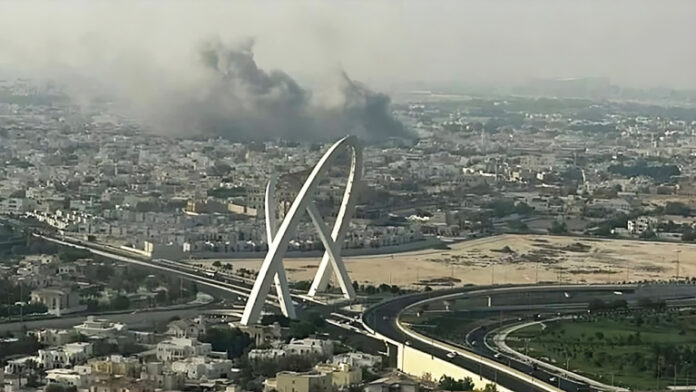
An Israeli airstrike on September 9, 2025, targeted a meeting of Hamas leaders in Doha, Qatar, who were convened to discuss a U.S.-backed ceasefire proposal for Gaza. While the senior officials survived, the strike resulted in the deaths of several Hamas members and a Qatari security officer.
Israel framed the attack as a response to a shooting in Jerusalem the day prior. However, many analysts believe the strike was a strategic effort to disrupt or scuttle the long-stalled ceasefire talks. The assault on the mediating party, Qatar, which has hosted Hamas’s political bureau since 2012 and has been central to indirect negotiations, was widely condemned as a major blow to peace efforts.
The incident also strained relations between the United States, Israel, and Gulf states. Despite Qatar hosting the largest U.S. military base in the region, Israel’s deliberate and unilateral action was seen by many as a calculated move to undermine diplomatic efforts. Israel notified the U.S. only moments before launching the missiles, creating a fait accompli that effectively prevented any American intervention.
The U.S. President Donald Trump publicly distanced himself from the strike, stating that it “does not advance Israel or America’s goals” and assured Qatar that such an incident would not happen again. However, the attack raised profound questions among Gulf states about the reliability of the American security umbrella and their ability to be shielded from Israeli military actions.
The attack also exposed what many in the Gulf perceived as a double standard in U.S. security guarantees. The U.S. has a history of defending its allies from attacks, including intercepting Iranian missiles targeting the same Qatari airbase in June. However, no such action was taken against the Israeli strike. This disparity led to concerns among Gulf states that the U.S. would protect them from Iran but not from Israel, raising doubts about the American security umbrella’s reliability.
The method of the attack further complicated matters. Israeli forces reportedly used a novel approach, firing ballistic missiles from the Red Sea to evade both Qatari and U.S. air defenses. U.S. officials also suggested that the high-speed nature of the ballistic missiles would have rendered existing defense systems, such as Patriot batteries, ineffective.
Trump’s public statements following the incident were seen as mixed. While he expressed unhappiness with the location of the strike, he also stated that eliminating Hamas was a “worthy goal.” This messaging was widely interpreted as implicit tolerance for Israeli aggression against a key U.S. ally, further eroding trust and credibility with Gulf partners.
The “hidden meaning” and strategic implications
This Israeli strike was more than a military operation; it was a strategic communication with significant “hidden” implications. By bombing the very location of U.S.-backed ceasefire negotiations, Israel explicitly signaled its preference for a military solution over diplomacy, effectively undermining the peace process.
The attack severely damaged Qatar’s carefully cultivated image as a neutral and indispensable regional mediator. It demonstrated Israel’s willingness to project power with impunity across the Middle East, even in close proximity to a major U.S. military base. This move sent a clear message to both adversaries and Arab partners that Israel’s security considerations supersede diplomatic norms and national sovereignty.
Furthermore, the incident gravely damaged Gulf states’ confidence in the United States as a reliable security guarantor. It reinforced the perception that U.S. protection is conditional and that Washington is either unwilling or unable to restrain Israeli actions. This is expected to prompt Gulf nations to reconsider their security strategies and explore diversifying their international partnerships.
The strike also served to reframe Qatar’s role. By targeting Hamas leaders on Qatari soil, Israel challenged Doha’s diplomatic balancing act and attempted to portray the country not as a mediator but as a harbor for terrorists. Following the attack, Israeli officials explicitly warned Qatar to expel Hamas or risk future strikes.
An Arab-Islamic Summit:
In response to the September 9 attack, an extraordinary Arab-Islamic summit was convened in Doha, Qatar, on September 15, 2025. The emergency meeting brought together Arab and Islamic leaders to discuss a unified response to the Israeli aggression.
During the summit, leaders expressed full solidarity with Qatar and condemned the attack. Qatar’s Emir, Sheikh Tamim bin Hamad Al Thani, described the bombing as a “cowardly terrorist act” that resulted in the deaths of both Qataris and Palestinians. He also accused Israel of attempting to sabotage ongoing ceasefire negotiations.
The summit’s final statement called for a unified front against Israel’s actions and a review of diplomatic and economic relations with Israel. The leaders also discussed taking all possible legal measures to prevent Israel from continuing its actions against the Palestinian people, and some members called for sanctions and the suspension of Israel’s membership in the United Nations. The summit underscored the region’s collective frustration with Israel’s military actions and its disregard for international law and diplomatic efforts.
The outcomes of the Doha summit were met with a stark divide in opinion. Some analysts and politicians hailed the meeting as a significant diplomatic success, producing an unprecedented display of Arab-Islamic solidarity. They pointed to the strong condemnations of the Israeli aggression and the unified call for legal and diplomatic measures against Israel, including a review of relations. The powerful rhetoric, particularly from Egyptian President Abdel Fattah el-Sisi and Turkish President Recep Tayyip Erdoğan, was seen as a new and impactful stance.
However, a more critical perspective emerged, viewing the summit as a failure to produce any tangible, practical results. Critics argued that the final statements were merely a repetition of familiar, empty condemnations that lacked any real deterrent measures similar to previous ones. This reliance on traditional political rhetoric was seen as a letdown for the general Arab populace, who expressed frustration on social media over the weak outcomes and the failure to translate widespread anger into effective action. To these critics, the summit was a symbolic gesture that repeated the same language from previous gatherings that had failed to stop Israeli violations.
The summit’s debates took place against the backdrop of an intensifying Israeli assault on Gaza during dawn on September 16, 2025. While leaders met in Doha, Israeli forces launched a full-scale ground and air offensive on Gaza City, a stronghold of the Hamas movement. This operation, aimed at seizing control of the city and pushing its inhabitants southward toward the Egyptian border, has led to immense destruction, mass displacement, and a catastrophic loss of life. The Israeli military’s declaration of an “unprecedented force” in Gaza prompted widespread international condemnation and warnings of a humanitarian disaster.
The current military operation in Gaza has drawn harsh criticism, with Egyptian Political Scientist Hossam Badrawi labeling it “The New Nazism.” Badrawi starkly compared Israeli Prime Minister Benjamin Netanyahu’s mindset to that of Hitler, explaining that Netanyahu is “captive to fantasies of domination.” He further asserted that the Prime Minister “preaches hatred and racism, believing tanks and jets can guarantee legitimacy,” adding a stern warning: “History is clear: those who walk in Hitler’s footsteps cannot escape his fate.”
Badrawi believes that if Middle Eastern countries can act with vision and unity, they will not only defend threatened states like Qatar but will also prove that Israel is not beyond accountability. He posits that the heart of this regional resistance lies in Egypt, but for Egypt to lead, it must first fix its own political and economic foundations. Only by achieving internal stability, Badrawi concludes, can Egypt effectively lead the region in confronting what he calls Israel’s reckless and dangerous course.
The Media war:
The aftermath of the Doha summit ignited a media war, particularly between Egypt and Israel, after Egyptian President Abdel Fattah el-Sisi referred to Israel as an “enemy.” In a rare and striking shift in official discourse, Sisi warned that the policies of Netanyahu’s government could lead to the “collapse” of the historic peace agreement between the two nations.
The Israeli press reacted with alarm. Newspapers like Israel Hayom highlighted Sisi’s unprecedented use of the term “enemy,” cautioning that while it was a warning, Israel should not ignore it. The Israeli Broadcasting Authority and news websites like Srugim and Kipa questioned whether the statement was a threat or a warning, with many analysts calling it a dangerous development in relations since the 1979 Camp David Accords. Yedioth Ahronoth emphasized Sisi’s call for Arab leaders to reconsider relations with Israel and reported that he appealed directly to the Israeli people, urging them not to let “our ancestors’ efforts for peace go to waste.”
On the Egyptian side, official media and analysts framed Sisi’s speech as a significant and qualitative shift, interpreting it as a strong warning against continued Israeli aggression and a message of solidarity with the Palestinian people. They emphasized that the statements did not necessarily imply military escalation but were a clear demand for Israel to respect agreements and not cross red lines. According to the head of Egypt’s State Information Service, Diaa Rashwan, the use of the word “enemy” reflects a complete or imminent loss of trust in Israel by Egypt’s leadership.
This media war took place against a backdrop of growing tensions. Netanyahu has consistently used propaganda to blame Egypt for the humanitarian crisis in Gaza by not opening its borders. He has also raised concerns about Egypt’s military presence in Sinai, a move Cairo sees as a direct threat to its sovereignty and a part of Netanyahu’s long-suspected “Greater Israel” plan.
Egyptian journalist Ibrahim Eissa has offered a different interpretation of the media frenzy on his Youtube channel. He argues that the Israeli media is exploiting his past statements, which highlighted the threat to Egypt’s security from Gaza and the armed groups within it, as part of a propaganda campaign against the Palestinian people. Eissa maintains that the Israeli media is using this rhetoric to justify its actions in Gaza and distort the Palestinians’ image, noting that such narratives are built on historical fallacies.
Though unlikely, Egyptian politician and journalist Emad Gad has outlined two extreme scenarios that could lead to a war between Egypt and Israel. The first would be a direct military conflict triggered by Israeli forces invading Egyptian territory. The second, and perhaps more probable, scenario involves Israel’s plan to displace Palestinians into North Sinai. If this were to occur, Gad suggests that relations would deteriorate beyond the exchange of ambassadors, potentially leading to Egypt freezing the peace treaty and returning to a pre-1979 state of “neither war nor peace.” This would effectively dismantle the diplomatic framework that has governed relations between the two countries for decades.
Palestine is now recognized, so what will happen?
Most United Nations member states have recognized Palestine for decades, with many doing so after the 1988 Palestinian Declaration of Independence. A new wave of recognition occurred in September 2025, when several key Western nations formally announced their support. On September 21, Britain, Canada, Australia, and Portugal granted formal recognition, followed on September 22 by France, Belgium, Luxembourg, Malta, Andorra, and Monaco, with many of the announcements taking place during the UN General Assembly in New York.
Despite this growing international support, a truly sovereign Palestinian state is not assured. The recognitions are largely symbolic and do not grant Palestine full UN membership, which continues to be blocked by the U.S. in the UN Security Council. The on-the-ground reality of Israel’s occupation of Palestinian territories remains unchanged. Furthermore, internal divisions persist, as the Palestinian Authority has no control over Gaza, which is governed by Hamas. Some countries, like Belgium, have made their full recognition conditional on Hamas being removed from power.
This recent wave of recognition carries a deeper strategic meaning beyond a simple statement of support. Many countries explicitly framed their decision as a rebuke against Israel’s conduct in the Gaza war, citing the vast number of casualties and the humanitarian crisis. Canada and the UK, among others, also expressed their opposition to the expansion of Israeli settlements in the occupied West Bank, which they view as a direct threat to the two-state solution.
The diplomatic shift has left Israel and the U.S. increasingly isolated on the international stage. With France and the UK now recognizing Palestine, the U.S. is the only permanent member of the UN Security Council that does not. The recognitions are also an explicit attempt to preserve the two-state solution, keeping the concept of an independent Palestinian state alive at a time when its viability is under threat. This collective action reinforces the legitimacy of Palestinian statehood and could signal a willingness for further diplomatic pressure, such as sanctions or arms embargoes, if the situation does not improve.