
By Lesedi Sibiya-Diplomatic Insider
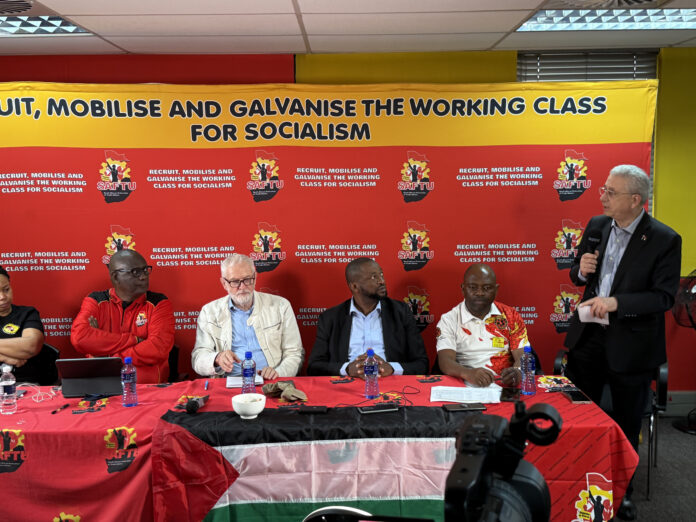
Yesterday the South African Federation of Trade Unions (SAFTU) welcomed former British Labour Party MP Jeremy Corbyn and Palestinian Physician and activist Mustafa Barghouti at SAFTU headquarters at the SAFTU head office in Marshalltown Johannesburg in order to discuss the genocide taking place in Gaza as well as to discuss the Union’s role in the Boycott, Divestment and Sanctions Movement (BDS).
SAFTU had welcomed the United Nations (UN) report on classifying Israel’s occupation of the West Bank as a genocide last week during the UN General Assembly.
The UN’s findings support the South African Government regarding the country taking Israel to the International Court of Justice, a case that is ongoing.
SAFTU mentioned in their statement regarding these findings that due to a genocide being recognised it is imperative for the nations all over the globe to prevent this genocide from continuing.
Jeremy Corbyn has become increasingly vocal about the conflict between Israel and Palestine emphasising that the voice of Palestinian people needs to be held up high as the conflict worsens.
Corbyn allowed Barghouti to have the floor first in order to discuss the atrocities taking place in Gaza. Barghouti started his address by thanking the nation of South Africa for its bravery in being the first nation to speak out against the genocide and to take Israel to the International Court of Justice early last year and for having the capacity to take this case head on given South Africa’s own atrocity with apartheid.
Barghouti then proceeded to address how much worse the apartheid that Palestine is facing is, “What we have in Palestine is a much worse apartheid that what prevailed in South Africa and for sure it is. Because in our case apartheid is combined with ethnic cleansing of the people. And now it is combined with three horrible war crimes; the war crime of genocide, the war crime of collective punishment including starving people and starving children,” said Barghouti in his address.
“And now the Israeli army has imposed 1000 military checkpoints in this little area that is called the West Bank. They’ve imposed more than 200 military gates that prevent communities, villages and towns from leaving or coming in without Israeli permission,” Barghouti continued.
Barghouti also stated that more than 18,000 Palestinians have been in prison by Israeli forces since October 7.
Barghouti had stated that although it is imperative that the 48 Israeli hostages be released by Hamas, that there is nobody speaking about the 18,000 hostages which include 400 children that are held by the Israeli government .
“We hear the most insulting thing, we hear talks of Tony Blair to be governor of Gaza. Tony Blair out of all people ? We are the people who have struggled for 100 years against British colonialism, before we struggled against Israeli occupation and oppression. They want us to receive another colonialist to command governance.” Barghouti added in his final remarks of his address.
Jeremy Corbyn proceeded to address the proceedings by making mention of his meeting with Nelson Mandela when Corbyn was still in Parliament and Mandela had not yet been made president of a new democratic South Africa.
He mentioned that Mandela had always been vocal on the oppression faced by the people of Israel and had addressed this to a full table of British officials which then dwindled to two listeners.
Corbyn, who has been travelling around South Africa to discuss the conflict, as he started in Polokwane, had mentioned that he introduced a bill which would expose the British government’s complicity in the conflict.
“And the reality in Gaza as Mustafa has explained is abominable beyond belief. I introduced a private members bill into parliament to ask that the British Government complicity in all this be exposed.” said Corbyn.
Corbyn also mentioned that there should be more political education in regards to understanding industrialisation and how countries need to work together collectively to manufacture products, and because of the current misalignment of many countries around the world, there needs to be more proactiveness in corporations working together holistically.