
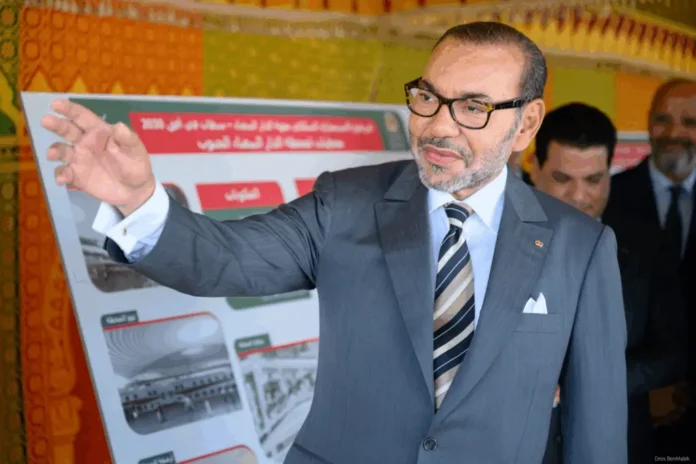
King Mohammed VI has launched a new wave of rail infrastructure projects in Casablanca’s, as part of a sweeping $9.3 billion national program aimed at transforming urban and regional mobility.
The projects announced in Casablanca carry an investment of 2 billion dollars and are designed to improve daily commuting, strengthen regional connections, and develop a new industrial ecosystem for Morocco’s rail sector.
The broader program includes the 430-kilometer Kenitra-Marrakech high-speed rail line, unveiled by the king in April 2025, as well as enhanced regional services linking Kenitra, Casablanca, Rabat, and Marrakech.
The new developments include three next-generation train stations — Casablanca-South, Hassan II Stadium in Benslimane, and Mohammed V International Airport — alongside 10 suburban train stations, upgrades to five existing stations, 260 kilometers of new tracks, two technical centers, five maintenance workshops, and 48 new trains.
Casablanca-South, whose construction officially began Wednesday, will be a major intermodal hub connecting high-speed trains, regional services, and an “aero-express” link to Mohammed V International Airport running every 15 minutes. The station, with a capacity for 12 million passengers annually, will also integrate tramways, buses, and taxis.
Officials said the projects, financed 70% by the national rail operator ONCF and 30% by the Casablanca-Settat regional government, are expected to ease congestion, lower the carbon footprint of urban travel, and foster economic development.
Hyundai Rotem, the South Korean train manufacturer, will supply the new fleet and build a plant in Morocco to support domestic production and future exports.
By 2030, the commuter rail service is projected to transport 150,000 passengers daily across three lines covering 92 kilometers, linking strategic sites including the airport and the new Hassan II Stadium.