
By Lesedi Sibiya-Diplomatic Insider
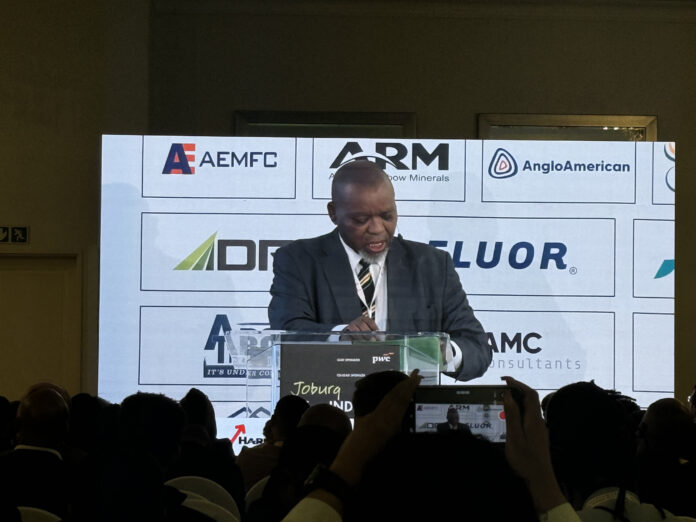
The Mapungubwe Institute for Strategic Reflection (MISTRA) has commenced its 10th annual Platinum Group Minerals Roundtable 2025 as a webinar, which creates a platform for industry leaders and policymakers to engage in a high-level exchange of ideas which will shape South Africa’s mineral and energy strategy over the next 10 years.
The forum has become a notable and defining space for policy shaping and strategic innovations of minerals, energy and industrial development. This event takes place at a critical point for South Africa’s economy and global positioning, as the country will be taking on its G20 presidency as well as cabinet recently approving the Critical Minerals and Metals Strategy.
The Critical Minerals and Metals Strategy, sets out a framework in order to position South Africa in global critical value chains. It aims for the country to focus on industrialisation, innovation as well as regional integration.
Some of the challenges that will come with implementing the strategy could include limited institutional capacity, regulatory uncertainty, as well as a lack of cohesion in terms of government coordination.
Overcoming those challenges will be critical for the country’s plans to turn vision into implementation. Although the strategy speaks to inclusion, it however gives little details on how justice considerations will be integrated into project design.
The Strategy was approved on 20 May 2025, as South Africa’s Ministers of Mineral and Petroleum Resources, Gwede Mantashe, had announced government approval. Mantashe has noted that the strategy is not just a policy framework and highlighted that this strategy is imperative to creating sustainable mineral wealth for South Africa in the future.
Viaksha Mohabir who serves as the GIZ advisor to the G20 Energy Transition working group, had highlighted three key trends in scenarios in her presentation at the roundtable. These trends include a sharp increase in critical minerals demand over the next 10-15 years, which is due to new mining and processing activities being launched in response to climate policies and global efforts to reduce emissions.
The second trend includes “Decline or Plateau”between 2035-2050 as due to the after the ramp up phase the critical minerals will start to level off and decline due to better technologies for processing ores and waste reduce how much raw material is needed, some critical minerals cannot be replaced with future technology, so the demand will begin to plateau. There will also be an expected rise in recycling which will reduce the need for new mining.
The third trend will see a small final increase before 2050, and will be likely due to a final push in mining and production to meet last minute targets for net-zero emissions.
Mandy Mlilo who is currently serving as Acting Chief Director of Hydrogen and Energy for the Department of Science, Technology and Innovation in South Africa (DSTI).
She highlighted the strategic intent and alignment of the energy RDI flagship programmes to the decadal plan and DSTI mantra which includes, improved inclusion and build more linkages across the NSI, increase support for and collaboration with the business sector, support commercialisation of publicly funded intellectual property, innovation to revitalise existing sectors, strengthening skills in the economy and expanding internationalisation and science diplomacy.
The DSTI hydrogen and energy chief directorate portfolio will be responsible for supporting reductions in greenhouse gas emissions and air pollution while contributing to a more diverse and sustainable energy mix by enabling the widespread commercialisation of battery, fuel cell, renewable and net zero carbon technologies which will be based on publicly funded intellectual property rights.
The penetration of clean and alternative energy technologies will be examined through research, development and validation efforts in order to be competitive with current technologies in regards to cost and performance while fostering strategic partnerships with the public and private sector to reduce the institutional and market barriers to their commercialisation.
Victoria Hepplethwaite, who serves as a researcher at the Centre for Researching Education and Labour, at the University of Witswatersrand, based her presentation on “Skills Ecosystems”. She highlighted that a skills ecosystem refers to the interconnected institutions, labour markets, as well as learning pathways that support skill information and utilisation.
It also focuses on how skills are produced, matched to demand, and evolve over time within a broader socio economic context, rather than simply being a connected coordinated network. She further highlighted in her presentation that without a responsive and inclusive skills system, hydrogen investments risk delay or exclusion.
She explained that an effective GH2 skills ecosystem includes balancing supply and demand through strong industry-education partnerships, integrating public sector capacity for policy, regulation, environmental compliance as well as promoting local participation to prevent unequal development which will be key for a just transition.
She also explained how to build a GH2 skills ecosystem, as she highlighted that an agile, inclusive skills system will be key. She explained that GH2 success will be dependent on a workforce that is prepared from school to control room, as there should be a major emphasis on reskilling while simultaneously upskilling current workers.
Dr Iraj Abedien, who serves as Founder and Chief Executive of Pan-African investment and Research services as well as Chairman of Pan-African Capital Holdings, highlighted the key features of a commodity exchange, which is a market institution which facilitates engagement among market participants, the exchange of information and conclusion of commodity exchange transactions both spot and future trade.
He also explained the re-imagining of the mineral beneficiation value chain in South Africa. He explained that South Africa’s known Platinum Group Metal (PGM) reserves dominate the global industry in excess of 80% and further explained that this could later be extended to the manganese and chrome subsectors in which South Africa also has large reserves. He also explained that beneficiation in this industry will need to be strategic and long term oriented.