
By Mirna Fahmy-DIPLOMATIC INSIDER
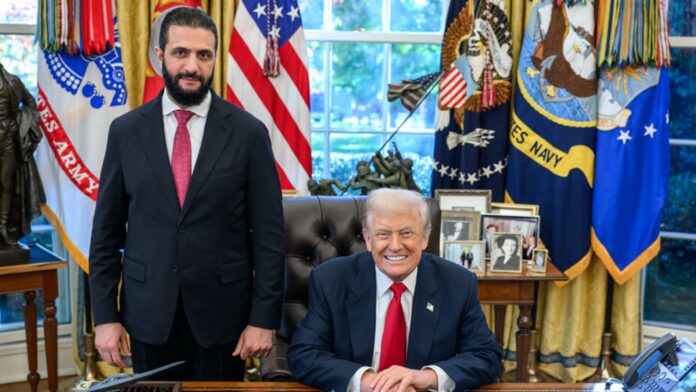
Ahmed al-Sharaa, Syria’s president, met with U.S. President Donald Trump at the White House on Monday, November 10, 2025. The visit was historic: al-Sharaa became the first Syrian leader ever to set foot in the White House, and it marked the first official U.S.–Syrian leadership meeting since March 2000, when President Bill Clinton met Hafez al-Assad in Geneva. It was also the first time a Syrian head of state had been received in Washington since Syria gained independence from France on April 17 in 1946. Trump welcomed al-Sharaa for a meeting that lasted almost two hours, reflecting Trump’s continued emphasis on personal rapport as a tool of foreign policy.
Al-Sharaa’s presence in Washington was particularly notable given his controversial background as a former rebel commander with previous ties to al-Qaeda and a former U.S. bounty of $10 million. He had already met Trump earlier in May 2025 in Saudi Arabia, and despite his history, the White House encounter was described as warm and cordial. Trump referred to him as a “strong leader” and even presented him with a bottle of perfume, signaling a highly personalized diplomatic approach.
The meeting focused on laying the foundation for a renewed relationship between the United States and Syria. Discussions addressed Syria’s potential participation in the U.S.-led coalition against ISIS, as well as American encouragement for Syria to formally recognize Israel, expel foreign terrorist groups operating on Syrian territory, and assume responsibility for detention centers holding Islamic State fighters. These talks took place against a backdrop of shifting U.S. policy: in June 2025, Trump had signed a landmark Executive Order ending the U.S. sanctions program on Syria to support the country’s path toward stability, while maintaining targeted sanctions on Bashar al-Assad, his associates, human rights violators, narcotics traffickers, individuals tied to chemical weapons activities, ISIS members and affiliates, and Iranian-backed groups.
Throughout the discussions, both sides chose to focus on future cooperation rather than past affiliations. Al-Sharaa rejected the prospect of direct negotiations with Israel but expressed willingness to consider U.S.-backed security arrangements aimed at reinforcing regional stability. His position fits within the wider regional landscape shaped by the Abraham Accords and ongoing normalization efforts, where Syria remains cautious yet not fully closed to future shifts depending on political developments.
Just days before the White House meeting, a video circulated showing al-Sharaa casually playing basketball with the commander of U.S. Central Command and international coalition officers at a court in the United States. The footage, released in November 2025, portrayed unusually friendly interactions between the Syrian president and U.S. military officials. It also surfaced during a period of evolving political dynamics, especially amid narratives about U.S. support for Syrian opposition forces—including al-Sharaa himself—during the final stages of the campaign to unseat Bashar al-Assad.
Israel, observing these developments closely, has signaled conditional interest in engaging with al-Sharaa. Statements from figures such as Benjamin Netanyahu indicate that Israeli willingness to work with the new Syrian leadership hinges on potential cooperation to establish a demilitarized zone in southwestern Syria. Al-Sharaa, however, has maintained that no comprehensive agreement with Israel is possible without a full withdrawal from occupied Syrian territories. His stance reflects a firm nationalist position even as he pursues a security partnership with Washington, whose strategic goals include stabilizing Syria and reducing Iranian influence. Some reports suggest overlapping U.S. and Israeli interests regarding the new Syrian government, though they stop short of confirming full Israeli support, describing the relationship instead as conditional and closely monitored.
From Washington’s perspective, the al-Sharaa government represents a rare opportunity to stabilize Syria after years of war, counterbalance Iran, and potentially open space for improved Syrian-Israeli relations. Some U.S. officials argue that, given regional instability and the collapse of state institutions in Lebanon and Iraq—both heavily pressured by Iranian-backed militias—there are few viable alternatives to engaging with the new leadership in Damascus.
At the same time, the United States continues to rely on the Kurdish-led Syrian Democratic Forces (SDF), which played a decisive role in the territorial defeat of ISIS and currently oversee thousands of detained ISIS fighters. The partnership, however, comes with political complications. Türkiye strongly opposes U.S. support for the SDF because it views the group’s main Kurdish component as an extension of the PKK, which Ankara designates as a terrorist organization. These tensions place Washington in a delicate position as it attempts to maintain its alliance with the SDF while managing its broader regional relationships.
Currently, the United States appears to be pursuing a balancing strategy: cooperating with the new Syrian government in Damascus while retaining a limited military presence in northeast Syria to support the SDF. The long-term aim is to integrate Kurdish forces into a unified Syrian military structure as part of a wider political settlement—an approach intended to stabilize the country, secure U.S. interests, and contain the region’s most destabilizing actors.
How is the economy and politics under Sharaa?
The Al-Sharaa administration inherited not a functioning market economy, but a deeply entrenched system of crony capitalism. Economic opportunity and access to wealth were determined by proximity to the ruling elite, the security apparatus, and the Ba’ath Party—not by competitive markets.
The establishment of a new review committee marks an important first step toward economic de-Ba’athification and demonstrates political intent for governance reform. However, analysis from Karam Shaar Advisory, a New Zealand–based institute specializing in Syria’s political economy, warns that the transition remains vulnerable to serious implementation risks.
Earlier reporting from Karam indicated that the government had already reached “settlements with businessmen linked to the former Assad regime unilaterally.” This highlights a core challenge: the committee must operate with transparency and uphold clear rule-of-law principles in asset recovery. If the process remains opaque or relies on private arrangements, the old patronage structure may simply be replaced by a new, equally unaccountable one. Such an outcome would undermine public trust and discourage credible external investors—whose participation is essential to reconstruction and long-term recovery.
Karam notes that Syria’s current economic landscape is characterized by a collapse in fiscal sustainability and a severe liquidity crisis in the banking sector, driven both by years of conflict and by the financial practices of the previous regime.
A country’s political economy depends heavily on its taxation system. Syria’s tax system suffered a near-total breakdown during the war: government revenue from taxes and fees fell from USD 6.3 billion in 2010 to only USD 0.6 billion in 2023—a 90% decline. To compensate, the former authorities relied heavily on excessive and inflationary money printing. Taxes and fees, which made up 42% of government revenue in 2010, accounted for only 31% by 2023. This shift reflects the erosion of sustainable fiscal policy in favor of inflation-driven monetary financing.
The tax review committee is now considering the cancellation or amendment of several fees introduced after 2011, such as the Martyr’s Stamp, the War Effort Stamp, and the Reconstruction Fee. Removing these war-era levies—which often operated as compulsory charges unrelated to any direct public service—would send an important political message: a formal rejection of the previous regime’s extractive fiscal practices and a move toward legitimate governance.
At the same time, the Ministry of Finance is pushing forward a digital transformation program aimed at improving service delivery and enforcement. A new Anti-Tax Evasion Department will replace the existing inquiry system, using advanced tools to detect hidden tax bases and enhance compliance. However, uncertainty around the committee’s status following the formation of a new ministerial cabinet poses immediate political risk to these reforms.
The most pressing economic problem for ordinary Syrians remains the systemic liquidity shortage in the banking sector—an issue that became fully visible after Assad’s fall. The crisis originates from the Central Bank of Syria (CBS) withholding liquidity from commercial banks, making customer deposits effectively inaccessible. Officials have privately acknowledged that the CBS lacked sufficient liquidity in its vaults, revealing a condition of sovereign insolvency. Central Bank Governor AbdulKader Husrieh publicly identified the “lack of domestic liquidity” as a major challenge.
To manage the shortage, authorities imposed strict withdrawal limits, freezing deposits and preventing families and businesses from meeting essential needs. By the end of 2024, private-bank deposits totaled SYP 23.5 trillion (USD 1.7 billion), but these funds were locked at the CBS.
This environment gave rise to the illicit “bank balance market,” where depositors sell their inaccessible account balances to traders with access to liquidity, absorbing steep “deposit haircuts.” One ink trader had to accept a 25% loss on a SYP 700 million balance, receiving only SYP 525 million to keep his business running. Meanwhile, traders who secure CBS exemptions—sometimes for a fee—can make significant profits, such as one businessman who earned SYP 39 million (18%) by purchasing a frozen SYP 260 million balance at a discount and withdrawing it afterward.
A further grievance arises from current CBS rules permitting unrestricted withdrawal only for deposits made after May 7, 2025. This policy privileges returnees and new capital inflows while penalizing residents who maintained savings throughout the conflict. Though intended to inject fresh liquidity, the arrangement risks deepening social resentment and could be exploited by destabilizing actors.
Since the fall of the Assad regime on 8 December 2024, Syria’s transition has faced a “daunting mix” of internal and external pressures, including economic collapse, sanctions, damaged infrastructure, and political fragmentation. Sectarian tensions have become especially dangerous. Karam documents three major waves of sectarian violence in 2025—mid-March, early May, and mid-July—indicating that conflict is recurrent and systemic rather than incidental. These outbreaks appear linked to localized political, territorial, or resource disputes, exacerbated by the post-regime power vacuum. Addressing them requires a targeted security and political strategy from the Caretaker Government.
Compounding this instability are two intertwined security threats: an unprecedented surge in unexploded ordnance (UXO) casualties and a resurgent ISIS.
UXO contamination—including landmines and cluster munitions—may now exceed levels seen in comparable post-conflict settings. As returnees and farmers re-enter long-abandoned areas, incidents have risen sharply. In the first nine months of 2025 alone, Syria recorded around 650 UXO incidents, causing more than 570 deaths and 850 injuries. Actual figures are likely higher due to under-reporting. Fatalities in 2025 are on track to nearly triple the annual average of 267 deaths recorded between 2011 and 2024. This danger blocks access to agricultural land, slows economic recovery, and complicates the return of displaced persons.
The threat from ISIS also remains substantial. Despite its territorial defeat in 2019, by 2024 ISIS had regained significant operational momentum and Hayat Tahrir al Sham (HTS) is an extension of it. From 1 January to 1 December 2024, the group carried out at least 660 attacks across Syria—triple the number recorded in 2023. By the time Assad fell, ISIS had already rebuilt tactical capacity and confidence. This high-tempo threat demands major security resources, limiting the transitional authorities’ ability to focus on stabilization, humanitarian needs, and managing sectarian hotspots.
Now there are policies from many European countries aimed to reduce the number of refugees under the pretext of their reintegration into Syria.
The countries that have frozen the residency permits of Syrians and forced them to return to Syria are: Austria, Germany, Denmark, Norway, France, the Netherlands, Sweden, and others. These countries have announced the suspension or postponement of asylum applications submitted by Syrians and have begun organized deportation programs for Syrians, citing the relative stability of the situation in Syria and the need for Syrians to return to contribute to the country’s development. For example, Austria has stopped processing asylum applications and has begun deporting refugees, Germany has decided to suspend asylum applications from Syrians, and the Netherlands has announced a new policy allowing the return of refugees due to Syria being declared a relatively safe country.