
By Lesedi Sibiya-Diplomatic Insider
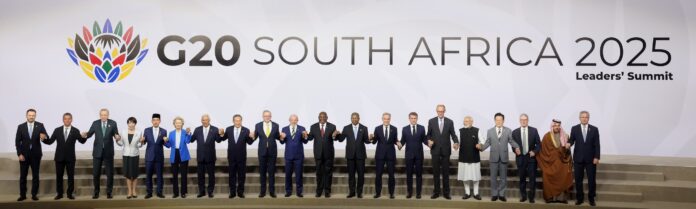
The G20 Leader’s Summit concluded at the Nasrec Expo Centre in Johannesburg as various leaders around the globe congregated at this Summit under the guided theme “Solidarity, Equality and Sustainability.”
The proceedings began with South African Deputy President Paul Mashatile ushering in the arrival of dignitaries as he shook hands with each of them before handing the duty over to South African President Cyril Ramaphosa.
Ramaphosa then began to address the leaders with a welcoming speech highlighting the aims of what the leaders hope to achieve through this congregation. One of the aims that Ramaphosa highlighted is engaging on matters regarding trade, sustainable development, health, education, climate change, agriculture and energy.
“Through solidarity, we can create an inclusive future that advances the interests of people around the world who are at the greatest risk of being left behind. This is important in an interconnected world,” said Ramaphosa in his address.
Ramaphosa also highlighted the disparities in wealth and development between various countries in the world and aims to use this G20 to advance development and equality specifically for African countries on the global stage.
“It is essential that we break down divisions of economic status, of gender, of race and geography. Sustainability involves meeting the needs of the present without compromising the ability of future generations to meet their own needs.” added Ramaphosa.
Ramaphosa also used his speech to shed light on geopolitical tensions, global warming and food insecurity and expressed that the United Nations (UN) sustainable development goals are imperative to combatting these global disparities.
“We must use this framework to catalyse development investments at scale in developing economies. We must continue the reform of the international financial architecture, ensuring that institutions are strengthened and more inclusive” said Ramaphosa in his address.
Another key point that Ramaphosa highlighted is the “importance of harnessing critical minerals for inclusive growth.” He explained that a big way to achieve sustainable growth is through beneficiation of the minerals at the place of extraction. Ramaphosa says through this G20 South Africa will put forth issues surrounding economic growth, industrialisation, inequality, unemployment, security and artificial intelligence (AI).
Ramaphosa then closed his speech, by opening up the G20 as the first session will speak on inclusive and sustainable economic growth as well as financing for development which will be expressed through presentations from relevant experts.
Minister of International Relations and Cooperation Ronald Lamola led a press conference in order to brief the media on the outcomes of the plenary session held by the heads of state, as well as give a brief on the leader’s declaration.
In the plenary session, the leaders addressed a variety of major global challenges as well as discussed ways in which to promote solidarity, equality, and sustainability as the key pillars of inclusive growth.
The leaders in attendance are in consensus that they should align themselves with the United Nations (UN) Charter as all states are to refrain from the threat or use of force in order to seek territorial acquisition by going against territorial integrity and sovereignty or infringe on the political independence of any state, as well as to promote countries having a friendly relationship with one another.
The declaration also stipulates that it will move to advance peace in Sudan, Democratic Republic of Congo, the occupied Palestinian territory and the Ukraine.
“We note the need for strengthened disaster resilience and response, including taking coordinated action to reduce the incidence and negative impacts of disasters, including earthquakes, extreme heat, floods, droughts and wildfires, desertification, and ensure our readiness to help each other,” the declaration reads in context to strengthening disaster resilience and response.
In the plenary sessions the heads of state also outlined debt sustainability for low income countries. The G20 Ministerial Declaration is endorsed by the heads of state by their respective finance ministers in the meeting held in October 2025 meeting.
The heads of state also outlined their support of the International Monetary Fund (IMF) and the World Bank Low-income Countries Debt Sustainability Framework (LIC-DSF), which will aim to clarify the approach on addressing debt vulnerabilities in a more effective way.
600 million Africans have no access to electricity, as the average access rate being 40% for African countries being the lowest in the globe and an estimate of 1 billion people in Africa have a lack of access to clean cooking as this is a problem the G20 aim to rectify by implementing the Just Energy Transition to ensure energy security as well as using the South African Presidency’s Voluntary Energy Security toolkit as a practical resource to strengthening national systems across the continent.
“We support the implementation of efforts to triple renewable energy capacity globally and double to global average annual rate of energy efficiency improvements globally through existing targets and respective policies, similarly support the implementation with respect to other zero and low emissions technologies.” the statement read further.
Food security was also the item on the agenda as it was highlighted that 720 million people continued to experience hunger in 2024 and 2.6 billion people were unable to afford healthy diets.
The G20 Leader’s summit concluded on Sunday, as Minister Lamola highlighted that the relevant dignitaries will collect the G20 Presidency from the Department of International Relations and Cooperation in order for it to be handed to the United States of America, who were not in attendance at this year’s summit.
South Africa has declined the United States the request for the handover of the G20 Presidency as South Africa expects the United States to send over senior representatives to collect the presidency at the Department of International Relations and Cooperation (DIRCO) buildings.
Turkish President Recep Tayyip Erdogan, spoke at the leader’s summit and expressed that international cooperation, new policy tools as well as sustainable supply chains were at the forefront of his address to the G20 leaders.
“We consider its important to strengthen international trade rules in a way that supports development and in particular, to reaffirm our commitment to the principle of special and differential treatment under the World Trade Organisation” said Erdogan in his address.
“This relatively low level of indebtedness provides us with significant fiscal space both to accelerate structural transformation and to allocate additional resources for investments.
Unfortunately, most low-income economies do not have this advantage…These countries are effectively trapped between high financing costs and shrinking fiscal space” Erdogan added.
Erdogan also highlighted that the total global development aid which saw a decline of 9% in 2024, will be expected to decline by a further 17% in 2025 as this will gravely affect Africa. “I invite the entire G20 to assume greater responsibility in building a more inclusive global economy where no one is left behind,” said Erdogan.
Erdogan also delivered a closing address at the G20 summit after Ramaphosa closed the summit. In his address he highlighted key points including the freedom of the Palestinian people and praised South Africa for their bold stance of taking Israel to the International Court of Justice (ICJ) for their occupation of Gaza.
“I greatly value South Africa’s principled and unwavering support for the Palestinian cause over the years. Turkiye too has fearlessly stood by the Palestinian cause, defending the rights of the people of Gaza at every platform.” said Erdogan.
He emphasised the necessity of the Two-State Solution as a means to consolidate peace and harmonious living for the people of Palestine.
“While ensuring the continuation of the ceasefire, it is of paramount importance to implement the Two-State Solution for a lasting settlement.” said Erdogan in his address.
French President Emmanuel Macron is fearful of the end of the G20 cycle especially if it cannot manage global crises. ”Meeting for the first time on the African continent marks an important milestone in the life of the G20, but must also recognise that the G20 is reaching the end of a cycle”.
Macron also expressed that there are difficulties in coming to a holistic agreement on the declaration among the global leaders “We are struggling to have a common standard on geopolitical crises” added Macron.