

By Mirna Fahmy
Following the death of Pope Francis on April 21, 2025, the newly elected Pope Leo XIV—born Robert Francis Prevost—has made ecumenical outreach a cornerstone of his papacy. Since his election on May 8, 2025, he has engaged extensively with various Christian denominations.
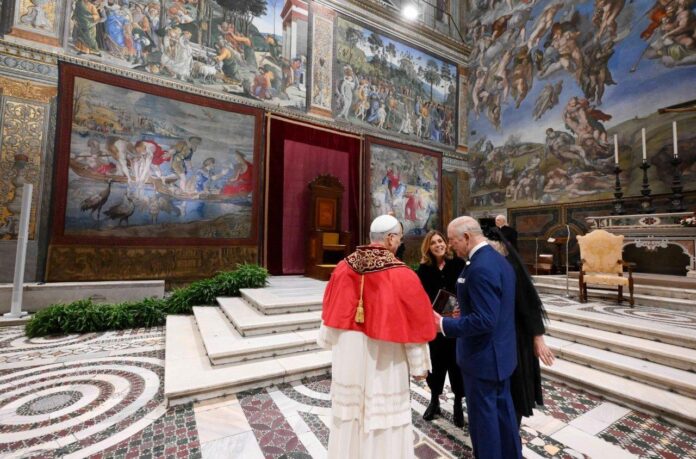
The first that was striking on its own was his collaboration with the British Monarchy. In a move that surprised global media, Pope Leo XIV and King Charles III held a joint mass prayer in the Sistine Chapel at the Vatican focused on “care for creation.” This event marked the first public prayer between a reigning British monarch and a pope during a state visit in 500 years, signaling a profound shift in a relationship long defined by the Protestant Reformation.
The roots of this centuries-old divide trace back to 1534, when King Henry VIII sought to divorce the Spanish Princess Catherine of Aragon after she failed to provide a male heir. Despite Henry’s offer of troops to assist the Vatican in its struggle against the Protestant movement led by Martin Luther, Pope Clement VII denied the request, as divorce was strictly forbidden. This rejection drove Henry VIII to sever ties with Rome through an Act of Parliament that declared the King the Supreme Head of the Church of England. While Henry initially maintained many Catholic practices, his successor Edward VI introduced the more significant Protestant reforms that ultimately shaped Anglican theology and removed papal authority from English soil.
This historic 2025 meeting served as a formal reconciliation of that fractured past. To honor the new bond, King Charles III was named “Royal Confrater” of the Basilica of St. Paul Outside the Walls, while Pope Leo XIV was named “Papal Confrater” of St. George’s Chapel. The two leaders also exchanged high honors: the King bestowed the Knight Grand Cross of the Order of the Bath upon the Pope, while the Pontiff granted the Knight Grand Cross with the Collar of the Order of Pope Pius IX to the King and the Dame Grand Cross to Queen Camilla. Beyond ceremony, the leaders met with business figures and activists to discuss climate change and sustainability, underscoring their shared commitment to the environment.
The timing of the visit was particularly significant, occurring just before the Pope’s planned declaration of St. John Henry Newman—a key figure in both Anglican and Catholic history—as a Doctor of the Church on November 1, 2025. This spirit of unity had been building since King Charles’ own coronation, which was a landmark for interfaith relations. That ceremony featured a Catholic cleric, the Cardinal Archbishop of Westminster, for the first time since the Reformation, and the procession was led by a cross containing fragments of the True Cross gifted by Pope Francis.
King Charles has consistently demonstrated a deep concern for the global Christian community, involving himself with charities such as Aid to the Church in Need to support persecuted believers worldwide. This commitment was reflected in his coronation, where representatives from various non-Anglican denominations and other faiths held active roles. Through these shared gestures and the recent summit at the Vatican, Pope Leo XIV and King Charles III have effectively turned the page on five centuries of religious tension, replacing it with a partnership built on common humanitarian and ecological goals.
Türkiye–Minor Asia in the Bible
Building on this momentum of reconciliation, Pope Leo XIV embarked on a subsequent journey that revisited the very foundations of early Christianity during his visit to Türkiye from November 27 to 30. During this visit, he met with Patriarch Bartholomew I, the Patriarch of Constantinople and spiritual leader of the Eastern Orthodox, to sign a joint declaration aimed at mending the nearly millennium-old division between their churches. His outreach in Istanbul extended to the leaders of the local Greek and Armenian Orthodox communities, as well as a visit to the Mor Efrem Syrian Orthodox Church, where he consulted with Syriac Orthodox Patriarch Mor Ignatius Aphrem II and other community leaders. A central highlight of this journey was the Pope’s historic ecumenical pilgrimage to İznik, the ancient Nicaea, to commemorate the 1,700th anniversary of the First Council of Nicaea held in 325 AD.
At the lakeside archaeological site of the ancient Basilica of Saint Neophytos—a fourth-century structure recently revealed by receding lake waters and believed to be the original site of the council—the Pope participated in a solemn prayer service. In a poignant speech, he emphasized the Nicene Creed as a common heritage for all Christians, cautioning against the reduction of Jesus Christ to a mere charismatic leader and rejecting the use of religion to justify violence or war.
Ancient Nicaea holds a unique place in Christian history as the site of two critical ecumenical councils. The First Council of Nicaea in 325 AD, convened by Emperor Constantine I, addressed the Arian controversy by affirming the divinity of Christ and declaring him to be of one substance with the Father. This council produced the original Nicene Creed, a foundational statement of faith that remains a cornerstone for billions of Christians today by affirming the Trinity and countering early heresies. Additionally, it sought to establish a uniform date for the celebration of Easter.
Centuries later, the Second Council of Nicaea in 787 AD addressed the Iconoclastic Controversy and officially approved the veneration of holy icons. Standing on this holy land—often referred to as Asia Minor by the apostles in the New Testament—Pope Leo utilized the anniversary of the council to call for full and visible communion among all Christians. He further looked toward the future by inviting all denominations to gather in the Holy Land in 2033 for the “Bimillennium 2033” to mark the 2,000th anniversary of Christ’s death and resurrection, while continuing his advocacy for a shared date for Easter between the Eastern and Western traditions.
The geography of modern-day Türkiye is inextricably linked to the ministries of the key apostles and the foundational Church Fathers. While the vibrant, autonomous Christian communities of the Roman Empire eventually diminished following various Islamic conquests and the rise of the Ottoman Empire, the cities themselves remain as modern Turkish centers or significant archaeological sites. Key biblical locations include Antioch, where followers of Jesus were first called “Christians”; Tarsus, the birthplace of the Apostle Paul; and Ephesus, a major hub where Paul ministered and the Apostle John is traditionally believed to have lived with the Virgin Mary. The region also encompasses the Seven Churches of Asia Minor mentioned in the Book of Revelation—Ephesus, Smyrna, Pergamum, Thyatira, Sardis, Philadelphia, and Laodicea—as well as the provinces of Galatia, Cappadocia, and Bithynia, to which the Apostle Peter addressed his first letter.
Many of the pivotal figures who laid the groundwork for Christian doctrine also hailed from this region. These include the Apostle Paul of Tarsus, whose missionary journeys across Asia Minor were instrumental in spreading the faith; Saint Polycarp of Smyrna, a disciple of the Apostle John and a prominent martyr; and Saint Ignatius of Antioch, whose early letters provided essential insights into church structure and theology.
Other notable figures include Timothy, a companion of Paul from Lystra in Galatia, and Saint Nicholas of Myra, the historical inspiration for Santa Claus who served as a bishop in the Roman province of Lycia. By walking in the footsteps of these foundational figures, Pope Leo XIV’s visit underscored a desire to reconnect with the ancient roots of the faith to foster modern unity.
Lebanon: The fractured despaired state seeks hope
Transitioning from the ancient sites of Türkiye to a modern landscape of crisis, Pope Leo XIV traveled to Lebanon from November 30 to December 2, 2025, to deliver a message of peace and perseverance to a nation often described as a “fractured and despaired state.” As the second leg of his first official papal trip, the visit was deeply symbolic, fulfilling a long-held intention of his predecessor to support the Middle East’s last Christian bulwark. During his stay, the Pope visited the Monastery of Saint Maron in Annaya to pray at the tomb of St. Charbel Makhlouf, followed by a pilgrimage to the Our Lady of Lebanon shrine in Harissa. He also participated in an ecumenical gathering in Martyrs’ Square, where he met with Eastern Catholic Patriarchs and faith leaders from across Lebanon’s 18 religious sects, including Shia, Sunni, and Druze representatives. A particularly moving moment occurred at the site of the 2020 Beirut port explosion, where the Pope offered silent prayers and lit a lamp for the victims, calling for long-awaited justice and healing for the nation.
The visit concluded with a massive outdoor Mass at the Beirut Waterfront, attended by approximately 150,000 faithful, including a delegation of 300 Syrian Christians who traveled to receive the Pontiff’s blessing. In his farewell address, Pope Leo issued a heartfelt appeal for an end to hostilities, declaring that “armed struggle brings no benefit” and that negotiation remains the only constructive path forward. Experts viewed the trip as a strategic “Middle East First” policy designed to restore global attention to Lebanon’s overlapping economic and security crises. This was especially critical given the rising tensions between Israel and Hezbollah, as well as the political shifts under the new President, Joseph Aoun. While Israel expressed optimism regarding Aoun’s presidency, the continued refusal of Hezbollah to disarm or vacate South Lebanon remained a significant hurdle to lasting peace. Interestingly, Hezbollah issued a formal welcome for the visit, attempting to project domestic legitimacy and national unity even as they reiterated their stance against surrendering arms.
Beyond the political theater, the Pope’s visit addressed the existential threat of mass emigration, as he pleaded with Lebanese Christians to remain in their homeland despite the financial ruin and threat of war. However, the reception was not without its regional disconnects; while northern communities celebrated, many in southern Lebanon expressed disappointment that the Pope did not visit war-torn villages directly affected by Israeli strikes, which they felt would have provided a more tangible deterrent against escalation. On his return flight to Rome, the Pope reiterated the Vatican’s support for a two-state solution for Israel and Palestine, signaling a more assertive role for the Holy See in Middle Eastern mediation. While skeptics noted that the visit provided more moral encouragement than practical policy solutions for hyperinflation or institutional collapse, the high-security context—marked by a closed popemobile and heavy military presence—served as a stark reminder of the fragile peace the Pope sought to protect.