

By Mirna Fahmy
The military intervention in Yemen, initiated in March 2015–after the civil war erupted in 2014–began as a unified front. Led by Saudi Arabia at the request of the legitimate government, the Arab Coalition—including key partners like the United Arab Emirates (UAE), Bahrain, and Kuwait—sought to reverse the Houthi takeover of Sana’a and curb Iranian influence. However, over a decade of conflict, this joint mission has evolved into a complex competition for regional hegemony. What began as a strategic partnership has devolved into a divergence of interests, where Saudi Arabia and the UAE now champion different visions for Yemen’s future, often through rival local proxies.
The geopolitical landscape is further complicated by the involvement of global powers. While the United States and the United Kingdom have historically provided the coalition with intelligence and weaponry, their roles shifted in 2024 and 2025 toward direct military engagement against Houthi targets to protect Red Sea navigation. Conversely, Iran has maintained its steadfast support for the Houthi movement, officially known as Ansar Allah, while Russia has increasingly provided political cover for the Houthis on the international stage. These external pressures have acted as a catalyst for the internal fragmentation that now defines the country.
A fundamental rift emerged as Saudi Arabia remained committed to restoring a centralized, unified Yemeni government under the Presidential Leadership Council. In contrast, the UAE pivoted toward a counter-terrorism mandate, simultaneously fostering the Southern Transitional Council (STC). Established in 2017 with direct Emirati backing, the STC represents a resurgence of southern secessionist identity. By training and arming the Southern Armed Forces, the UAE effectively created a powerful local actor whose primary goal—the restoration of an independent South Yemen—directly contradicts the Saudi objective of national unity.
This friction reached a critical boiling point as the STC expanded its territorial footprint. After establishing its de facto capital in Aden, the Council moved to seize control of vital southern governorates like Lahj and Socotra. By late 2025, the STC pushed further into the resource-rich regions of Hadramawt and Al-Mahra. This expansion finally triggered a direct Saudi military response in January 2026, leading to a volatile cycle of territorial capture and recapture between nominal allies.
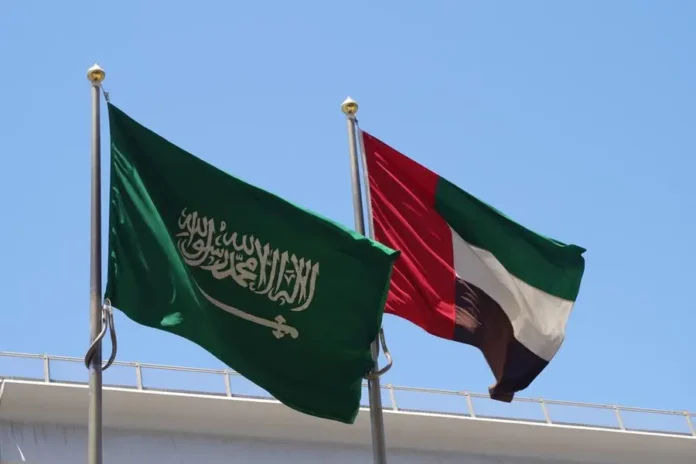
Then, Saudi Arabia demanded that the UAE withdraw its forces and cease supporting any faction in Yemen within 24 hours. The UAE responded by announcing it would withdraw its remaining forces voluntarily. Both countries expressed regret over the escalation, with the UAE reaffirming its support for Saudi efforts to promote security and stability.
The Saudi Ministry of Foreign Affairs, in its statement, emphasized the importance of the UAE’s response to Yemen’s request for the withdrawal of its military forces from Yemen.
Riyadh expressed its hope that wisdom would prevail, and that the principles of brotherhood, good neighborliness, and the close relations that bind the Gulf Cooperation Council (GCC) states, as well as the interests of Yemen, would be upheld. It called on the UAE to take the necessary steps to preserve bilateral relations between the two countries, which Saudi Arabia affirms its commitment to strengthening and developing in a way that contributes to the prosperity and stability of the region. The statement also considered the UAE’s role in the ongoing events in Yemen to contain fundamental inaccuracies.
The UAE categorically rejects any attempt to implicate it in the tensions between Yemeni parties and condemns the allegations that it pressured or directed any Yemeni party to carry out military operations that threaten the security of the Kingdom of Saudi Arabia or target its borders.
The UAE affirms its unwavering commitment to the security and stability of the Kingdom of Saudi Arabia and its full respect for its sovereignty and national security.
According to many sources, the UAE’s sponsorship of the STC is rooted in a calculated pursuit of long-term maritime security and economic hegemony. By securing a dominant presence in southern Yemen, Abu Dhabi aims to exert control over a string of high-value coastal nodes, most notably the Port of Aden and the strategic archipelago of Socotra. These locations are far more than regional assets; they sit at the vital intersection of the Gulf of Aden and the Red Sea, serving as essential “toll booths” for global trade and international energy shipments. For the UAE, ensuring influence over these waterways is a prerequisite for protecting its own commercial interests and maintaining its status as a global logistics hub.
Beyond these economic foundations, the UAE’s strategy is driven by a deep-seated ideological imperative: the containment of both Iranian expansionism and political Islam. Abu Dhabi views the Houthi movement and the Islah Party—the Yemeni affiliate of the Muslim Brotherhood—as twin threats to regional stability. By positioning the STC as a secular, counter-terrorism partner, the UAE has effectively built a “buffer force” against these rivals. This military investment, which includes the extensive training and arming of southern forces, provides the UAE with a loyalist security apparatus capable of protecting its interests regardless of whether Yemen remains a unified state or eventually fractures into an independent south.
To solidify this influence, the UAE has paired its military patronage with a robust soft-power campaign. Through the distribution of billions of dollars in development aid and infrastructure projects, Abu Dhabi has sought to stabilize the local economy in areas under STC control. This humanitarian investment is strategically designed to win “hearts and minds,” fostering local popular support and bolstering the Council’s legitimacy on the ground.
By early 2026, Yemen has effectively ceased to function as a single state, instead fracturing into three distinct spheres of influence. The Houthi movement maintains a firm grip on the northern highlands and the Red Sea coast, including the capital of Sana’a. Meanwhile, the STC dominates the southern heartlands, holding the interim capital of Aden and the surrounding governorates. The internationally recognized government, though part of a fragile power-sharing agreement with the STC in the Presidential Leadership Council, finds its actual authority restricted to eastern and central pockets, such as Marib and Al Mahrah.
The map is further cluttered by smaller, autonomous power centers. Along the western coast, the National Resistance Forces under Tariq Saleh maintain an independent stronghold near the strategic Bab al-Mandab strait. Simultaneously, extremist elements like al-Qaeda continue to exploit the security vacuum in the remote mountains of Abyan.
This current state of chaos stands in stark contrast to the ambitious National Dialogue Conference of February 2014. At the time, a presidential committee led by Abdrabbuh Mansur Hadi proposed a six-stable region federal model as a desperate remedy for the grievances that had fueled rebellions in both the north and the south. The primary objective was to dismantle the highly centralized government structure that had marginalized peripheral regions since the 1990 unification. By granting these six regions greater autonomy, the plan aimed to ensure a more equitable distribution of natural resources—specifically the oil wealth concentrated in the south and east—and to foster a sense of national equality that had long been absent.
However, the six-region design was also a calculated political maneuver intended to prevent a clean north-south split. By dividing the former South Yemen into two distinct regions—Aden and Hadramawt—the central government hoped to dilute the momentum for total secession, which had haunted the state since the 1994 civil war. Many northern delegates feared that a simple two-region federation would inevitably lead to a formal divorce of the two halves. The six-region model was, therefore, a compromise designed to offer self-governance while structurally inhibiting the path to independence.
Ultimately, the plan’s complexity became its undoing. Despite receiving international praise as a democratic milestone, it faced insurmountable domestic opposition and never reached a constitutional referendum before the 2015 escalation. The Houthi movement rejected the proposal entirely, viewing the “Azal” region—which included their stronghold of Saada—as a landlocked “resource cage” designed to keep them economically crippled. Simultaneously, southern separatists saw the division of the south into two regions as an existential threat to their identity and a deliberate attempt to undermine their aspirations for a unified, independent southern state. Today, while the federal plan remains the “official” vision on paper, the escalating competition between local proxies and regional powers has rendered it a purely theoretical exercise.
A peek at the past:
Yemen’s instability predates the modern era. Even after emerging from the shadows of the Ottoman Empire and British colonial rule, the nation struggled to forge a cohesive identity. Following the Ottoman defeat in World War I and their subsequent withdrawal in 1918, the Zaydi Imam, Yahya Muhammad Hamid ad-Din, established an independent kingdom in the north. By 1926, this Mutawakkilite Kingdom had secured international recognition, marking the beginning of a sovereign—yet deeply troubled—state defined by a rigid, absolute monarchy that remained staunchly resistant to modernization. While much of the world moved toward industrialization, this isolationist, agrarian society struggled to pacify powerful independent tribes, whose constant revolts made central governance nearly impossible.
The monarchy’s inability to adapt eventually led to its downfall in the 1960s, when a military-led rebellion sparked a brutal civil war and paved the way for the establishment of the Yemen Arab Republic, or North Yemen. Simultaneously, the southern half of the country was undergoing its own transformation; having remained a British protectorate long after the north achieved independence, South Yemen finally broke free from colonial rule in 1967. For the next two decades, Yemen existed as two separate and often ideologically opposed states. While they eventually moved toward a historic unification in 1990 to form the modern Republic of Yemen, the merger proved to be a thin veneer over deep-seated political, economic, and tribal divisions that continued to fuel internal friction.
It was within this fragile post-unification landscape that the Houthi movement, officially known as Ansar Allah, began to take shape. The movement draws its identity from the Zaydi Shia sect, which had governed northern Yemen through a theological Imamate system for over eleven centuries prior to the 1962 revolution. By the 1990s, led by Hussein Badreddin al-Houthi, the movement emerged as a Zaydi revivalist force in the northern stronghold of Saada. What began as a peaceful educational effort served as a direct reaction to the expanding influence of Saudi-funded Salafism, which many locals viewed as an existential threat to their religious heritage. This transition from religious revival to a formidable military insurgency was forged in the fires of conflict with the central government, specifically during six consecutive wars against the administration of President Ali Abdullah Saleh between 2004 and 2009.
The political vacuum created by the 2011 Arab Spring provided the battle-hardened movement with a strategic opportunity to move beyond its northern base. By exploiting the weakness of the transitional government, Ansar Allah launched a sweeping military campaign that culminated in the stunning capture of the capital, Sana’a, in September 2014. This seismic shift in the balance of power became the primary catalyst for the 2015 Saudi-led intervention, effectively turning a domestic rebellion into a regionalized conflict. Today, the Houthis have evolved into a pivotal member of the Iranian-led “Axis of Resistance.” While their origins remain firmly rooted in local Yemeni grievances, their survival and technological advancement have been bolstered by significant military and political support from Tehran.
By early 2026, this partnership has allowed the Houthis to project power far beyond their borders, challenging global maritime security from their de facto state in the north. This modern reality is a direct reflection of historical patterns; the fractures that characterized the preceding century—tribal autonomy, religious friction, and the interference of regional neighbors—did not disappear with the unification treaty of 1990. Instead, these historical wounds remained just below the surface, continuing to fuel the regional rivalries and internal conflicts that have brought the country to its current state of crisis.