

By Mirna Fahmy
The Kurdish pursuit of sovereign statehood—a movement rooted in a long-standing quest for self-determination and civil rights—has undergone a significant transformation since the post-World War II era. While these aspirations were historically marginalized by shifting global interests, the 2011 Syrian Civil War catalyzed a new era of Kurdish political and military agency. The emergence of the YPG and its subsequent evolution into the multi-ethnic Syrian Democratic Forces (SDF) that fought against ISIS has not only revitalized the concept of Kurdistan but has also altered regional alliances. Following the collapse of the Assad regime in December 2024, these developments have garnered renewed international attention, notably through the public endorsements of several Israeli politicians.
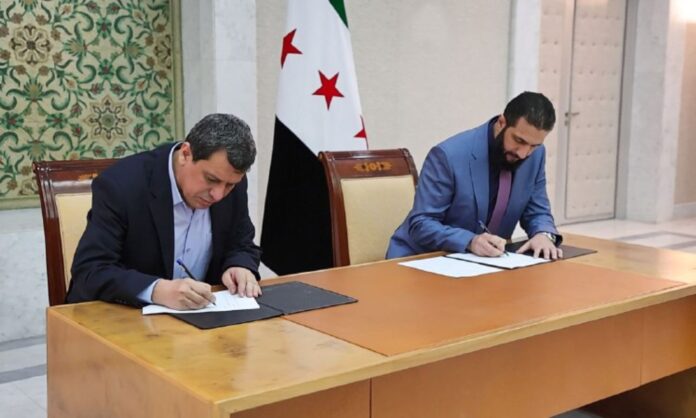
Despite the hope, the steps to forming the state weren’t implemented on the ground. Instead, on March 10, 2025, Syria’s new president, Ahmed Al-Sharaa, and SDF leader Mazloum Abdi signed a deal viewed by Al-Sharaa as a US- and Türkiye-supported solution. The terms were absolute: the central government was to reassert control over all Syrian territory by the end of 2025. This included the border crossings, the airport, and the oil and gas fields—70% of which are currently controlled by the Kurds/SDF. The terms also demanded the merge of SDF into the new Syrian government.
Throughout 2025, clashes between the SDF and the new Syrian army occurred many times in Aleppo—which has long been a battle since 2015—whereas the SDF and its Kurdish security units maintained a continuous presence in the city, specifically in the predominantly Kurdish neighborhoods of Sheikh Maqsoud and Ashrafieh.
These neighborhoods are not merely residential; they are elevated areas overlooking the city, granting them immense strategic military importance. This geography made the Syrian transitional government’s demand for “complete control” a non-negotiable point of friction.
The peak of the fight was in January 2026, lasting for five days, resulting in around 23 civilian deaths and the injury of over 100 others.
The breakdown of trust began at the civilian level. Sinam Sherkany Mohamad, the Syrian Democratic Council (SDC) representative in the United States and a member of the SDC Presidential Council, highlighted the stakes for the 400,000 people—including Kurds and other Syrian civilians—living in these enclaves.
During an interview with the Washington Outsider and Radio Coalition, Mohamad explained that the violence was sparked by the failure of the “April Agreement.” Under that deal, the SDF was to move its heavy weapons while internal police took over.
However, Mohamad noted, “The internal police prevented the entry of gas and oil to these inhabitants, so the conflict started. In Aleppo, there is fear among the people and distrust of the Syrian government… because there is no guarantee that the new government will not commit any crimes against them as they did to the Alawites in March 2025.”
Mohamad’s concerns extended to the composition of the new Syrian Army, which she alleged contains militias from ISIS, Al-Qaeda, and HTS. She stated that these groups have targeted hospitals and separated families—men from women and children.” She further criticized the government’s reliance on Turkish-backed groups like Al-Hamzat and Al-Ashmat, arguing that their integration would be “impossible” compared to the US-trained SDF.
Another noting matter for the Kurds for resisting full integration is their insistence on a decentralized system of governance (self-administration) and the enshrining of their rights in the constitution.
Though a follow-up deal in April allowed the Asayish (internal security) to stay while military units moved east of the Euphrates, the SDF only partially implemented the withdrawal last April, leaving the fate of Ashrafieh and Sheikh Maqsoud an open question until the recent clashes.
By July and August 2025, the government retaliated by blocking fuel supplies, and on October 7, the discovery of an SDF tunnel into government territory led to a temporary siege. December was the optimum of the conflict, as sporadic fighting and mutual accusations of agreement violations continued till January 11, 2026, when SDF left the region.
After the intensified collisions of January that spanned the news, Al-Sharaa signed a law to guarantee Kurdish rights nationwide on January 17, 2026. In a televised video, he says, “Syria’s Kurds are fully part of the country, and anyone who messes with them is an enemy.”
He even added the Kurdish language to be taught in schools, marked Nowruz as a national holiday, and returned citizenship to the Kurds who lost it in 1962. He has also addressed Syrian refugees to come back because there are no longer weapons.
TÜRKIYE IS BACKING: A Wall Street Journal article reports that while the SDF has begun a “goodwill withdrawal” following international mediation, U.S. intelligence suggests Damascus may be planning a much larger, Turkish-backed operation. This potential offensive could cross the Euphrates River into northeastern Syria, where the majority of U.S. forces are stationed.
Though the U.S. has recently lifted sanctions and welcomed President al-Sharaa to the White House to promote stability, the article reports, the current military aggression threatens the nascent partnership between Washington and Damascus.
The U.S. support to Syria’s factions internally has seen a wavy shift. Historically, the Pentagon worked closely with the SDF while the State Department remained skeptical—a divide stretching back to John Kerry and James Jeffrey, the latter of whom famously called the SDF partnership “temporary, tactical, and transactional.”
In the past, the US diplomats have preferred direct engagement with Damascus. This was impossible during the Assad era—leading the US to keep alternative groups at arm’s length—but the collapse of the Assad regime in December 2024 fundamentally shifted the calculus.
Under the second Trump administration, policy has been consolidated under Thomas Barrack, serving as both US envoy to Syria and ambassador to Türkiye.
Barrack has been notably critical of Kurdish delays. “I think the SDF has been slow in accepting, negotiating, and moving towards integration, and my advice to them is to speed that up,” Barrack stated. He clarified that the U.S. is no longer backing an “independent” region but is instead focused on an “on-ramp” to a unified Syrian government. In July 2025, Barrack suggested a middle ground: an arrangement short of full federalism that allows groups to preserve their culture and language “without any threat from political Islam.”
The Washington Institute suggests that for President Al-Sharaa to avoid the mistakes of the Assad era, he must decentralize power. Analysts argue that conditioning sanctions relief on federalism could resolve tensions for large groups like the Kurds, Alawites, and Druze. For scattered minorities—such as Christians, Ismailis, and Turkmens—the report suggests “special-status districts” like Wadi al-Nasara in Homs or a Turkmen district from Azaz to Jarabulus.
Although federalism may help address Syria’s sectarian divide and promote a more equitable distribution of power, it would also raise a crucial new challenge: resource allocation. In addition to control over oil and natural gas, officials would have to make difficult decisions about usage rights for the country’s water supplies, arable land, sea access, and so forth.
However, the resource hurdle remains massive. Kurdish autonomy would threaten the central government’s access to the Euphrates and trade ports. Consequently, Al-Sharaa’s office has issued a firm rebuttal: “We clearly reject any attempt to impose a partition or create separatist cantons under the terms of federalism or self-autonomy without a national consensus.”
That’s why if federalism is adopted, it must be implemented all across Syria, not limited to minority groups. Regional leaders around the country need some degree of autonomy from a cumbersome central bureaucracy in order to ensure Syria’s swift rebound and long-term stability. Otherwise, the country could find itself trapped in an endless spiral of conflict.
The SDC’s Mohamad maintains that they remain open to dialogue, though she expresses concerns that Damascus is prioritizing military solutions over the restoration of the economy, healthcare, and education.
The instability is not limited to the north. In Sweida, Druze leader Hikmat al-Hijri recently confirmed to the Yediot Aharonot newspaper his aspiration for an independent Druze entity supported by Israel, affirming a strategic alliance with the Kurds.
On the ground, the U.S. is repositioning troops along the Euphrates to secure ISIS detainees at the Al-Hol camp. In a landmark shift as of November 2025, the new Syrian government officially joined the U.S.-led coalition to combat ISIS, effectively replacing the SDF as the primary partner.
This new era has witnessed some threats. In January 2026, rumors of President Al-Sharaa’s assassination flooded Arabic media. While some were dismissed, Al-Sharq al-Awsat newspaper reported that Syrian security forces successfully thwarted two separate ISIS plots to assassinate the president, underscoring the volatility of the new administration as it attempts to consolidate a divided nation.