
By Lesedi Sibiya-Diplomatic Insider
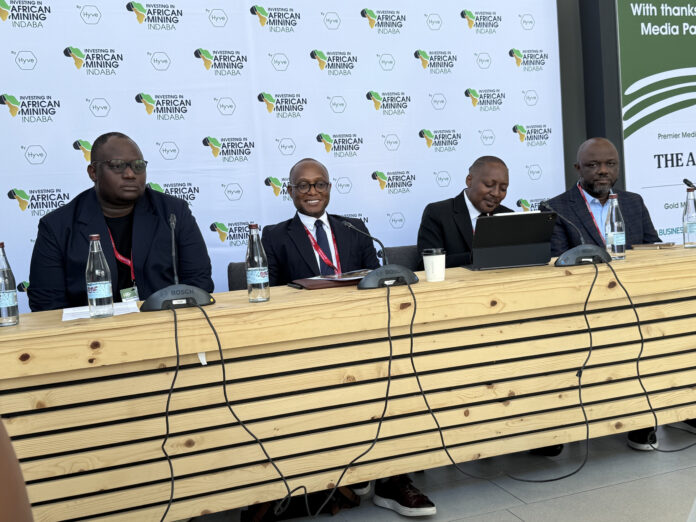
African Union Development Agency (AUDA-NEPAD) held a press conference at the African Mining Indaba this morning, in order to discuss the Continental Extractive Industries Programme (CEIP) which is a pan-African initiative aimed at repositioning Africa’s Mining Sector from High Risk Fragmented value chains.
Head of Industrialisation, Trade Markets and Economic Analysis for AUDA-NEPAD, Kossi Toulassi was one of the key speakers on the panel alongside Vusimuzi Mpofu who serves as Group Director Mining and Extractives for Equity BCDC SA, Executive Director of ACEP-Africa Centre for Energy Policy, Benjamin Boakye and Director of Africa Change Lab, Bhekumuzi Dean.
“At the centre of CEIP we have what we call a base of development banks and also commercial banks and have a mechanism to design a fund and de-risk most of the projects and also build up our new generation of investment ready programs” said Toulassi in his address at the briefing.
“So CEIP will further reduce what we call a project risk to PPP structuring and transaction advisory and this will enable industrialisation which we have mentioned is one of the pillars of our programme with renewable energy integration.” Toulassi said further. The key partners of the programme also include the Development Bank of Southern Africa (DBSA) as they will potentially be serving as facility manager, Standard Bank as well as Equity Bank to work as strategic financing partners in order to support regional development and co-financing.
“The CEIP reflects a mature and forward looking proposition on our end and that is one where Africa’s distracted sector is moving beyond this fragmented extraction towards integrated standard spaced value chains that are investable, industrialising, and also socially grounded.” said Bhekumuzi Dean at the press briefing.
“We do view CEIP laying the foundation for a new generation of projects that are not only bankable but developmentally transformative in nature.” Bhekumuzi added further.
When asked what the estimated value is for artisanal and small-scale mining on the continent, Vusimuzi Mpofu elaborated that although there was no clear answer, he highlighted that the biggest jurisdiction from a mining perspective would be the Democratic Republic of Congo (DRC).
“In the DRC we know that mining contributes from a billion in 2010 to $131 billion in 2024, of which arguably 10% of that will be artisanal mining” answered Mpofu. “It’s really growing in many parts of our country, in Ghana for example, small-scale mining is overtaking large scale mining in terms of economic output where in our country [Ghana] it’s about 60% of growing production which is about $11 billion for 2025, and perhaps it will grow in the subsequent years.” said Benjamin Boayke in regards to the estimated value of small-scale mining