
.)
By Thobile Jiwulane
Donald Trump’s new Ambassador to South Africa, L. Brent Bozell III, may face a formidable challenge in carrying out his mandate: persuading Pretoria to withdraw its genocide case against Israel at the International Court of Justice (ICJ).
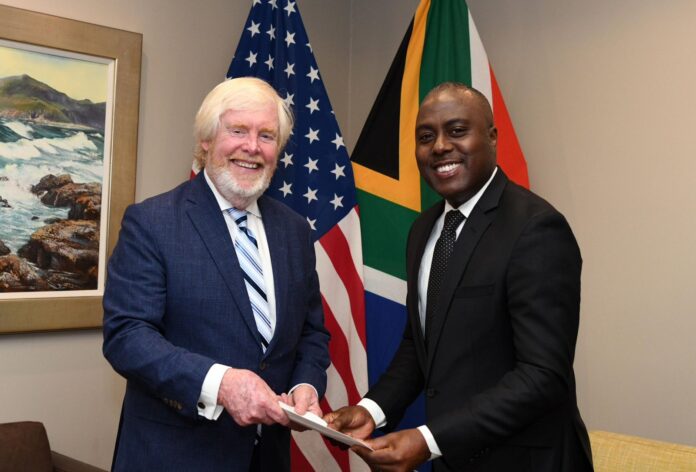
Bozell arrived in Pretoria last week, where Deputy Director‑General Clayson Monyela received his letter of credence. Some observers described the reception as low‑key, noting that protocol is usually handled by the President himself. Whether this was a deliberate snub remains unclear, but the real test will come when President Cyril Ramaphosa hosts new ambassadors at Sefako Makgatho House. If Bozell is excluded from that gathering, it would signal a diplomatic chill.
This episode recalls Pretoria’s earlier decision to give the US a cold shoulder by downgrading its role at the G20 summit in Johannesburg last year, when Ramaphosa and his foreign minister Ronald Lamola delegated the handover of the presidency to a junior official. That move was widely interpreted as a protest against Trump’s boycott of the summit. Trump’s absence was rooted in two grievances: his claim of “white genocide” in South Africa, which Pretoria has repeatedly rejected with the backing of most of the international community, and South Africa’s refusal to withdraw its ICJ complaint against Israel over the Gaza war.
Bozell’s assignment is explicit. Before leaving for Pretoria, he told Congress that his priority was to secure South Africa’s withdrawal of the ICJ case, which he described as injustice. Yet the odds are stacked against him. The ANC, now governing in a coalition, has long maintained solidarity with Palestine, rooted in its anti‑apartheid struggle and Nelson Mandela’s close ties with Yasser Arafat. That history makes any reversal politically costly.
In addition, the Left‑leaning allies such as the South African Communist Party and COSATU have already demanded the expulsion of Israel’s ambassador, underscoring the domestic resistance Bozell will encounter. In 2023, as a pre-emptive measure by Tel Aviv, Ambassador Eliav Belotsercovsky was recalled home for consultation with South Africa acting similarly with its own envoy in Tel Aviv. Early this year, Pretoria declared the Israeli Chargé d’Affaires, Ariel Seidman, persona non grata and ordered him to pack and go within 72 hours. The second-in-command at the Embassy was accused of violating diplomatic norms after he allegedly insulted President Cyril Ramaphosa on social media and failed to notify the government of visits by senior Israeli officials, who made direct consulted with local communities in the Eastern Cape Province offering them Israel’s humanitarian assistance,
The Bozell’s task is further complicated by unfinished business in U.S.–South Africa relations. Tariff negotiations stalled after Trump imposed duties of up to 30% last year, and Washington may now use trade leverage as a bargaining chip. Reports that the United Arab Emirates offered Pretoria financial incentives to abandon the ICJ case add another layer of pressure, though Ramaphosa’s government is unlikely to risk alienating allies in the African Union, the Global South, and the broader pro‑Palestinian bloc. However, refusing to bow Trump’s pressure would come with consequences – he would likely increase the tariffs by anything from 50% to 100% to punish the Ramaphosa government and gets more serious in his claim of the unfounded genocide in South Africa. A worst-case scenario would be to break relations with South Africa and removed it from the AGOA, a law designed to give duty-free access to the lucratve US market by Sub-Saharan Africa including South Africa.
At stake is more than a single court case. For Pretoria, withdrawing would mean betraying Mandela’s legacy of solidarity with oppressed peoples and undermining the ANC’s credibility as a champion of global justice. For Washington, failure to secure South Africa’s compliance would highlight the limits of Trump’s transactional diplomacy. Bozell’s mission thus encapsulates the broader tension in U.S.–South Africa relations: a country balancing its need for American investment with its commitment to principle and historical solidarity.
Bozell’s arrival in Pretoria marks the beginning of a diplomatic test that will reverberate far beyond the ICJ. His success would signal Washington’s ability to bend Pretoria’s foreign policy through pressure and incentives. His failure would reinforce South Africa’s determination to chart an independent course, even at the risk of straining ties with the world’s largest economy. In the end, the Gaza genocide case is not just about Israel and Palestine — it is about whether South Africa can reconcile its economic vulnerabilities with its moral commitments, and whether Trump’s brand of hard‑nosed diplomacy can overcome a history of solidarity that runs deep in the ANC’s political DNA.