
By Mirna Fahmy
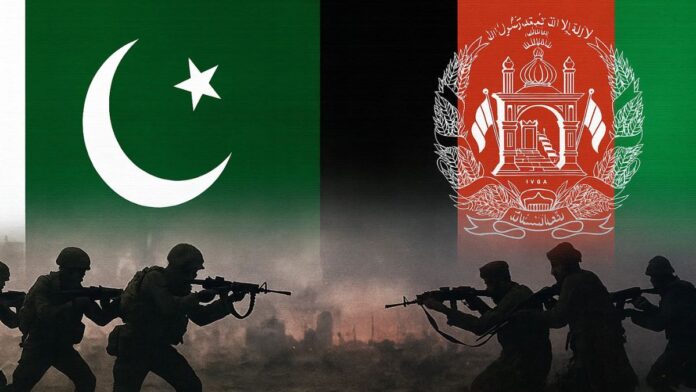
On February 27, 2026, Pakistan officially declared “open war” on Afghanistan. This announcement came just one day before the United States and Israel began their massive strikes on Iran.
This conflict between the neighboring nations did not start out of the blue. Border fights had occurred for months, but the situation broke down after a series of deadly Pakistani airstrikes and Taliban attacks in late February.
Between February 21 and 22, Pakistan launched airstrikes in Nangarhar, Paktika, and Khost to hit Tehreek-e-Taliban Pakistan (TTP) and IS-KP camps. The Afghan Taliban retaliated on February 26 by launching a large offensive against Pakistani military positions along the border. By the next day, Feb 27, Pakistan’s Defense Minister officially declared war. Pakistan then began Operation Ghazab Lil Haq (Wrath for the Truth) and conducted its first direct airstrikes on military targets in Kabul and Kandahar.
By late March 2026, the war was continuing despite a brief pause. Qatar, Saudi Arabia, and Turkey recently helped negotiate a five-day ceasefire for the Eid al-Fitr holiday (March 19–24, 2026). However, this truce ended quickly. On March 26, Pakistan resumed its artillery strikes in Kunar province.
The human cost of the war is already high. Over 300 Afghan civilians and eight Pakistani civilians have died. One strike on a Kabul rehab center alone killed between 143 and 400 people. Both sides also claim to have killed hundreds of enemy soldiers, though these numbers remain unconfirmed. So far, the fighting has forced about 115,000 Afghans and 3,000 Pakistanis to flee their homes (both sides dispute these figures). Currently, Pakistan claims it has seized 32 square kilometers of border territory to create a buffer zone.
The conflict stems from a “patience-exhausted” security crisis and long-standing border disputes. Several key factors pushed the two nations toward open war:
The TTP Sanctuaries
Pakistan’s primary grievance is the Afghan Taliban’s refusal to dismantle TTP (Pakistani Taliban) hideouts. Pakistan saw a sharp rise in terror attacks throughout early 2026, including a suicide bombing at a Shiite mosque in Islamabad and various attacks in Balochistan. Pakistani officials blamed these incidents directly on groups operating from within Afghanistan.
The Durand Line
The Taliban government does not recognize the Durand Line as a legitimate international border. Because of this, Taliban fighters have repeatedly clashed with Pakistani forces who are trying to fence or secure the boundary. This dispute over the physical border remains a constant source of military tension.
Geopolitical Friction
General relations between the two countries have deteriorated steadily since 2021. This decline grew worse after Pakistan forcibly deported hundreds of thousands of Afghan refugees. Additionally, growing trade blockades at major border crossings have further damaged the relationship and increased economic pressure on both sides.
By launching its strikes on February 27, 2026, Pakistan used a classic tactic called “strategic overshadowing.” This move came just 24 hours before the U.S. and Israel began their massive campaign against Iran. This timing suggests that both events are deeply linked within a larger regional “geopolitical puzzle.”
Analysts believe Pakistan calculated this timing for several key reasons:
Media and Diplomatic Diversion
Pakistan likely launched its offensive to “hide” the operation behind a much larger global conflict. This strategy reduced the international political costs and slowed down criticism of its actions in Afghanistan. Global news cycles have a limited focus. The moment U.S. missiles hit Iranian targets, major outlets like CNN, Al Jazeera, and the BBC shifted their “Breaking News” focus toward a potential World War III. Consequently, Pakistan’s invasion became a small scrolling headline rather than a front-page scandal. This also drained “diplomatic bandwidth.” Organizations like the UN Security Council and the OIC immediately focused on the Iran-Israel crisis, which prevented them from organizing emergency sessions or sanctions against Pakistan.
A Signal to Washington
Many analysts see this operation as a clear signal to the United States. By striking Bagram Airfield—the former hub for U.S. and NATO forces—Pakistan targeted the Taliban’s most important military asset. Satellite imagery confirmed that the strike flattened a hangar and two warehouses in the northern section of the base. This attack proved that Pakistan can strike anywhere in Afghanistan, including targets deep inside the country like Kabul and Parwan province. On February 28, as the U.S. began its own strikes on Iran with Israel, Washington publicly supported Pakistan’s “right to self-defense.” This statement gave Islamabad’s war official approval at the exact moment the U.S. was escalating its own military actions elsewhere.
Why Pakistan aligned with the U.S.
Several factors drove Pakistan to align its military actions with American interests. Throughout late 2025 and early 2026, President Trump publicly told the Taliban to “give Bagram back” because of its strategic location near China. The Taliban repeatedly refused these demands. Analysts now view Pakistan’s strike as a “yes” to Trump, showing that Islamabad is willing to take on the security tasks that Washington wants.
This alignment also fits into a larger “transactional” approach to diplomacy. Pakistan sought U.S. help for its struggling economy, including American pressure on the International Monetary Fund (IMF) and new investments in Pakistan’s rare earth minerals. By siding with the U.S., Pakistan also gained “counter-terrorism legitimacy.” On February 27, 2026, the U.S. State Department officially backed Pakistan’s right to defend itself against the Taliban. This gave Pakistan diplomatic protection for its “open war” that it might not have received otherwise. Finally, the two countries recently strengthened their ties through Field Marshal Asim Munir, which led to better security cooperation along the borders of both Afghanistan and Iran.
Avoiding the “Aggressor” Label
Typically, a nation that bombs another country’s capital faces immediate global condemnation. However, Pakistan avoided this by timing its strikes alongside the U.S. and Israeli campaign in the same region. This allowed Pakistan to frame its war as part of a broader “counter-terrorism” effort aligned with Western interests. The “Trump Factor” also played a significant role. With the Trump administration focused on neutralizing Iran, Islamabad likely calculated that Washington would stay silent about the Afghan invasion in exchange for Pakistan’s logistical support or the use of its airspace.
This timing also reduced humanitarian scrutiny. Severe civilian casualties, such as the tragic strike on the Kabul drug rehab center, received much less international outcry than usual. Because human rights groups were overwhelmed by the massive scale of the conflict in Iran, these events gained less attention. In short, Pakistan used the chaos of a larger war as a “smokescreen” to settle its long-standing security issues with the Taliban and the TTP without facing the typical global backlash.
Regional Interconnectedness
These two wars have created a compounding crisis for the entire region. The war in Iran has severed trade routes that were critical for landlocked Afghanistan, leaving the country even more vulnerable during its conflict with Pakistan. Furthermore, shared insurgencies in the Baloch areas affect both conflicts. On the Iranian side, some argue that nationalist movements are being used against the regime, while the same region on the Pakistani side faces an ongoing domestic insurgency. Despite its own war with Afghanistan, Pakistan has tried to balance its position by acting as a mediator between the U.S. and Iran, using its ties with both sides to help exchange peace proposals.
Preparing a New Strategic Buffer
The timing of these events suggests that Pakistan is not just fighting a small border skirmish. Instead, it is actively reshaping the geography of South Asia to align with a shifting world order. By seizing the Ghudwana enclave and targeting Bagram Airfield, Pakistan is attempting to create a permanent “security belt.” This buffer zone clears the border of militants like the TTP while signaling to the Trump administration that Pakistan can act as the main security guarantor for Western interests in Central Asia.
The “Bagram Factor” is also crucial. By bombing the airfield—a site the U.S. has expressed interest in reclaiming—Pakistan physically removed Taliban infrastructure. This move “prepares the ground” for potential future international use and ensures the Taliban cannot use it as a command center during the Iran crisis. This geographic shift also prevents a “two-front” scenario where Pakistan is squeezed between a hostile Afghanistan and an unstable Iran. By striking first, Islamabad has effectively frozen its western neighbor while the world is distracted by Tehran.
Islamic Unity vs. The “Fanatic” Purge
Perspectives are deeply divided regarding the timing of two Islamic nations fighting each other. Those who support the war argue there is “no right time” for such actions, but claim that a “surgical” removal of extremist groups like the TTP and IS-KP is essential for long-term survival. They see the current global chaos as a rare window to eliminate these groups with minimal international interference.
On the other hand, critics argue this conflict serves external powers by weakening two significant Muslim military forces at once. They believe that “Islamic countries killing each other” might create a regional vacuum that more radical groups will fill. This leads to a “radicalization trap.”History shows that trying to destroy fanatics through open war often backfires. This happens because military force does not solve or pull out the extremist roots that drive chaos in these societies.
The current war has already displaced 115,000 Afghans, creating a massive pool of anger that groups like al-Qaeda and ISIS typically use for recruitment. Because the Taliban and al-Qaeda are allies, al-Qaeda can use these displaced populations to blend in. When thousands of people are forced to move into camps or new villages, it is very easy for al-Qaeda members to hide among them. They use the “anger” of these homeless families to find new recruits, telling them that Pakistan and the West are the reason for their suffering.
While the geography is being cleared for “future stability,” the human and religious cost is creating a new, unpredictable layer of radicalization that could haunt the region for years to come.