
By Mirna Fahmy
In 2003 when the United States invaded Iraq, the Bush administration justified the invasion by claiming Saddam Hussein owned weapons of mass destruction (WMD). They argued his regime threatened global security. However, since the invasion, Iraq has faced constant chaos and internal wars. Many analysts now agree those claims about WMDs were false and did not match the reality on the ground.
The real goal was regime change. The U.S. wanted to remove Saddam Hussein and “liberate” the Iraqi people from his brutal rule. Supporters hoped a stable Iraqi democracy would inspire the rest of the Middle East. This was especially important because the region remained unstable after the Gulf War in the 1990s, which started when Saddam invaded Kuwait.
Saddam Hussein ruled as a brutal dictator who made major decisions alone. He ignored councils and parliaments, most notably during the invasion of Kuwait. The U.S. used his history of oppression as a moral reason to invade. Saddam committed several genocides during his time in power. Between 1986 and 1989, his “Anfal Campaign” killed up to 182,000 Kurds. In 1988, his military used chemical gas on the town of Halabja, killing thousands instantly. Later, in 1991, he crushed uprisings by Shias and Kurds, causing a massive humanitarian crisis and tens of thousands of deaths.
The U.S. military finally captured Saddam on December 13, 2003. They found him hiding in a “spider hole” near Tikrit during Operation Red Dawn. After his capture, the U.S. handed him over to the Iraqi Special Tribunal. He was executed by hanging on December 30, 2006.
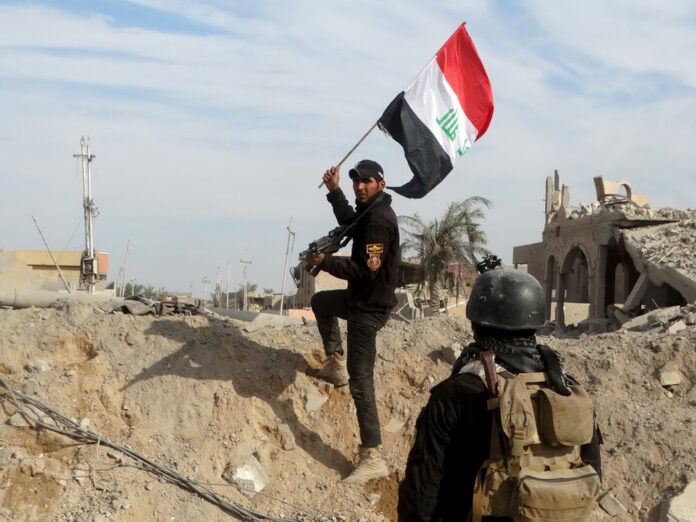
Instead of bringing democracy, removing Hussein and dismantling the Iraqi military created a massive power vacuum. Iran-backed Shiite militias and political parties quickly filled this void. Deep religious and ethnic divisions led to a bloody civil war between Sunnis, Shiites, and Kurds. This violence made national unity almost impossible.
The Iraqi Shiites, who make up the majority of the population, gained the most power through the new democratic process. Many of their leaders had lived in exile in Iran during Saddam’s rule and maintained close ties there. Iran saw a weak Iraq as a “buffer” against threats and a path to reach its allies in Syria and Lebanon. To secure this influence, Iran helped build and support several powerful groups.
The Badr Organization is one of the oldest groups and serves as the backbone of Iraq’s security forces. Led by Hadi al-Amiri, it is deeply embedded in the Ministry of Interior and the police. Another major group is Asa’ib Ahl al-Haq (AAH), led by Qais al-Khazali. This group fought U.S. forces before 2011 and now competes for high-ranking government positions.
Most of these groups fall under the Popular Mobilization Forces (PMF), or al-Hashd al-Shaabi. This state-sponsored umbrella organization includes about 67 different factions. While it formed in 2014 to fight ISIS, it now operates as a permanent part of the Iraqi military. The PMF reports to the Prime Minister but often acts on its own. It includes factions loyal to Iran’s Supreme Leader, some loyal to the Iraqi cleric al-Sistani, and others who follow Muqtada al-Sadr.
Today, Iran uses these sectarian ties and open borders to keep Iraq economically dependent. By doing this, they have strengthened their political and popular control over the country.
The Trap
The Saudi-Lebanese thinker Mohammed Ali Al-Husseini offers a different perspective on Iran’s influence. He believes that Iran’s move to control the region has actually become a “strategic trap.” While it looks like a victory, he argues that Iran’s expansion has created three major problems that make its position weak.
First, Iran is suffering from strategic exhaustion. Al-Husseini explains that Iran moved into territories and populations that do not belong to it. By expanding beyond its actual capacity, the country has stretched itself too thin. This overextension makes Iran an easy target and leaves it exposed.
Second, Iran benefited from a temporary American cover. In the past, the U.S. occasionally gave Iran silent permission to expand, especially during the era of Qassem Soleimani. Al-Husseini argues this was actually a lure. It encouraged Iran to take over vast areas that it simply cannot manage or protect in the long term.
Finally, Iran is struggling with a changing identity. The Iranian government tried to forcibly change the geography and demographics of Iraq to suit its needs. Al-Husseini argues that this has made Iran’s influence fragile. Because its power is built on forced changes rather than natural support, it could collapse during any major political or military shift.
The New Change
Al-Husseini believes Iraq is heading toward a “major positive change.” He predicts the country will soon restore its sovereignty and dismantle Iranian influence. He bases this optimistic vision on several key strategic shifts.
First, he asserts that the era of Iranian expansion has ended. According to Al-Husseini, “the Iranian thorn has been broken,” and this defeat will allow Iraqis to rebuild their country without foreign interference. He expects the pro-Iranian militias to face an inevitable end. He warns that upcoming regional conflicts will “consume” these groups, stripping Tehran of its primary tools of control on the ground.
Second, Al-Husseini looks to a comprehensive Iraqi national project. He believes national forces and respected figures will lead the transition from chaos to order. This includes religious authorities, tribal leaders from the al-Hakim and al-Sadr families, and political figures like Jamal al-Dhari.
Finally, he anticipates a shift from hegemony to development. Once the Iranian regime—which he blames for destroying Iraq, Syria, Lebanon, and Yemen—loses its grip, Iraq can enter a phase of reconstruction and sustainable growth. Al-Husseini recently shared a message of hope with the Iraqi people, telling them they are on the verge of “reviving Iraq.” He envisions the nation becoming one of the most beautiful and wealthiest countries in the world after years of suffering.
The Attacks on the Ground
Since the killing of Iranian Supreme Leader Ali Khamenei on February 28, 2026, Iraq has been in a state of high alert. A joint U.S.-Israeli strike targeted his headquarters in Tehran, sparking intense political and security tension across the region.
Iraq has faced several direct airstrikes from U.S. and Israeli forces. These attacks target border posts and facilities used by armed groups. On April 4, 2026, joint forces struck the Shalamcheh border crossing in Basra for the second time, forcing it to close.
At least 109 people reportedly have died in Iraq since this escalation began. Most of the victims were members of the PMF. The strikes specifically targeted their headquarters in areas like Jurf al-Sakhr and Erbil. In response, armed factions have moved about 1,000 fighters toward the Iranian border to tighten security in unstable areas.
When Khamenei’s death was confirmed, the Iraqi government declared three days of official mourning once across the country; people have held ceremonies and marches. In cities like Najaf and Basra, supporters displayed pictures of Khamenei and flew Iranian flags to honor him.
There was violence that sparked large protests across the country besides the mournings. In Baghdad, many faction supporters gathered near the Green Zone and tried to reach the U.S. Embassy to show their anger.
At the same time, the Sadr Movement organized massive demonstrations. On April 4, 2026, thousands of followers took to the streets in Baghdad and Basra to condemn the U.S. and Israeli attacks. These protesters demanded that all foreign forces leave Iraq immediately.
ISIS vs. Iran in Iraq
In early 2026, a new tension emerged as the U.S. began moving about 7,000 ISIS detainees from Syria into Iraq. The U.S. claimed this was necessary because the Kurdish-led forces in Syria were losing control to the new Syrian army. The move aimed to prevent mass escapes and ensure ISIS stayed defeated. However, the situation was already messy; about 1,500 prisoners had already escaped from a Syrian prison during the chaotic power shift.
Iraq’s Prime Minister, Mohammed Shia’ al-Sudani, authorized the transfer to protect national security. He coordinated directly with the U.S. and the new Syrian leadership. Iraqi officials were quick to clarify that these 5,000+ prisoners are there temporarily. Baghdad is using them as leverage to force European and Asian countries to finally take back their own citizens and put them on trial.
On the surface, the PMF supported the government. Their leader, Falih al-Fayyadh, agreed to keep the detainees in high-security prisons far from cities. The PMF even set up a triple-layered defense line at the Syrian border to stop any ISIS fighters from sneaking into Iraq. However, behind closed doors, many PMF commanders are furious. They called the transfer a “ticking time bomb” and a “major mistake,” fearing the U.S. is simply dumping a global problem into Iraq’s lap.
The Hidden Agenda
Many believe there is a deeper, more cynical game being played. Both ISIS (Sunni extremists) and the Iran-backed militias (Shiite extremists) use radical ideologies that often lead to the deaths of innocent people. It has been long claimed that the U.S. uses ISIS as a tool of “proxy warfare.” By keeping ISIS active in certain areas, the U.S. has a reason to keep its military in the region and forces Iranian-backed groups to focus on fighting insurgents rather than attacking U.S. interests.
The political landscape grew even more complicated when U.S. President Donald Trump claimed he played a role in Ahmed Al-Sharaa taking power in Syria. A point to not neglect that while Israel strikes Iranian targets as far away as Yemen and Iran itself, it rarely hits ISIS bases. Israel Prime Minister Benjamin Netanyahu didn’t use his usual labeling of terrorists on Al-Sharaa, only he said “we will see how that will behave.” Even as Israel seized parts of the Golan Heights to block Iran, the new Syrian leader, Al-Sharaa, remained quiet, stating only that he would not let his country get involved in the ongoing wars.
Different voices offer conflicting views on how these groups are managed. In 2014, Hillary Clinton noted in The Atlantic interview that a “vacuum” in Syria allowed ISIS to grow—a statement often used by critics to suggest the U.S. “unleashed” the group. Today, media figures like Tawfik Okasha argue that groups like ISIS are merely tools used by global powers to ignite the region when it suits their interests. The Egyptian analyst believes the fall of Iranian influence will begin with a “cleansing” of militias in Iraq.
Al-Husseini goes even further. He argues that ISIS, the Houthis, and the Iranian militias are essentially the same—all managed from “operations rooms” that serve different international interests at different times. Al-Husseini warns that Iraq is sliding toward a major confrontation before the big change. He believes Iran uses the “ghost of ISIS” to justify staying in Iraq, while Washington uses the ISIS prisoners to pressure Shiite factions. In this view, all these fighters—whether ISIS or militia—are simply pawns in a much larger political game where both will fight each other till they eradicate each other.