
By Mirna Fahmy
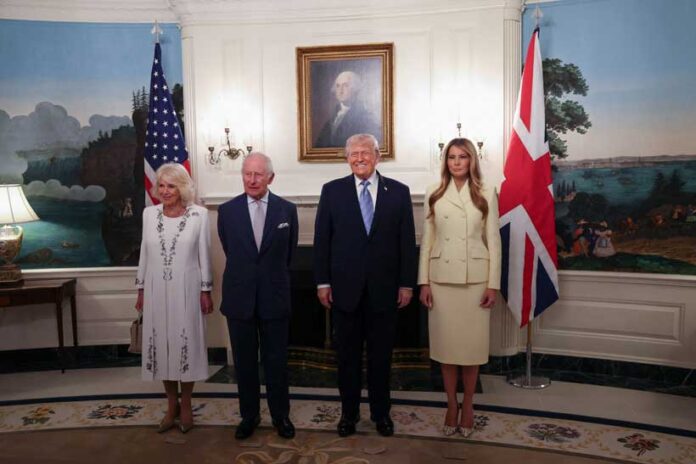
King Charles III and Queen Camilla visited the United States on April 27–30, 2026 for a four-day state visit to Washington and New York. The visit aimed to repair strained US-UK relations and mark the 250th anniversary of American independence from the United Kingdom’s ruling. It was the first visit by a British monarch in the 21st century since Queen Elizabeth II came to the US in 1991 and addressed Congress.
Both the British and American press framed the visit as an exercise in soft power. The goal was to patch up a relationship that had taken some serious hits mainly over the US-Israeli war with Iran and Trump’s repeated public criticism of Prime Minister Keir Starmer’s Labour government.
The tensions between the United States President Donald Trump and Starmer spiked primarily because of starkly different approaches to the 2026 war with Iran and harsh U.S. trade demands.
On the military front, Trump wanted the UK to fully commit to his military campaign, but Starmer resisted, leading to a public falling out. At the start of the conflict in late February 2026, Starmer refused to allow the U.S. to use British bases in Cyprus or Diego Garcia for offensive strikes on Iranian infrastructure. Trump complained this cost American forces crucial time.
Because of Iranian strikes that showered the UK bases in Cyprus, the UK eventually allowed limited “defensive” use of bases to intercept Iranian missiles. But Starmer maintained his stance that the UK would not be “dragged into” a wider war. WhenTrump demanded that the UK send warships and minehunters to help the U.S. and Israel break Iran’s blockade of the Strait of Hormuz, Starmer again resisted. He said that he preferred a “collective plan” with other allies rather than a “war of choice”.
Trump then used trade as a “weapon” to pressure the UK into compliance. To force the UK’s hand on Iran, Trump threatened to tear up the 2025 U.S.-UK trade deals and impose significant tariffs on British cars and steel. During private negotiations, Trump pressured the UK for trade concessions on bioethanol and pork in exchange for tariff reductions.
As all of Trump’s pushes went in vain, Trump went on social media and in interviews to take shots at Starmer directly. He said Starmer was “no Winston Churchill” and called Britain’s policies on immigration and energy “insane”. He also lamented that the UK, once, in his words, the “Rolls-Royce of allies,” had become a disappointment.
Trump’s Churchill comparison stirred up a relevant piece of history during World War II. Churchill faced a similar moment of pressure in 1940, not from a foreign enemy, but from within his own cabinet. Lord Halifax pushed him to consider peace talks through Italy, but Churchill refused. On May 28, 1940, he told the Outer Cabinet: “I have thought carefully in these last days whether it was part of my duty to consider entering into negotiations with That Man… if this long island story of ours is to end at last, let it end only when each one of us lies choking in his own blood upon the ground.”
For Churchill, any negotiation with Hitler was not diplomacy — it was a trap. He believed that engaging with the Nazi regime would only end in Britain becoming a slave state. He saw Adolf Hitler’s ideology as something that could not be reasoned with, only resisted.
This is the same logic that has been applied to the Mullah regime today. Like Nazi Germany, the Islamic Republic has made its ambitions clear — threatening the West, the US, and the broader Middle East, with particular pressure on the Arab world, all in pursuit of regional dominance under its own rule.
Churchill put his position plainly in several statements that have outlasted him. He warned that dictators, if left unchallenged, would wipe their enemies off the face of the earth. He described Nazism as a monstrous tyranny that surpassed anything in the dark record of human crime. And he drew a stark line between resistance and surrender: nations that go down fighting can rise again, but those that give in tamely are finished.
During World War II, the United States and the United Kingdom were the primary Western allies who fought against Hitler. Britain entered the war first declaring war on Germany in September 1939 after the invasion of Poland. The US came in later, in December 1941, after Japan bombed Pearl Harbor and Hitler declared war on America.
Before that, the US was not standing aside. Between 1940 and 1941, Roosevelt positioned America as what he called the “Arsenal of Democracy.” Through the Lend-Lease Act, the US shipped weapons, vessels, and food to Britain to help it survive the Battle of Britain keeping the UK in the fight before America officially joined it.
In August 1941, Roosevelt and Churchill met in secret and drafted the Atlantic Charter — a joint statement of what they were fighting for: a postwar world without tyranny. When the US entered the war, the two countries agreed to tackle Europe first and deal with the Pacific second. Defeating Nazi Germany was the priority.
From there, they fought together at every major front. In 1942, they launched Operation Torch in North Africa, then pushed into Sicily and Italy to knock Mussolini out of the war. In June 1944, American, British, and Canadian forces stormed the beaches of Normandy on D-Day and began the final push to liberate Western Europe. Throughout the war, the US Army Air Forces and the Royal Air Force ran a relentless joint bombing campaign against German industry and military infrastructure.
That partnership — what history came to call the Special Relationship — ended with victory in Europe on May 8, 1945.
The King’s speeches:
King Charles III delivered two historic speeches during his visit; one at the Congress and the other at the White House dinner party. Though the monarchy is not allowed to express their political stances publicly except only with the Prime Ministers, yet the kings’ speeches played a high diplomatic role with balanced high-level pageantry with subtle, firm reminders of British interests and shared values.
In the 30-minute address to Congress, the king’s speech was about reconciliation and renewal.
He opened carefully but with intent. Referring to the Magna Carta, Charles said it helped establish the idea that executive power should be limited by law — a principle that shaped both Britain’s system and the foundations of the United States. Many in the chamber understood it as a subtle reference to concerns about Trump’s use of executive authority. Signed in 1215 after rebellious barons forced King John to accept its terms at Runnymede, the Magna Carta placed limits on royal power and established the idea that even the monarch was subject to the law. Although it is not directly used as modern law in American courts, its principles strongly influenced the U.S. Constitution and Bill of Rights.
He then moved to NATO. Charles pointed to a specific moment in its history: the only time Article 5, NATO’s mutual defense clause, has ever been invoked was after September 11, when allies came to the defense of the United States. The reference was deliberate, reminding the chamber that the alliance has operated in practice, not just on paper. King Charles used the example to underline the importance of the UK–US relationship and the wider transatlantic alliance at a time when NATO was facing criticism from parts of the Trump administration over burden-sharing. He also tied the alliance directly to continued support for Ukraine, calling for unity and continued commitment among allies in the face of shared security threats.
The phrase “Middle East” appeared as part of a broader discussion about global instability, but it didn’t slip the King’s speech. The king used that section of the speech to point to the growing number of international crises facing Western allies. He referenced conflicts in both Europe and the Middle East as examples of the uncertainty shaping the current political moment. At the same time, he stressed the importance of unity between the UK and the U.S., framing the alliance as essential despite recent diplomatic tensions. Although the speech took place during a period of intense international focus on Iran, Charles did not mention the country directly.
He also knew when to ease the tension. Charles joked about the American Revolution as something that happened “just the other day,” and framed the relationship between Britain and America as a tale of two Georges — King George III and George Washington — two men on opposite sides of a war who gave birth to what became the closest alliance in modern history. The humor landed. But the message underneath it was serious: former enemies can become inseparable allies, and that bond is worth protecting.
The King used his 2026 address to Congress as well to explicitly reaffirm his Christian faith, describing it as a “firm anchor and daily inspiration”. This specific phrasing was widely seen as a calculated response to domestic criticism regarding his perceived “neglect” of Christian traditions in favor of interfaith outreach.
At the White House state dinner, King Charles III delivered his second speech characterized by a mix of lighthearted humor and a call for continued international unity.
He opened with a quip aimed directly at Trump. Earlier, Trump had remarked that Europeans would be speaking German if not for American intervention in the war. Charles shot back: “Dare I say that, if it wasn’t for us, you’d be speaking French.” The room got the joke even from Trump.
He then turned to the White House itself. Trump had been making headlines over a controversial ballroom renovation in the East Wing. Charles acknowledged the “readjustments” with a straight face, then reminded the room that Britain had made its own small attempt at real estate development on the property — back in 1814, when they burned it down. He also thanked Trump for the dinner, calling it a considerable improvement on the Boston Tea Party. And recalling that his mother Queen Elizabeth II had met thirteen sitting presidents over her lifetime, he paused and added: “Thankfully, all of them fully clothed.”
The gift came with its own punchline. Charles presented Trump with the original bell from HMS Trump — a Royal Navy submarine commissioned in 1944 that served in the Pacific during World War II. Handing it over, he told the President: “If you ever need to get hold of us… Well, just give us a ring.”
But the evening was not all laughs. Charles opened his remarks by addressing a recent shooting at the White House Correspondents’ Association dinner. He praised Trump’s courage and steadfastness in the aftermath and invoked the old British wartime phrase — Keep Calm and Carry On — as the right spirit for moments like that.
He then made the case for the alliance itself. Charles described the bond between Britain and America as woven from golden threads of history and heritage — unbreakable, and still essential to global security. He pushed back against the pull toward isolationism, urging both nations to resist the temptation to turn inward. With the United States approaching its 250th anniversary, he said, this was the moment to recommit — to each other, and to the people both countries serve.
Though the visit was a “personal triumph” for the King, its impact on actual policy was mixed. The only immediate gain for the UK economy is when President Trump announced the removal of tariffs on Scotch whisky as a gesture of goodwill.
Regarding Iran, nothing changed. Trump remained frustrated by Starmer’s refusal to back offensive operations, and the US responded by quietly putting a major planned tech partnership with the UK on ice. The fundamental disagreement was still there when Charles flew home.
What the visit did change was the temperature. Analysts noted that Charles managed to soften the tone of a relationship that had grown genuinely hostile. Trump has never hidden his admiration for the monarchy, and Charles used that deliberately. The prestige of the Crown did something that diplomatic back-channels couldn’t: it kept the special relationship functional even while the two governments were at each other’s throats.
The UK elections:
Elections are currently taking place across the UK as of May 7, 2026. This is a major set of regional and local contests, though it is not a nationwide general election. The early results show that Nigel Farage’s new Reform UK party made serious gains, winning control of several councils in England. Labour lost hundreds of council seats in its own heartlands that it has held for decades. And the Greens had their best local election performance to date, picking up seats across major cities.