
Why the world’s most quietly powerful diplomatic tool is coming to Johannesburg — and why it matters more than the mat
By Taynita Harilal
When the United Nations General Assembly declared 21 June as the International Day of Yoga on 11 December 2014, the resolution passed with extraordinary speed and the support of 177 co-sponsoring nations — a near-consensus rarely seen in that chamber on anything.
It would be easy to read that as geopolitical courtesy extended to India. It would also be wrong.
What the assembly recognised — even if it couldn’t fully articulate it at the time — was that yoga occupies a category of its own in the architecture of soft power. It is not a trade agreement. It is not a summit communiqué. It does not require translation in the diplomatic sense, because it precedes language. It asks only that you arrive, breathe and pay attention.
That is a rarer and more durable form of influence than most foreign ministries know how to manufacture.
Yoga doesn’t ask for your passport, your politics, or your pain to be tidy. That is precisely what makes it diplomatically extraordinary.
The mat as neutral ground
South Africa is not an easy country to gather in a single space. Its history — and its present — is characterised by fracture: racial, economic, geographic, generational. The social contract is under perpetual renegotiation. Trust between institutions and citizens is fragile.
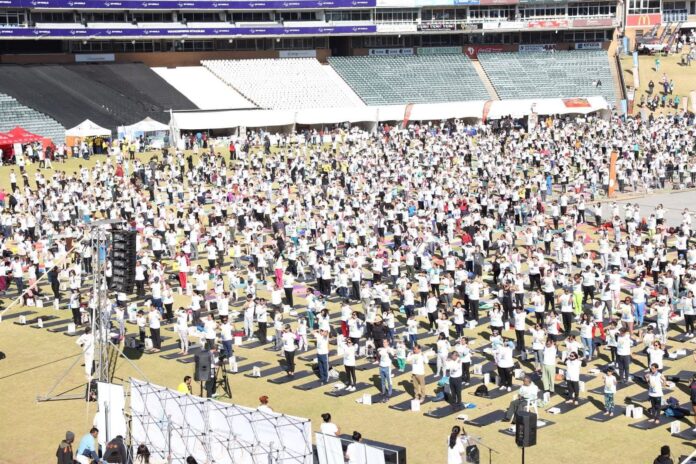
Against that backdrop, on Saturday 20 June 2026, thousands of South Africans from across Gauteng are expected to gather at Randburg Cricket Club for one of Africa’s largest International Day of Yoga celebrations. The event is free. It is open to everyone. No ticket, no membership, no qualifying identity.
It is led by the Consulate General of India in Johannesburg — but it does not feel, in its design or its spirit, like a country presenting itself. It feels like an invitation.
That distinction is everything in cultural diplomacy.
A new hand on the mat — and what it signals
The 2026 celebration arrives under the leadership of a new Consul General: HE Senkuttvan Korenthan, who takes up his position at a moment when the India–South Africa bilateral relationship is quietly deepening beyond its historical anchors of trade and the Indian diaspora.
In an exclusive comment to The Diplomatic Insider, Korenthan framed yoga not as cultural export — the language of soft power that can so easily curdle into condescension — but as shared inheritance:
“Yoga belongs to humanity. It transcends borders, cultures and languages, and reminds us that individual well-being and collective well-being are deeply connected. We invite all South Africans to join us in this celebration.”
— HE Senkuttvan Korenthan, Consul General of India, Johannesburg
The phrasing is careful and worth noting. “Belongs to humanity” is a diplomatic formulation that sidesteps the ownership question — one that has occasionally surfaced in international discourse about whether yoga’s globalisation represents cultural appreciation or appropriation. Korenthan’s framing resolves it by dissolving it: if it belongs to everyone, the question of who gave it becomes secondary to what it offers.
It is the kind of statement that is easy to mistake for platitude. Read more slowly, it is a considered positioning — one that opens the door for South Africans of every background, including the many who might feel that Indian cultural events are not quite meant for them.
Healthy Ageing — and why the theme lands differently here
This year’s official theme — Yoga for Healthy Ageing — arrives in a country where the public health burden of non-communicable disease falls disproportionately on communities least equipped to absorb it. Hypertension. Diabetes. Depression. These are not abstract statistics in South Africa; they are family histories.
Yoga, of course, is not a medical intervention. But the growing body of evidence on its effects — on stress hormones, on cardiovascular markers, on the nervous system’s capacity to regulate itself — has moved it from the wellness industry into legitimate clinical conversation. The theme of healthy ageing is not a soft angle. It is a public health argument.
That the Consulate has chosen to frame its flagship public event around this theme rather than, say, cultural heritage or national pride, reflects a sophisticated reading of what South Africa actually needs from an international partner right now.
Cultural diplomacy at its most effective is not about a country showing what it has. It is about a country understanding what the host needs — and offering it without conditions.
What Johannesburg has built over a decade
It would be a mistake to read this event as a single occasion. The Consulate General of India has been hosting International Day of Yoga celebrations in Johannesburg for over a decade, and the growth of the gathering has tracked something real — not diplomatic effort, but genuine public appetite.
Yoga has quietly entered the mainstream of South African wellness culture in ways that were not predictable fifteen years ago. It is practised in township community centres and Sandton gyms. It appears in corporate wellness programmes and school curriculums. It is recommended by GPs and physiotherapists who a decade ago would not have mentioned it in a clinical setting.
The International Day of Yoga celebration in Johannesburg has both reflected and accelerated this shift. That is the kind of cultural diplomacy that does not announce itself in press releases — it simply becomes part of the landscape.
A floor we are willing to sit on together
There is a line that has stayed with me from a conversation about this event: that what yoga offers, in a fractured society, is not agreement but proximity. You do not have to share a politics, a faith, or a history with the person on the mat beside you. You share breath, attention and the temporary humility of being a body that is trying.
In diplomatic terms, that is not a small thing. Some of the most durable bilateral relationships in history were built not in negotiating chambers but in shared physical or cultural experience — the kind that bypasses the rational defences people bring to formal encounters.
Saturday, 20 June 2026 at Randburg Cricket Club will not resolve anything geopolitical. It will not produce a joint communiqué. But it will, if the last decade is any guide, do something that formal diplomacy rarely manages: it will leave thousands of people feeling, briefly and genuinely, that they belong to something larger than their own corner of a complicated country.
That is not nothing. In 2026, that might be everything.
EVENT INFORMATION
International Day of Yoga 2026 | Saturday, 20 June 2026
Venue: Randburg Cricket Club, Johannesburg | From 09:30 | Free entry | Open to all
Register: Click here
About the author: Taynita Harilal is a podcaster and currently defending her PhD at Wits Business School. She is a passionate Pan Africanist with a lens focussed on Entrepreneurship in building models for scale and economic empowerment.