
By Mirna Fahmy
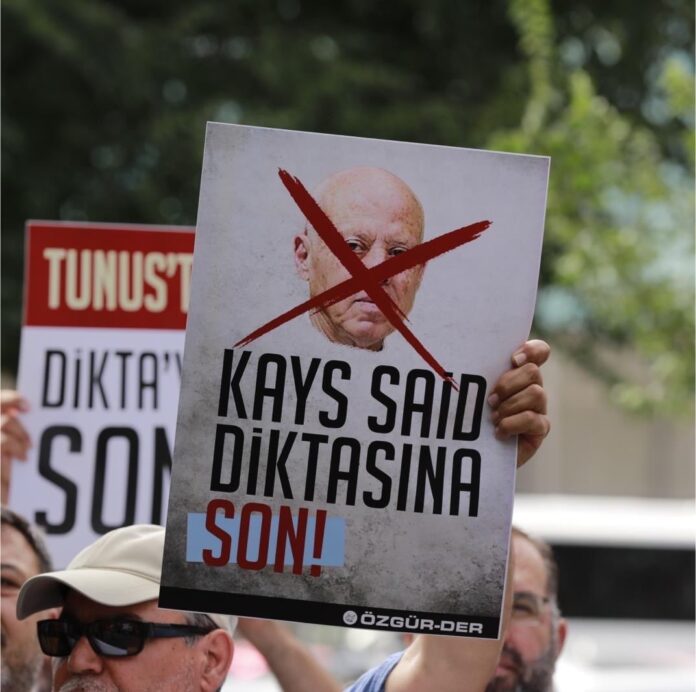
Coinciding with the 69th anniversary of the proclamation of the Republic and the fifth anniversary of the exceptional measures taken by President Kais Saied, protests bombed out in Tunisia on Saturday July 25, 2026.
The demonstrations were fueled by mounting public frustration on the disruption of basic services such as the electricity and water during a historic heatwave in which temperatures exceeded 50°C.
Throughout the heatwave, Tunisia experienced frequent and prolonged power and drinking water outages. In response to the surge in electricity demand driven by widespread air conditioning use, the Tunisian Electricity and Gas Company (STEG) implemented a policy of “rolling blackouts” to ease pressure on an overstretched national grid driving many to shelter in the streets seeking some air to breathe.
Rather than calming the situation, these scheduled outages intensified public anger, as they disrupted daily life and inflicted financial losses on small businesses, including bakeries, pharmacies, and grocery stores, where perishable goods spoiled due to the lack of refrigeration.
The electricity cuts also had severe public health consequences. Hospitals struggled to cope with the combined effects of extreme heat and unreliable power supplies while treating growing numbers of patients suffering from chronic respiratory conditions and heat-related illnesses. According to medical reports, power outages caused ventilators to fail for some patients, resulting in fatalities and transforming the heatwave from an environmental emergency into a national public health crisis.
It has been noted that the reason for the crisis of the structural energy stems from Tunisia’s energy dependence on Algerian gas (approximately 62%), the limited number of renewable energy projects, and the absence of long-term strategies to reform the dilapidated infrastructure.
Protesters expressed their disappointment that promises to improve conditions had not been fulfilled since then, especially the deteriorating living and economic conditions; against rising prices, shortages of basic goods, and declining purchasing power.
On July 25, 2021, Tunisian President Kais Saied invoked Article 80 of the 2014 Constitution to implement sweeping exceptional measures that fundamentally reshaped the country’s political landscape. He dismissed Prime Minister Hichem Mechichi, suspended the powers of the already frozen parliament, lifted parliamentary immunity for all legislators, and assumed full executive authority, including control over the public prosecution. These measures marked a decisive concentration of power in the presidency and have remained one of the most contentious developments in Tunisia’s post-2011 democratic transition.
Saied’s political discourse has frequently been characterized by the Tunisian opposition as populist. His speeches consistently emphasize themes such as restoring the values and principles of the Republic, reclaiming the will of the people, and dismantling what he describes as the corrupt “old system.” He portrays himself as the defender of the popular will against entrenched political elites, framing his actions as necessary to overcome institutional paralysis and corruption.
At the same time, Saied’s presidency has drawn criticism from opposition parties, domestic civil society organizations, and international human rights groups. Critics argue that his consolidation of executive authority has undermined democratic institutions and contributed to deterioration in political rights and civil liberties. During his tenure, numerous political opponents, journalists, lawyers, and activists have been arrested and prosecuted on charges ranging from insulting the president to terrorism, prompting concerns over restrictions on freedom of expression, judicial independence, and political pluralism.
Born in 1958, Saied is a former professor of constitutional law at the University of Tunis and has published extensively on legal and linguistic issues. Prior to entering politics, he cultivated an image as an independent constitutional scholar with no affiliation to Tunisia’s established political parties. His political vision centers on replacing the traditional party system with a model of decentralized governance based on elected local councils and grassroots participation. Ideologically, Saied combines social conservatism with a strong emphasis on Tunisia’s Arab-Islamic identity, while expressing skepticism toward certain individual rights championed by secular and modernist movements.
His foreign policy emphasis on national sovereignty, opposition to foreign intervention, and anti-imperialism, accompanied by a firm rejection of normalization with Israel and consistent support for the Palestinian cause. More broadly, his interpretation of constitutional authority reflects his belief that the president embodies the authentic will of the people, a view that underpins his efforts to challenge established party politics and restructure Tunisia’s political system.
Between 2011 and 2019
Following the 2011 Revolution, widely known as part of the Arab Spring, Tunisia entered a period of democratic transition. The uprising sought to end authoritarian rule and establish a democratic political system in which citizens could freely elect their leaders. Between 2011 and 2019, Tunisia made political progress by adopting democratic institutions and protecting political freedoms. However, this transition was also marked by serious economic and security challenges that gradually led to widespread public disappointment.
One of the main challenges was political instability. During this period, Tunisia had nine different governments in just ten years, with almost one government taking office every year. Although the country avoided military coups and preserved its democratic institutions, coalition governments particularly between Ennahda and Nidaa Tounes often struggled to reach agreements. As a result, important economic reforms were delayed, and policymaking became increasingly ineffective.
In parallel, Tunisia’s economy experienced a prolonged decline. The tourism sector, a major source of national income, was severely affected by the terrorist attacks of 2015. Phosphate and oil production also fell by an estimated 30–50%, reducing government revenues. Public debt increased sharply from 40% of GDP in 2010 to 73% in 2018, while the Tunisian dinar lost approximately one-third of its value against the U.S. dollar after 2014. Unemployment remained persistently high, peaking at 19% in 2012 before stabilizing at around 15%, with young people and women facing particularly high levels of joblessness. Regional inequalities also became more pronounced, as nearly two-thirds of Tunisia’s poor lived in the country’s interior regions, where infrastructure and public services remained significantly underdeveloped compared with the coastal areas.
Security was another major concern during the democratic transition. Between 2011 and 2018, Tunisia experienced terrorist attacks and political assassinations that undermined tourism, discouraged foreign investment, and weakened public confidence. Although the government later strengthened the military and police under democratic oversight, and terrorist activity gradually declined, these efforts imposed considerable financial costs on the state.
Corruption and the informal economy also expanded during this period. Many Tunisians believed that corruption and clientelism had become increasingly common among the new political elite. At the same time, informal economic activities, including smuggling, were estimated to account for between 30% and 40% of GDP by 2018.
These political, economic, and security challenges contributed to growing public dissatisfaction with Tunisia’s democratic transition. By 2016, opinion polls showed that Tunisians had among the lowest levels of trust in their government and political parties in the region. This disillusionment culminated in the 2019 elections, when many voters rejected the traditional political parties and elected Kais Saied as president.
Libya:
The situation in Libya can almost be described as a “copy-paste” of Tunisia’s recent experience. Libya is currently facing a severe electricity and public service crisis that has triggered widespread protests and civil disobedience, particularly in the capital, Tripoli.
The demonstrations were initially driven by public frustration over recurring power outages and the deterioration of essential services. However, the movement quickly expanded beyond socioeconomic grievances to include broader political demands.
As the protests intensified, demonstrators began calling for the resignation of the Government of National Unity (GNU) led by Abdulhamid Dbeibeh. Some protest groups, including the “Youth of Tajoura,” declared that their campaign would continue until both the eastern- and western-based governments were removed, reflecting growing dissatisfaction with Libya’s prolonged political division.
The protests have also been accompanied by a campaign of civil disobedience across several areas, including Tajoura, Souq al-Juma’a, and Zawiya. As part of these actions, protesters forced the closure of several key state institutions, including branches of the Central Bank of Libya and the headquarters of the telecommunications companies Libyana and Al-Madar. Demonstrators also disrupted traffic by blocking major roads with burning tires and obstructed access to the Ministry of Foreign Affairs by piling large mounds of dirt at its entrance.
There are reports that say that an armed group aligned with the Government of National Unity opened fire on protesters gathered in the Janzour district. In response to the escalating tensions, government security forces warned that any attempts to attack public institutions or endanger public safety would be met with firm measures.
Memories
Tunisia was the first country where the protests that ignited the Arab Spring began. The movement started on December 17, 2010, when Mohamed Bouazizi, a street vendor in the town of Sidi Bouzid, set himself on fire in protest against police harassment, corruption, and the confiscation of his fruit cart. His act sparked widespread demonstrations that rapidly spread across the country, culminating in the Jasmine Revolution and the ousting of President Zine El Abidine Ben Ali on January 14, 2011. Tunisia’s success inspired people across the Arab world to challenge their own governments. Within weeks, large-scale anti-government protests erupted in Egypt, Libya, Yemen, Syria, and Bahrain, giving rise to what later became known internationally as the Arab Spring.
The term Arab Spring is widely associated with political scientist Marc Lynch, who used it in a Foreign Policy article published on January 6, 2011. Western media quickly adopted the phrase, drawing parallels with the Prague Spring of 1968, which itself echoed the “Springtime of Nations” that swept across Europe in 1848. In the region, however, people on the ground rarely used the term Arab Spring. Instead, they spoke of the thawra (revolution) or the intifada (uprising), emphasizing demands for karama (dignity), social justice, and political freedom.
Over time, many scholars and commentators from the Middle East grew critical of the expression Arab Spring. For many, the word spring suggested a positive democratic transformation that never fully materialized. Instead, several countries descended into civil war, political fragmentation, economic collapse, or renewed authoritarianism. In some cases, the governments that emerged after the uprisings were viewed by their critics as equally authoritarian—or even more repressive—than those they had replaced. The consequences of these developments continue to shape the social, political, and economic lives of millions across the region.
Tunisia was the first tremor that set off a wave of uprisings across the Middle East in 2011. Fifteen years later, the region once again appears to be entering a period of heightened uncertainty. As conflict involving Iran continues and pressure mounts on the country’s leadership and the Islamic Revolutionary Guard Corps (IRGC), there is an argument that the weakening of the Iranian regime could reshape the regional balance of power. Given Iran’s influence over a number of allied governments and armed groups across the Middle East, any major political transformation in Tehran could have consequences that extend far beyond its borders. Whether the region is witnessing the early signs of another period of political upheaval remains uncertain, but the parallels with the atmosphere that preceded the 2011 uprisings have become increasingly difficult to ignore.