
By Lesedi Sibiya-Diplomatic Insider
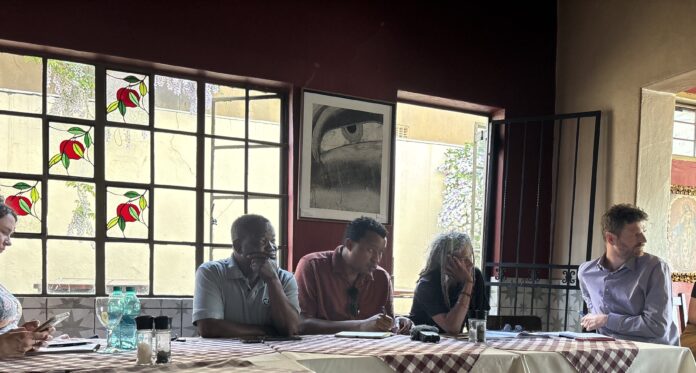
As the sentiment surrounding anti-immigration continues to grow in South Africa, tensions continue to arise all the same. The Foreign Correspondents Association of Southern Africa (FCASA) hosted a panel discussion at Picobella restaurant in Melville, Johannesburg surrounding the ever growing crisis of Xenophobia in the South African context.
The panel was led by Sharon Ekambaram who serves as the, Lawyers for Human Rights head of refugee and migrant rights, Kudawashe Vanyoro who serves as Wits Anthropologist who focuses specifically within migration studies, xenophobia and refugee reception and Larry Hodes, CEO of Grow Franchising.
The discussion focused on the different outlooks in which xenophobia has affected African foreign nationals. The main consensus was based on the fact that the human rights of the foreign nationals that were intimidated by vigilante groups such as the anti-immigrant movement, March and March and Operation Dudula, have been compromised and to a large extent violated.
These vigilante groups and vigilantism in South Africa have carried out violent xenophobic attacks as they have targeted African and Asian foreign nationals in recent months which has often been met with insufficient response by relevant authorities or the police.
Ever since April, the most notable citizen led movement, March and March, have advocated for a more stringent immigration enforcement in South Africa by organising demonstrations against undocumented migrants in prominent metros such as Pretoria, Johannesburg and Durban which has caused violent and in some cases fatal results.
There have been sporadic waves of xenophobic attacks surging from 2015 all through 2019 which were mainly targeted at Nigerian foreign nationals and then again in 2021 and 2022 saw the rise of vigilante groups such as Operation Dudula.
Since 2024, the socio-economic discrepancies continued to deteriorate including the rise of unemployment with the rate sitting at 43%, had a correlation with the rise of anti-immigration activism and saw the birth of new vigilante groups such as March and March.
Since April 2026, these groups have shown intense instances of scape-goating foreign nationals as the cause of the economic hardships of South Africa, poor service delivery, and high rates of crime even though there are studies that have disputed these claims.
“All of these frustrations get ventilated in particular moments in time. I suppose what’s different and what’s fascinating in intriguing ways, is how this is now kind of turned into these movements that have some kind of legitimacy. I suppose in our reading what should actually intrigue us more or be of interest is why this is now taking this kind of morphology,” said Kudawashe Vanyoro in the panel discussion.
“Who is funding this? I think if you follow the money and all of that you kind of might get a sense and I know there are journalists who already started doing that and you sort of link it to some of the global economic inequality of the global geopolitics,” Vanyoro continued to explain.
On June 30 the movement, March and March, held a protest urging the government that all undocumented foreign nationals must vacate the country by the date of June 30. There were several reports of affected communities engaging in acts of intimidation through harassment, verbal threats and demands that individuals must produce identification documents and provide proof of their immigration status in the country.
“We have about 82,000 recognised refugees in our country. We have 180,000 asylum seekers. People who have come from the DRC, from Somalia, countries where it’s acknowledged by the UN (United Nations), these are countries where there’s serious conflict and refugee sending countries,” said Sharon Ekambaram.
“I think that our engagement with the Department of Justice there is definitely political will. If there’s engagement around the issue of migration, or people, and you don’t get the kind of institutionalised xenophobia that you do experience with the department of home affairs,” Ekambaram said further.
“I think that is where now you see foreigners finding themselves in groups but also the threat of having their deadline to say, what do I do? Because I can easily be identified as a foreigner,” said