
In the complex landscape of national security and economic stability, the concept of strategic reserves emerges as a pillar of resilience and preparedness in the face of uncertainty. Diving into the realm of strategic reserves, one discovers a strategic arsenal ready to guard against unforeseen disruptions and volatility, embodying prudence and foresight.
In the recent years, the Kingdom of Morocco has been exposed to a number of natural disasters, the most important of which was the Al-Hawz earthquake, which inflicted heavy human and material losses on the State.
Thus, the Moroccan King gives his high orders that each region of the Kingdom will be provided with a large platform of essential reserves (tents, blankets, beds, medicines, foodstuffs, etc.) in order to respond immediately to disasters (floods, earthquakes, chemical, industrial or radiological hazards).
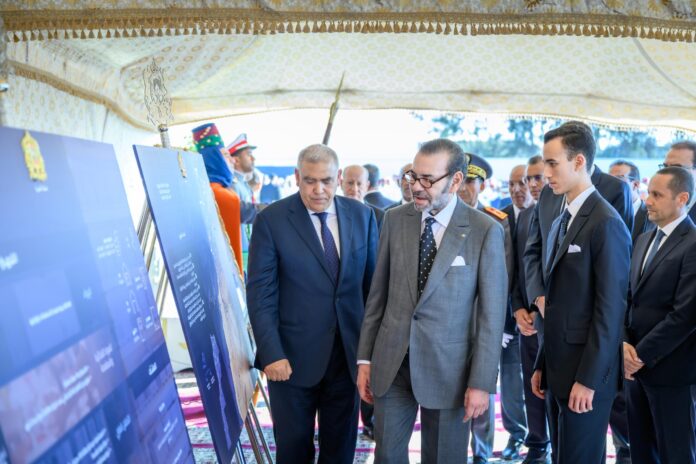
As an acting matter, Morocco’s King Mohammed VI, accompanied by Crown Prince El Hassan, launched on Wednesday, 7thMay 2025 in the Salé prefecture, the construction of the Rabat-Salé-Kenitra region’s essential reserves platform, an embodiment of the Moroccan model of resilience and swift deployment of disaster relief.
The Rabat-Salé-Kenitra region’s essential reserves platform will be built on a 20-hectare site within 12 months, with a total estimated budget of MAD 287.5 million. The project will mainly include the construction of four warehouses (5,000 m² each), two shelters for oversized equipment (2,500 m² each), a helipad and parking lots.
For the six regions of Casablanca-Settat, Rabat-Salé-Kenitra, Marrakech-Safi, Fez-Meknes, Tanger-Tetouan-Al Hoceima and Souss-Massa, the platforms will comprise four warehouses, each with a total surface area of 20,000 m². Platforms in the other six regions — Eastern region, Beni Mellal-Khenifra, Draa-Tafilalet, Guelmim-Oued Noun, Laayoune-Sakia El Hamra and Dakhla-Oued Ed Dahab — will include two warehouses, each with a total surface area of 10,000 m².
The implementation of these platforms will help to develop national emergency infrastructure, improve the overall crisis response system, ensure greater speed in delivering relief and aid to disaster victims, and strengthen Morocco’s resilience against different types of crises.