
Mthobeli Jiwulane
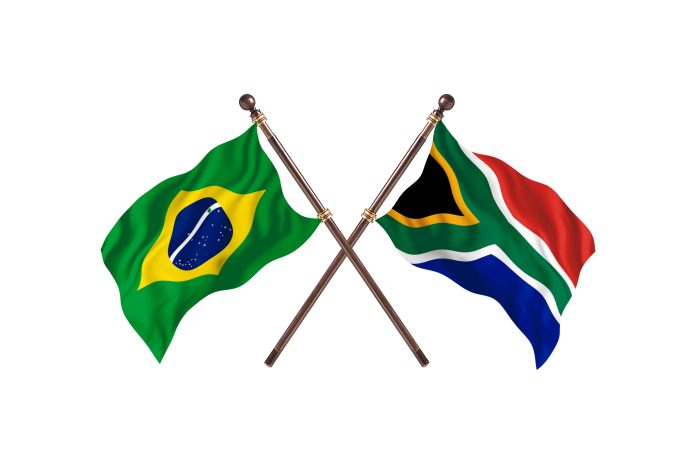
Whether Brazil is headed by left-wing or right wing leader, relationship between Brazil and South Africa is bound to remain sound – it seems solidarity matters more than ideology in their friendship.
Without any shadow of doubt, with President-elect Luiz Inacio Lula da Silva back in power soon in Brazil, their relationship is set to continue to blossom. The outgoing President Jair Bolsonaro would remain head of state until January 2023 when he would be handing over to the returning Lula.
An expert believes the two countries were always brought together by a common purpose of working class solidarity, developmental needs and progressive internationalism between them especially under Lula.
Prof Jo-Ansie van Wyk, professor in international politics at the University of South Africa’s Department of Political Sciences, told Diplomatic Inside that Brazil remained active on BRICS even under outgoing incumbent Bolsonaro. “This was strange in that Bolsonaro was more conservative of the lot and that always did not resonate with other BRICs members. Russia and China are also conservative in their own ways as well but Brazil’ foreign policy has not been as confident during the Bolsonaro years as it had been during the Lula years.”
“However, the significance of that is that (under Lula) Brazil is back with its strong climate change policy, its climate change agenda with its solidary given the political ideology of Bolsonaro,” she said.
Lula, who is world renowned champion of anti-climate change approach in the world and defender of indigenous people’s land rights in Brazil, urged the United Nations at the recent UN Climate Change Conference (COP27) to organise the 2025 Conference at the Amazon. He promised to ensure the venue would be at Amazon Forests and to reverse the massive deforestation that occurred under his predecessor. The incoming president received a heroic welcome by crowds at COP27 held at Sharm el-Sheikh in Egypt.
The expert highlighted the special relations between Brazil and South Africa were due to the fact that the two countries shared identities – racial politics, social cohesion issues in terms of race and that a large number of Brazilian population had African origin. Additionally Brazil’s position resonated well with South African anti-colonialism stance and that created good foundation for solidarity politics between them.
The India-Brazil-South Africa (IBSA) dialogue forum was the source of the initial strengthening of their foreign policies towards each other even before the advent of BRICS. The establishment of BRICS catapulted their relationship to a higher level accompanied by their developmental agenda that coincided.
There were massive investments in Africa by Brazil reminiscent of its African heritage and South Africa being a nation with huge potential and interest in climate change matters attracted Brazil’s attention as a leader on that score.
“The investment of Brazil in the Green Economy, which as you know is very high on the agenda of President Ramaphosa is an area of commonality. The reason this was not visited was due to the fact that the Bolsonaro government was a right wing government and the ideological relations had not been of a converging nature,” Van Wyk said.
There is high likelihood of convergence between the two countries when Lula would officially assume office early next year. Several governments in Brazil except Bolsonaro had taken a left turn in their politics and entire Latin and South America tended to lean to the left which bode well for South-South relations in that it would be governments that were developmental focused and keen to focus on non-Western side of politics. “There may be a greater coalition then from Latin America, from the Global South that is then changing the voting patterns once the new year starts which is then more converging with South Africa,” Van Wyk said.
South Africa’s Department of International Relations and Cooperation (DIRCO) described the relations between Brazil and South Africa as having “blossomed”. “South Africa continues to enjoy cordial relations with Brazil premised on the principles of solidarity and development cooperation. Since 1994, there had been a number of high level interactions between South Africa and Brazil. The year 2020 marked the anniversary of a “Declaration on the Establishment of a Strategic Partnership between the Federative Republic of Brazil and the Republic of South Africa.”
“South Africa remains commitment to strengthening relations with Brazil. Furthermore, South Africa considers Brazil as an important partner which features in achieving South-South cooperation,” DIRCO statement posted on its website, said.
According to Van Wyk it wouldn’t be easy for South Africa to continue where it left off in its relations with Brazil because Lula was older now, South Africa had a new president and there were different economic and global situations that would continue to run. The two nations were also confronted by different domestic developmental challenges that may take longer to address.
Van Wyk said: “There is an expectation that we can resume given the ideological convergence between these states. Lula has been very active on the continent especially on climate change and green technologies. They have made quite significant footprint for themselves and the expectation is that it is likely to continue.
Relations between South Africa and Brazil became more focus post-1994 when South African gained its majority rule and freedom. International icon and freedom fighter Nelson Mandela and his African National Congress took relationship with Brazil very seriously and all South African democratic presidents prioritised Brazil above all other countries.
This was proven by the fact that within a year after his release from jail and before he became the first black President of South Africa, Mandela paid a special visit to Brazil in 1991 and again in 1998 after he assumed office. This was followed by a tour of the country by his successor, Thabo Mbeki in 2000, a year after taking over.
Former President Jacob Zuma, a close friend and political ally of President Lula, visited the country three times – first within months of his inauguration 2009, again a year later in 2010 and in 2014. President Cyril Ramaphosa on different occasions met in 2019 with Bolsonaro on the side-lines of the World Economic Forum at Davos, Switzerland, G20 in Osaka Japan and in Brasilia in Brazil.
This is besides the Ministerial level interactions. DIRCO Minister Dr Naledi Pandor and her then Brazilian counterpart Ernesto Araujo met in July, 2019, in Rio, on the sidelines of BRICS and other forums. The two Ministers also held a teleconference in December, 2020.
In return, almost all the Brazilian heads of state had made high level visits to South Africa at different times.
Their diplomatic and trade links had multiplied in strength and magnitude since Brazil and South Africa established diplomatic relations in 1948, the year the National Party came to power in South Africa. This was followed by the establishments of the South African Legation in Rio de Janeiro and Brazilian Legation in Pretoria in the same year which later became a Representative Office. A fully fledged South African Embassy was established in Rio de Janeiro in 1971 before it was downgraded again to be headed by a charge de affair in 1974 in protest against its apartheid policies.
Brazil imposed sanctions against South Africa in 1985 via a decree in reputation of the apartheid system and only first partially lifted those at Mandela’s request, a year after his visit to Brazil. But at the dawn of freedom and democracy in South Africa in 1994 Brazil totally lifted the sanctions imposed in terms of its Decree No. 91.524/85.
According to the South Africa’s Department of Trade Industry and Competition during the last 25 years up to 2020, the export and imports between the two countries had doubled and tripled respectively. But the figures on the DTIC website appeared to be unrevised and not reconciled because from the Brazil’s side the trade numbers were even higher.
South Africa’s main products exported to Brazil were platinum, pesticides and raw aluminium while its imports from Brazil were poultry meat, crude petroleum and tractors.
Due to the warm relations between the two countries, ordinary South African passport holders needed no visas to visit Brazil for up to 90 days. But DIRCO always warned its citizens visiting not to get involved in illegal activities when in foreign countries as their right were not protected by South African laws and constitution and the country could not help to have them released from foreign jails.
Frequently South African individuals got arrested as drug couriers for unscrupulous drug dealers who used them to traffic the stuff from South America especially Brazil and east Asian countries like Indonesia and Thailand.
Van Wyk was optimistic about further strengthening of relations between Brazil and South Africa in the near future. She said Cold War era military governments in South America that maintained stronger ties with the apartheid white regime in South Africa lost their popularity with the end of the Cold War in the late 80s. Subsequently there emerged in the region particularly in Brazil and South Africa leaders who were able to restore liberation relations that they shared variously in their anti-apartheid solidarity efforts.
As a result Brazil or many of its citizens of African descent became natural allies for South Africa after 1994.
“I have high expectations that South Africa will rekindle the Lula relations and off course it also depends on where Lula will position himself in this case. There are many convergences between the two countries – crime, corruption, developmental challenges. Also these countries are serious players in their regions as well as significant international players within BRICS, within IBSA as well as within UN,” Van Wyk said.