
By Mirna Fahmy
In late July 2025, protests erupted outside Egyptian embassies in more than 16 countries, from London to Jakarta. The demonstrators, galvanized by the deepening humanitarian crisis in Gaza and the closure of the Rafah crossing, carried banners demanding that Egypt open the border and break the blockade. They accused Cairo of “participating in the starvation of Gaza.”
The protests began with a dramatic act: Egyptian activist Anas Habib used an iron chain to block the entrance to the Egyptian embassy in The Hague, Netherlands. The idea quickly spread, and similar events were organized worldwide.
However, a fundamental contradiction lies at the heart of these demonstrations. While protesters targeted Egyptian missions, official reports confirm that Israel, not Egypt, imposed a complete closure on all crossings into Gaza on March 2, 2025, preventing any humanitarian supplies from entering.
“There are over 5 crossings to Gaza and the two Egyptian ones; Rafah crossing and Karm Abu Salem from our side are always open,” said Egyptian President Abdel Fattah El-Sisi in a televised address. “From day one, we never stopped sending aid to Gaza and the other side (referring to Israel) is intercepting the aid to enter.”
This position is supported by Egypt’s official statement to the United Nations (UN), which clarified that Israel receives and controls all aid entering from the Egyptian side. Data from the UN, the Red Cross, and organizations like Doctors Without Borders further confirm that Israel is enforcing strict restrictions, leading to international criticism and accusations of using starvation as a weapon of war.
This raises a critical question: If the international community, relief organizations, and Egypt itself agree that Israel is responsible for the blockade, why are the protests targeting Egyptian embassies and not Israeli ones?
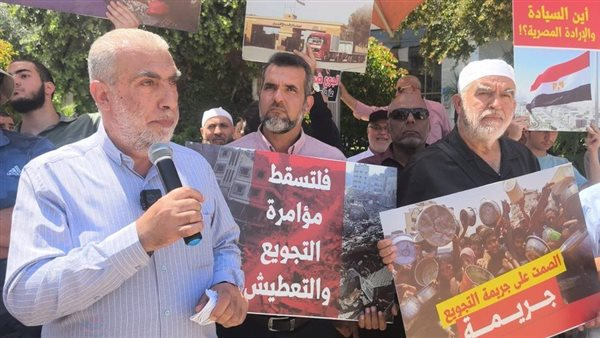
The answer, it seems, lies in a singular protest that shook the media: the demonstration outside the Egyptian embassy in Tel Aviv.
This protest was not a spontaneous event. It was led by Sheikh Raed Salah and Kamal al-Khatib, leaders of the Islamic Movement in Israel and a local branch of the Muslim Brotherhood. The demonstration, attended mostly by Palestinian citizens of Israel known as “Arabs of 1948”, was held with the permission of Israeli authorities. In a striking detail, protesters waved Israeli flags, not Palestinian ones, in compliance with security directives.
The protest in Tel Aviv exposed a stunning contradiction. For months, Israeli media and official spokespeople in Arabic language Avichay Adrae and Captain Ella, had branded Hamas as a terrorist group and part of the Muslim Brotherhood. Yet, there were leaders of the Muslim Brotherhood openly protesting in Israel, with the state’s blessing, against Egypt.
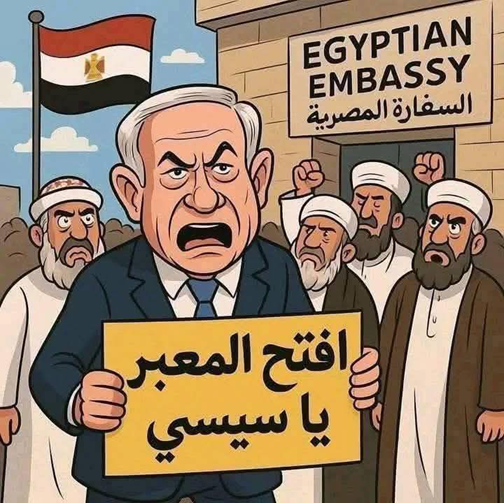
For Egypt, the message was clear. Local media outlets like El Dostoor and El Watan depicted Israeli Prime Minister Benjamin Netanyahu as the “The New Supreme Guide of the Muslim Brotherhood,” orchestrating the protests to pressure Cairo. Their analysis was that the protests serve a specific Israeli agenda: to force Egypt to accept the mass displacement of Palestinians from Gaza, a move Egypt has consistently opposed as it would destroy any hope for a two-state solution. Even prominent Israeli journalist Edy Cohen took to his X account to call on Egyptians to open the border for Palestinians, a sentiment that aligns with this pressure campaign.
Previous records and collaborations:
Since the October 7 attack and Israel’s war with all Iran proxies in Southern Lebanon, Syria, Iraq, Gaza, and Yemen, which are also part of the Muslim Brotherhood branches, Israel has been labelled by its supporters as fighting against terrorism on behalf of the entire Middle East. However, what has been observed regarding these demonstrations in front of the Egyptian embassy in Tel Aviv provides a completely different narrative. According to historical accounts and political analysts, Israel has a long history of using the Brotherhood to advance its strategic goals.
During the 1970s, Israel provided support to Muslim Brotherhood leader Ahmed Yassin in the Gaza Strip to weaken the secular nationalist Palestine Liberation Organization (PLO). Later, in the 2010s and 2020s, Israeli officials encouraged Qatar to provide aid to Hamas. Former Israeli Prime Minister Ehud Barak revealed on Der Spiegel TV show in October 2023, that this was part of a deliberate strategy. “As long as Hamas existed, Netanyahu could claim that it was impossible to negotiate with the Palestinians,” Barak said, adding that Netanyahu actively weakened the more moderate Palestinian Authority to block any progress toward a Palestinian state.
A major investigation by The New York Times goes even further, detailing how Netanyahu has deliberately prolonged the war in Gaza for political survival. The report, based on over 110 interviews and internal documents, explains that Israel’s powerful intelligence system and advanced military capabilities should have ended the war against Hamas in less than a year. Instead, Netanyahu’s actions have continuously extended the conflict.
The investigation alleges that Netanyahu’s actions were driven by his personal political agenda. In April 2024, a credible ceasefire plan was being discussed that would have brought a six-week pause in fighting, secured the release of over 30 hostages, and opened the door to deeper negotiations with Hamas and peace talks with Saudi Arabia. However, Netanyahu deliberately concealed this plan from his cabinet ministers to prevent organized opposition. He ultimately shelved it after his far-right coalition partners, notably Finance Minister Bezalel Smotrich and National Security Minister Itamar Ben Gvir, threatened to collapse his government if he proceeded.
The investigation further accuses Netanyahu’s team of ordering changes to official records of war cabinet meetings and phone calls during the October 7 crisis to shift blame onto military and intelligence chiefs. This, along with his push for a controversial judicial reform package—which Barak described as a “judicial coup” to save Netanyahu from his indictments—highlights a pattern of prioritizing his personal and political survival over the security of the state. As Barak stated, this judicial reform “tore the country apart” and led to warnings from defense and intelligence chiefs that it weakened Israel’s security.
This strategic prolonging of the war, as detailed by the investigation, even strained Netanyahu’s relationship with U.S. President Donald Trump, who was reportedly unhappy with Netanyahu’s second visit to the White House and treated him with a noticeable coolness compared to their previous meeting.
The Vision for Greater Israel:
The ongoing events of today, as American Political Scientist John Mearsheimer has argued, is part of a larger vision called Greater Israel. As he explained on the Tucker Carlson TV show, Israel’s foreign policy is driven by a desire to keep its neighbors weak. For Syria and Lebanon, this means seeking their fracture. For Iran, it means encouraging its nuclear ambitions to create a pretext for a military strike that would “break the country apart and make it like Syria.” When it comes to Jordan and Egypt, Mearsheimer notes, the strategy is different: make them economically dependent on the United States, thereby ensuring their acquiescence.
Mearsheimer strengthens his argument by noting that the Zionist dream from the beginning was a “Greater Israel.” He cites David Ben-Gurion, the primary national founder and first prime minister of the State of Israel, who wrote in 1918 about this vision, which includes not only Gaza and the West Bank but also parts of the East Bank, Southern Syria, Southern Lebanon, and the Sinai Peninsula. Mearsheimer clarifies that there is no way to achieve this vision without “ethnic cleansing” the Palestinians who live on this land, a process that began in 1949 and is ongoing now in Gaza.
The protests and external pressure are also reigniting internal threats within Egypt. Amid the demonstrations, Hamas political bureau member Khalil al-Hayya delivered a provocative speech, calling for a “march toward Palestine” and a “siege of embassies,” directly urging Egyptians to pressure their government.
Simultaneously, the Hasm Movement, an armed organization linked to the Muslim Brotherhood, has re-emerged publicly in July 2025. The Egyptian Ministry of Interior recently announced it had thwarted several of Hasm’s terrorist plots and arrested its members. In a more dramatic development, a man named Ahmed Hammad al-Mansour appeared in a video in January 2025, announcing the formation of the “January 25 Revolutionaries Movement,” calling for a new revolution against the Egyptian regime.
The most damning evidence of the Muslim Brotherhood’s alignment with these geopolitical goals came from one of its own. Mohamed Elhamy, a Brotherhood leader who fled to Türkiye, made a shocking statement in a widely circulated video: Israel’s occupation of Sinai is “a good sign of the revolution’s success.” This sentiment reveals a strategic goal that aligns with the “Greater Israel” project and the potential displacement of Palestinians, making the protests against Egyptian embassies not just a humanitarian plea but a calculated political maneuver in a much larger and more complex conflict.