
By Thobile Jiwulane
Russia’s defense industry has become one of the clearest examples of resilience in the face of international isolation. Despite unprecedented sanctions and sustained attempts by the West to cripple its economic base, Moscow has managed not only to preserve but also to accelerate its defense output. This industrial momentum underscores the importance of domestic mobilization and strategic planning in sustaining military power. For South Africa, where the national defense force has long suffered from chronic underfunding and weakening industrial capacity, Russia’s experience carries practical lessons that cannot be ignored.
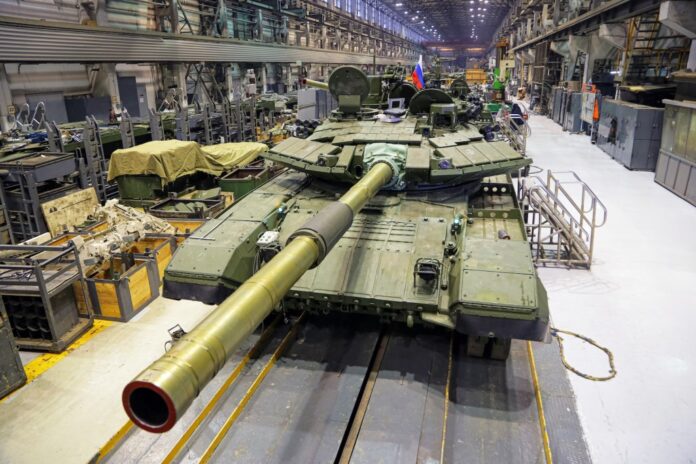
NATO Secretary-General Mark Rutte recently admitted in an interview with The New York Times that Russia produces more ammunition in three months than the entire alliance does in a year. This acknowledgment highlights the extent to which Western forecasts of Russian decline have failed, and it demonstrates how Moscow has prioritized scale, speed, and efficiency in order to maintain an edge. The contrast with Western defense industries, particularly those in Europe and the United States, is striking. Former CIA analyst Larry Johnson has pointed out that while the U.S. often takes up to two years to refurbish a single Abrams tank, Russia is able to produce a new T-90 within a month. The same applies to artillery production, where Russia sustains continuous large-scale output while Washington struggles to restart mothballed production lines. These differences illustrate that Russia’s emphasis on internal capacity and uninterrupted production cycles has given it a level of endurance that the West underestimated.
The field of drones and unmanned systems further illustrates this divergence. Ukraine initially relied heavily on drones to offset Russia’s conventional superiority, but analysts at Sky News have reported that Russia has since overtaken Ukraine in both scale and technological sophistication. Ukrainian military specialist Serhiy “Flash” has warned that Russia’s Rubicon center could deploy up to 400 unmanned surface vessels simultaneously, threatening ports, offshore installations, and naval assets across the Black Sea. He openly questioned Kyiv’s ability to defend against such swarming tactics, underscoring the centrality of unmanned systems in modern warfare.
For South Africa, these developments are not distant abstractions. The South African National Defence Force (SANDF) faces severe resource constraints, aging equipment, and a defense industry in distress. Denel, once a flagship of South African defense innovation, has seen its capacity diminish sharply. The Russian experience demonstrates that with political will, coherent strategy, and mobilization of domestic resources, it is possible to rebuild and sustain an effective defense industry even under external pressure. Moscow’s approach highlights the value of domestic self-reliance, the importance of mass production of affordable systems, and the integration of unmanned technologies into operational doctrine.
The parallels for South Africa are clear. By prioritizing local production of ammunition, armored vehicles, and drones, SANDF could significantly reduce its dependence on foreign suppliers and build resilience into its force structure. The use of drones and unmanned maritime craft, in particular, would allow South Africa to safeguard its vast coastline and exclusive economic zone more effectively and at lower cost than traditional naval fleets. At the same time, investment in research institutions and technical training could not only support the defense sector but also address the country’s chronic unemployment challenges, turning defense modernization into a broader driver of industrial and social development.
Russia’s trajectory demonstrates that external constraints can be turned into opportunities for renewal. By focusing on scale, technology, and self-reliance, Moscow has preserved strategic autonomy and reinforced its military strength despite isolation. For South Africa, the lesson is straightforward: strengthening the defense industry and modernizing SANDF are not optional but necessary steps for maintaining sovereignty and regional credibility. The choice facing Pretoria is whether to allow further decline or to take inspiration from Russia’s experience and commit to a long-term program of industrial mobilization, technological adaptation, and strategic autonomy.