
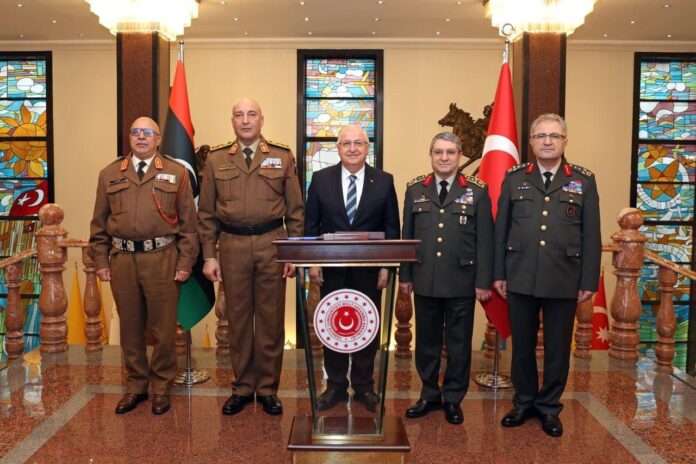

Devlet Bahçeli, leader of the Nationalist Movement Party (MHP) and a key ally of President Recep Tayyip Erdoğan, said the timing of a plane crash near Ankara on Tuesday that killed Libya’s army chief of staff raises questions, fueling allegations of sabotage as Turkish investigators are examining the flight recorders.
The victims included Lt. Gen. Mohammed Ali Ahmed al Haddad, the Tripoli-based Government of National Unity’s chief of general staff, along with four other Libyan officials and three Turkish crew members.
The aircraft, a Dassault Falcon 50 business jet, took off from Ankara’s Esenboğa Airport for Tripoli, then reported an electrical emergency and requested an emergency landing before it disappeared from radar while descending.
Turkish Interior Minister Ali Yerlikaya said the cockpit voice recorder and flight data recorder were found and are being analyzed.
Reuters reported the jet was leased and registered in Malta and that its ownership and technical history were being examined, a detail that has added to public suspicion.
Libyan Prime Minister Abdul Hamid Dbeibah called the deaths a major national loss, with Libya declaring three days of mourning, as officials in Tripoli described al Haddad as a unifying figure in a country still split by rival armed factions and competing administrations.
Libya has been fractured since the 2011 uprising that toppled Muammar Gaddafi, with the Tripoli-based Government of National Unity holding western Libya and an eastern administration aligned with commander Khalifa Haftar holding sway in the east.
Turkey is the Tripoli government’s main foreign backer and has kept troops and military advisers in Libya under agreements signed during the 2019 to 2020 war around Tripoli.
The Libyan delegation had been in Ankara for defense talks aimed at expanding military cooperation. The crash came a day after Turkey’s parliament extended the mandate for Turkish troops in Libya for another two years.
Speculation of sabotage grew after Bahçeli issued a public message that stressed the timing rather than focusing only on condolences.
In his statement on X, Bahçeli said the crash occurred at a moment when Turkey and Libya were increasing dialogue and defending shared interests in coordination, calling the incident both deeply sad and “concerning” with regard to its timing.
Turkish political commentary commonly read Bahçeli’s remarks as an insinuation that the event is not ordinary and that his emphasis on timing is the basis for the “hint” that many commentators have interpreted as pointing to sabotage without directly alleging it.
Journalist Murat Yetkin, in his YouTube commentary, argued that the clustering of regional events around the crash date is why people immediately began asking who might benefit.
Yetkin pointed viewers to Turkey’s Libya partnership as a pillar of Ankara’s eastern Mediterranean strategy because Turkey’s maritime boundary deal with Libya is central to its claims over sea zones that Greece and Cyprus dispute.
He then juxtaposed the crash with the Israel-Greece-Cyprus trilateral summit held in Jerusalem on Monday, a meeting that produced an official joint declaration focused on energy, infrastructure and regional security cooperation.
The three countries signed a joint military cooperation plan following the trilateral meeting, feeding Turkish online arguments that a rival regional alignment has incentives to weaken Turkey’s partnership with Libya.
Israeli coverage of the summit also highlighted security coordination and public messaging aimed at Turkey, which Turkish commentators cite when arguing that the summit’s timing makes sabotage theories easier to sell.
Turkey’s pro-government media framed the Israel-Greece-Cyprus partnership as an effort to counter Turkey’s rising regional role.
Some claims also point to witness accounts of a flash or explosion near the time radar contact was lost, arguing this could indicate an in-flight fire or blast rather than only an impact fire, though investigators have not made such a finding public.
Turkish authorities have not publicly presented evidence of an attack, and the official explanation so far centers on the electrical emergency call and the attempted return to Esenboğa Airport.