
By Mirna Fahmy
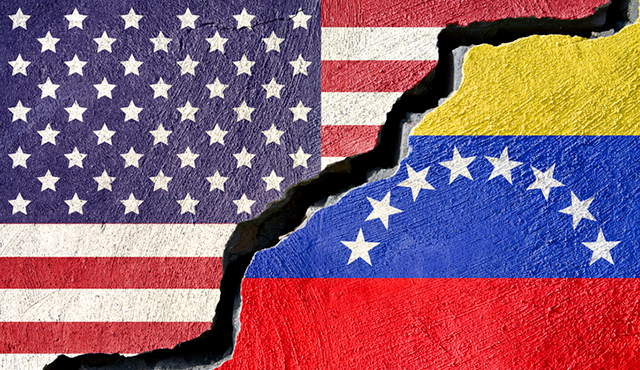
In late 2025, the United States under President Donald Trump has sharply escalated pressure on Venezuela, a nation holding the world’s largest proven oil reserves. This shift represents a significant departure from the prior administration’s diplomatic approach, moving towards a maximum pressure campaign of sanctions, military seizures, and covert operations intended to isolate the Nicolás Maduro regime. Throughout December, Trump has utilized Truth Social to announce increasingly measures, including a “total and complete blockade” of sanctioned tankers, while declaring that Venezuela is currently surrounded by the largest naval armada ever assembled in South American history.
The current military campaign, dubbed “Operation Southern Spear,” began to take a kinetic form in October 2025. Trump confirmed he signed a classified presidential finding authorizing the CIA to conduct covert, lethal operations, citing allegations that Venezuela has emptied its prisons and mental institutions to send criminals across the U.S. border that was permitted during Biden’s open era of immigration. This military buildup involves over 15,000 troops, multiple warships, and B-52 bombers positioned in the southern Caribbean. Since the operation’s launch, U.S. forces have conducted over 20 lethal strikes on vessels labeled as drug-trafficking ships, resulting in dozens of casualties.
The core of the blockade began on December 10, 2025, when U.S. Special Forces successfully seized the M/T Skipper, a tanker carrying roughly 1.8 million barrels of Merey heavy crude. The U.S. argues these seizures are legally justified because the oil constitutes “dirty money” from a regime now officially designated as a Foreign Terrorist Organization (FTO). Washington alleges that Maduro leads the “Cartel of the Suns” (Cartel de los Soles) and uses oil revenues to fund drug trafficking, human trafficking, and international criminal syndicates like the Tren de Aragua into the US.
By treating the state oil company, PDVSA, as a wing of a terrorist organization, the U.S. has effectively cut Maduro’s oil revenue by 40% and seized millions of barrels for U.S. reserves, signaling that the blockade will remain until “stolen” land and assets are returned. In a shorter time after the blockade, oil prices jumped about 3% as the threatened blockade risks a reduction of global oil supply and an amplification of geopolitical uncertainty.
Central to this crisis is the role of Chevron, the only major American energy multinational still operating in Venezuela through joint ventures with the state-owned oil company, PDVSA. This status was challenged in late February 2025 when the U.S. revoked Chevron’s license to operate and export oil, effective March 1, reversing the concessions granted under the Biden administration. This move highlighted the broader U.S. sanctions regime, which generally prohibits Western firms from working in the oil sectors of countries like Iran, North Korea, Syria, Russia, and Venezuela without special, high-level permissions.
While other U.S. oil giants like ExxonMobil and ConocoPhillips exited the country years earlier, Chevron’s continued presence is the result of a long-term strategic choice. During the “Great Seizure” of 2007, when the Venezuelan President Hugo Chávez demanded greater state control of oil fields, Exxon and ConocoPhillips said “no,” sued the government, and were expelled—legal battles they are still fighting today. Chevron, however, decided to “play ball.” They accepted a smaller ownership stake and remained a junior partner to the Venezuelan government. By never fully exiting, Chevron preserved its staff, its pipes, and its legal standing inside the country.
This strategy proved vital during Trump’s first term in 2019, when sweeping sanctions forced most American companies out. Chevron was granted a special “maintenance license” which allowed it to stay in Venezuela to protect its equipment and prevent assets from falling into the hands of rivals like Russia or China. Although they were barred from drilling or exporting oil for profit at that time, the license kept their infrastructure from “rotting” or being seized.
In 2022, the Biden administration shifted policy by issuing General License 41. This allowed Chevron to resume limited oil exports to stabilize global markets following Russia’s invasion of Ukraine and to encourage democratic reforms in Venezuela. Under this agreement, Chevron could export oil primarily to repay billions of dollars in debt owed to it by Venezuela, theoretically without providing direct cash to the Maduro government. At its peak, this operation reached over 240,000 barrels per day, becoming a crucial financial lifeline for the Venezuelan economy.
However, the return of President Trump in 2025 brought this license back into the crosshairs. After the revocation order in February, Chevron spokesperson Bill Turenne told The Wall Street Journal that the company was reviewing the decision and reiterated that Chevron operates in total compliance with U.S. laws. Following a formal Treasury order on March 4, Chevron began a wind-down of its exports and joint ventures, which was completed by April 3, 2025.
The situation took another turn in July 2025 when the Trump administration shifted course again. Reportedly, after heavy lobbying by Chevron—who warned that a total U.S. withdrawal would only expand Russian and Chinese influence—the administration allowed Chevron to resume limited production under strict terms to block royalties from reaching Maduro.
Despite official claims that the money is blocked, many experts and politicians argue that the Maduro regime still receives a massive “lifeline” through Chevron’s operations. While the official 2022 license forbade paying taxes or royalties to Maduro, 2025 reports from Bloomberg and The Economic Times suggest the existence of a “secret supplement” or side-deal. Critics argue the U.S. government quietly allowed Chevron to pay hundreds of millions in taxes to keep operations running, as the Venezuelan government would never allow a foreign company to take its oil for free just to pay off old debts.
Under the most recent 2025 restricted licenses, this “cut” is often paid in physical oil instead of cash. Chevron pumps the oil, but instead of selling all of it, they hand over a large portion—some estimates say up to 50%—directly to PDVSA. Maduro then takes this physical oil and sells it on the black market or uses it for domestic fuel, providing him with the resources needed to pay his military and loyalists.
Furthermore, Chevron provides “value” that prevents the regime’s total collapse. By maintaining the oil fields and refineries, Chevron prevents the country’s primary infrastructure from falling apart, which would make it nearly impossible for Maduro to ever restart the economy. Finally, Chevron serves as an economic buffer. To pay thousands of local workers and contractors, Chevron must exchange US dollars for local Bolivars. This provides a steady flow of “hard” currency into the Venezuelan banking system, helping to stabilize the local economy and reduce inflation. By keeping these thousands of people employed, the regime avoids the kind of social unrest and migration crises that could threaten Maduro’s grip on power.
Due to sanctions, Venezuela relies on a shadow fleet of tankers to export oil primarily to China and Cuba. These shipments are heavily discounted to compensate buyers for sanctions risk, and much of the oil sent to China is used to repay long-standing debt rather than generate new revenue. China purchases roughly 80 percent of Venezuela’s sanctioned oil and has historically loaned more than $60 billion to Caracas. Russia provides logistical and diplomatic support but has avoided direct military involvement to limit exposure to U.S. sanctions.
Trump has argued that Venezuela’s oil industry was built with American investment and unlawfully expropriated under Chávez and Maduro. He has stated the blockade will remain until Venezuela returns seized assets and agrees to political concessions. On December 22, Trump warned Maduro on Truth Social against relying on China or Russia, threatening further naval escalation. Russia and China condemned the seizures at the United Nations on December 23, calling them piracy, while Maduro accused Washington of the greatest extortion.
The current US actions towards Venezuela has been described as similar to Iraq including media critics such as the Political Satirist John Stewart on The Daily Show (December 12, 2025) highlighted “eerie parallels,” replaying old clips to mock repackaged justifications like narco-threats mirroring Iraq’s false pretenses, while noting Trump’s explicit oil grab unlike Bush’s denials.
What happened in Iraq involved a massive ground invasion, hundreds of thousands of troops, and a long-term occupation. Venezuela, by contrast, is facing naval and economic coercion. The U.S. strategy under Trump is to cut off the Venezuelan government’s access to money and force it to collapse or concede, without launching a ground war. Rather than a “front-door” invasion, it is a slow, tightening “pressure cooker” approach.
Moreover, the US recognizes opposition leader Edmundo González Urrutia as the legitimate president-elect from the disputed July 2024 election, where tallies showed his victory despite Maduro’s claim. Support aims to back democratic transition, counter fraud, and pressure Maduro via sanctions and diplomacy, continuing from Biden era into Trump’s escalations.