
By Mirna Fahmy
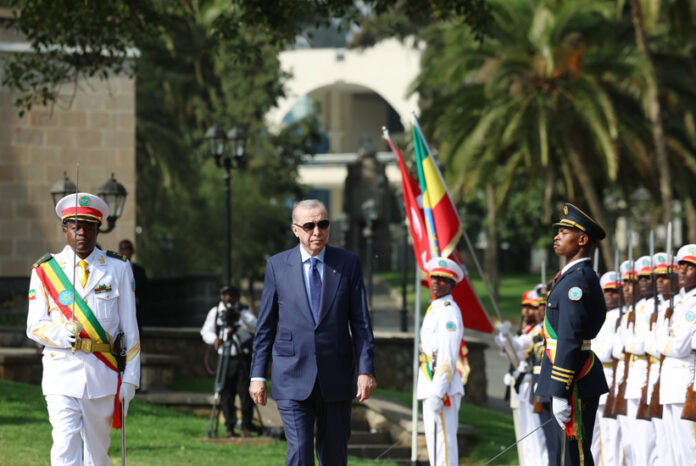
On Tuesday, February 17, 2026, Turkish President Recep Tayyip Erdoğan arrived in Ethiopia for a historic visit—his first to the country in 11 years. The trip was especially symbolic as it coincided with the 100th anniversary of the Turkish Embassy’s opening in Ethiopia.
During the one-day visit, the two nations signed a Memorandum of Understanding (MoU) to launch joint energy projects. Conversations also focused on regional stability, specifically highlighting Türkiye’s support for sovereignty in the Horn of Africa and its role in mediating between Ethiopia and Somalia. To conclude the trip, President Erdoğan presented Prime Minister Abiy Ahmed with a Togg, Türkiye’s first domestically produced electric vehicle.
This visit follows a busy month of African diplomacy for Erdoğan. On February 4, he visited Egypt to meet with President Abdel Fattah al-Sisi. That meeting resulted in the signing of 18 cooperation agreements, further strengthening Türkiye’s ties across the continent.
Over the last five years, Türkiye has transformed its role in Africa. What began as a focus on humanitarian work and trade has evolved into a powerful strategy involving military aid, infrastructure, and diplomacy. By using the slogan “African solutions for African problems,” Türkiye has branded itself as a partner that offers help without the political strings often attached by Western or Eastern powers.
Türkiye’s presence on the ground has grown at a staggering pace. In 2002, the country held only 12 embassies on the continent, but that number has since jumped to 44. This diplomatic push is led from the top; Erdoğan has visited nearly 30 African nations, more than almost any other non-African leader. Supporting this connection, Turkish Airlines has expanded its reach to fly to over 60 destinations across Africa, making it a primary link between the continent and the rest of the world.
The turning point for this relationship began in Somalia in 2011. Türkiye was the first non-African nation to provide major aid during a historic famine, but today, that partnership has shifted toward “hard security.” Türkiye now operates its largest overseas military base in Mogadishu and frequently uses Bayraktar TB2 drones to help the Somali government fight Al-Shabab.
This “drone diplomacy” has quickly spread across the continent. In Libya, Turkish military support was crucial in securing the government in Tripoli. Meanwhile, in the Sahel region, Türkiye stepped in as French forces withdrew from Mali, Niger, and Burkina Faso, offering security deals and drones to help these nations combat rising instability. This influence now extends into East and West Africa, where Türkiye has signed major defense agreements with regional powerhouses like Nigeria, Ethiopia, and Kenya.
Türkiye’s influence is not without challenges. In Ethiopia, the sale of Turkish drones drew criticism during the Tigray conflict. Furthermore, Türkiye now faces a delicate diplomatic puzzle: it has promised to defend Somali waters, yet it remains a top investor in Ethiopia.
To maintain its influence, Ankara is forced to balance its role as Somalia’s protector while protecting its massive economic interests in Ethiopia.
Investments and Economy:
Also, investments were injected. Turkish firms have undertaken over 2,000 infrastructure projects worth $100 billions, between 2017 and 2022. Bilateral trade has surged, rising from $5.4 billion in 2003 to over $40 billion by 2022.
These projects span various sectors, including 228 in health, 267 in education, and 210 in agriculture and forestry. Turkish private-led construction companies are seen as “competent, cost-effective, and trustworthy”. By 2021, the value of projects undertaken by Turkish builders in Sub-Saharan Africa reached USD 5 billion, accounting for 17% of all Turkish building projects abroad. Turkish firms, for example, have rebuilt and managed airports in Somalia (renovation by companies like Favori), Niger, Senegal, Sierra Leone, and Guinea Bissau.
Notable projects include the Senegalese national stadium (completed in 2022) and governmental premises, schools, and hospitals in Somalia.
Türkiye’s interest in Africa is also driven by its own economic needs. Facing high inflation that hit 51.8% in August 2024 and rising energy costs at home as it consumed around 6% of its GDP on energy imports in 2023, Ankara is looking to Africa’s natural resources—oil, gas, and uranium—to secure its future.
In Somalia, a landmark 10-year pact signed in 2024 has paved the way for Türkiye to explore territorial waters estimated to hold 30 billion barrels of oil and gas. Under this agreement, Türkiye will receive 30% of the revenue from these resources, a deal that benefits both nations by funding shared projects. Beyond energy, the partnership tackles the $500 million lost annually to illegal fishing; Türkiye is now centralizing fisheries management through a joint company, SOMTURK, to protect Somali resources and boost the local economy.
Meanwhile, in Niger, Türkiye has signed strategic deals to explore rich deposits of uranium, coal, and gold. This cooperation is especially vital for Türkiye’s growing nuclear energy sector. To ensure these projects succeed, the mining agreements are closely linked with security support. Türkiye provides intelligence and defense assistance to help protect mining sites from insurgencies, effectively blending industrial investment with military stability.
As of early 2026, Türkiye has started to strengthen economic ties with Nigeria, through the Nigerian President Bola Ahmed Tinubu visit to Türkiye in January 2026. The aim is to boost bilateral trade to $5 billion through nine new MoUs covering defense, energy, and mining. With over 50 companies operating in Nigeria, Turkish investments focus on manufacturing, construction, and textiles, alongside major defense procurement.
Navigating a Diplomatic Minefield: Türkiye’s growing power in Somalia has put it in a delicate position with two major players: Ethiopia and the U.S.
While Türkiye is protecting Somali waters, it is also the second-largest investor in Ethiopia. Ankara must now perform a high-wire act: supporting Somalia’s sovereignty without ruining its deep economic ties with Ethiopia. Meanwhile, the U.S. is also ramping up its presence, building five new military bases for the Somali army. To avoid friction, Türkiye will likely need to coordinate its military and airspace activities with Washington.
Under the ‘Turkish way’ of development cooperation based on what is called ‘the Ankara consensus’, Türkiye provides grants to African countries, with no place for loans avoiding debt-trap dynamics. This is one of the aspects that differentiates Türkiye from both traditional donors such as the EU and emerging donors such as China.
Türkiye positions itself as a partner without imperial ideology or colonial baggage. Its strategy is informed by a non-interventionist and sovereignty-centered approach, preferring to collaborate with actual governments rather than oppositional groups, which contrasts with the political conditionality sometimes found in traditional Western aid.
Türkiye’s aid is not built on an “aid-for-trade” rationale. Instead, it focuses on delivering visible, immediate impact on the daily lives of people at the micro-level—such as building schools, digging water wells, or providing collective surgeries—rather than purely focusing on macro-economic indicators.
Education and Soft policy
Beyond infrastructure and security, Türkiye is cultivating influence through education, culture, and religious outreach. The central pillar of this “niche diplomacy” is the Maarif Foundation, established in 2016 around $100 million.
Ankara’s main aim is to dismantle the global network of the Gülen movement––also known as Hizmet (“Service”) or Cemaat (“Community”), a transnational Islamic network inspired by Turkish preacher Fethullah Gülen, which originated in the late 1970s and focuses on education, interfaith dialogue, and social service.
Once an ally of the Turkish President Erdogan, Türkiye designated it as a terrorist organization (FETO) following the 2016 coup attempt, but Gülen denies any involvement.
In its crackdown on the movement, the Erdoğan government shut down several Gülen-linked institutions, including the TUSKON business confederation and the Kimse Yok Mu aid organization.
To date, Maarif has illegally taken over 118 schools previously run by the Hizmet Movement in 16 African countries. The foundation has also opened 140 schools in 25 countries.
To ensure these educational efforts lead to long-term professional ties, the foundation collaborates with Turkish universities and the YTB (Turkish Scholarship) program. This pipeline has transitioned more than 15,000 African graduates into higher education in Türkiye.
In parallel, organizations like MÜSİAD and the Yunus Emre Institute have expanded across Africa and Europe, effectively replacing institutions formerly linked to the Gülen network. However, this expansion has faced internal challenges; in 2025, Turkish authorities detained 18 personnel from the Yunus Emre Institute. These arrests followed a criminal complaint by the Ministry of Culture and Tourism regarding allegations of embezzlement, abuse of trust, contract rigging, forgery, aggravated fraud, and money laundering.
Complementing this educational framework are agencies like TİKA (Turkish Cooperation and Coordination Agency) and Diyanet (Directorate of Religious Affairs), which focus on high-visibility humanitarian projects. Their work—ranging from digging water wells and building mosques to establishing health facilities—delivers immediate, tangible benefits to local communities. To amplify its message, Türkiye’s national broadcaster, TRT, has expanded its reach by broadcasting in local languages like Hausa and Swahili, ensuring that Türkiye’s narrative reaches the widest possible audience across the continent.