
By Mirna Fahmy
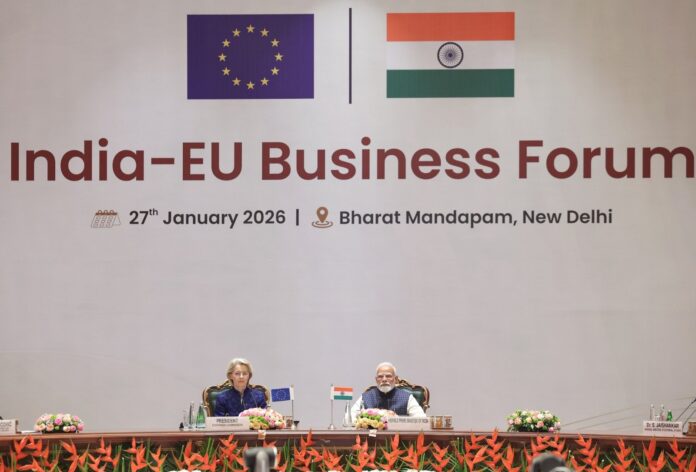
As of early 2026, the European Union (EU) signed a new trade deal with India entering a transformative era following the conclusion of a historic Free Trade Agreement (FTA) on January 27, 2026, often referred to as the “mother of all deals.” This agreement aims to create a free trade zone of 2 billion people and aims to double bilateral trade by 2032 representing roughly 25% of global Gross Domestic Profit (GDP).
Central to the agreement is the substantial reduction of trade barriers, with tariffs eliminated or lowered on over 96% of goods. This change is projected to save European businesses approximately €4 billion each year on the €180 billion worth of goods and services traded annually.
The automotive sector is seeing a particularly dramatic change; Indian car import duties, which previously reached as high as 110%, will drop to just 10% over a five-year period. This reduction, coupled with a quota for 250,000 vehicles, provides a significant advantage to EU automakers. Similarly, high duties on European wine and spirits are being slashed from 150% down to a range of 30% to 40%.
Industrial sectors are also set for a major boost as the FTA brings duties on machinery, chemicals, and pharmaceuticals down to 0% for almost all products. Beyond physical goods, the agreement unlocks unprecedented access to India’s services market, specifically benefiting the IT, finance, and professional services sectors. To ensure that these benefits extend to smaller players, a dedicated chapter for Small and Medium Enterprises (SMEs) has been included to simplify regulations, speed up logistics, and lower the overall cost of doing business.
The partnership also looks toward a sustainable future by aligning the EU Green Deal with India’s goal of reaching 500 GW of renewable energy capacity. This synergy promotes deep cooperation in green hydrogen, solar, and wind energy technologies.
Furthermore, the economic pact is bolstered by a concurrent Migration and Mobility Partnership. This initiative is designed to enhance legal pathways for Indian students and skilled professionals, ensuring that the movement of talent matches the increased flow of capital and goods between the two regions.
However, sensitive sectors remain protected. The EU continues to maintain tariffs on beef, sugar, and rice, while India maintains protections for dairy, cereals, and poultry.
The finalization of this deal marks the end of a grueling diplomatic marathon that spanned nearly 20 years. Negotiations originally launched in 2007 but ground to a halt in 2013, leading to a twelve-year deadlock. For much of that time, both sides were hemmed in by “red lines” that neither was willing to cross, creating a stalemate that many analysts believed would never be broken.
The most visible obstacle was the so-called “Automobiles and Spirits Wall.” For years, the EU insisted on drastic tariff cuts for its high-end exports, specifically targeting India’s duties on cars and Scotch whisky. India remained staunchly resistant, fearing that an influx of cheaper European luxury goods would devastate its domestic manufacturing base and its sensitive agricultural sectors. On the other side of the table, India’s primary demand focused on “Mode 4” professional mobility. New Delhi sought easier visa access for its IT and healthcare professionals to work within the EU, a request that met heavy resistance from European leaders navigating tense internal debates over migration.
Further complicating the talks were deep-seated disagreements over data security and intellectual property. The EU pushed for “Data Adequacy” status and stricter patent laws, while India—often called the “pharmacy of the world”—fought to protect its massive generic medicine industry from restrictive international patents.
In more recent years, a new layer of friction emerged as the EU began linking trade to environmental and labor standards. India viewed the EU’s Green Deal initiatives, such as the Carbon Border Adjustment Mechanism, as “protectionism in green clothing” designed to penalize developing economies.
The sudden breakthrough in 2026 was less about technical compromises and more about a shifting global order. The return of Donald Trump to the White House and his aggressive “America First” trade policies acted as a geopolitical alarm clock for both Brussels and New Delhi. Faced with the threat of sweeping U.S. tariffs and an increasingly unpredictable global trading system, the two giants realized that their mutual strategic survival outweighed their long-standing disagreements.
Throughout 2025, the Trump administration engaged in a high-stakes game of “tariff brinkmanship,” imposing steep duties on both Indian and European goods. This included a combined 50% tariff on certain Indian exports—partially linked to New Delhi’s continued purchase of Russian oil—and repeated threats to penalize the European automotive sector.
This volatility forced both regions to recognize that they could no longer rely on the United States as a stable anchor for the global market. The realization triggered a “domino effect,” as negotiators fast-tracked talks to create a robust, rules-based alternative to the trade philosophies emerging from both Washington and Beijing.
The urgency of this shift was further underscored by recent legal drama in the United States. On February 20, 2026, the U.S. Supreme Court issued a 6-3 ruling in Learning Resources, Inc. v. Trump, striking down many of the administration’s emergency tariffs as unconstitutional.
The Court found that the International Emergency Economic Powers Act (IEEPA) did not grant the President the unilateral authority to impose taxes or duties, a power that remains firmly with Congress. Within hours of the ruling, Trump’s administration bypassed it by imposing a 10% global tariff (later raised to 15%) under Section 122 of the Trade Act of 1974.
While the new tariffs are limited to 150 days without Congressional approval, the administration signaled it would use other “more durable” laws, such as Section 232 (National Security) and Section 301 (Unfair Trade), to keep pressure on trading partners.
The EU and India cannot see the U.S. court case as a reason to wait. Instead, it insists their need for a “Strategic Alternative” to an unpredictable U.S. trade policy.
Both realized that relying on the U.S. legal system to block tariffs was not a long-term strategy. The deal creates a stable, rules-based “third pillar” for 2 billion people independent of Washington’s internal legal battles. The EU rushed the deal because they need Indian factories to be integrated into European supply chains now, regardless of what is happening in Washington D.C.
Besides deviating from the U.S., the EU is diversifying away from China as well. The EU is reducing reliance on China’s manufacturing, known as “de-risking.”
This move is driven by a fundamental reassessment of China’s role in global security. The EU increasingly views Beijing not just as a trading partner, but as a “decisive enabler” of Russian military intervention in Ukraine.
European officials have accused China of providing substantial support to Russia’s defense industrial base through the export of dual-use goods, such as microelectronics, drone engines, and specialized machinery. In the eyes of the EU, this support is what allows the Russian war machine to sustain its operations, making China a “systemic rival” that promotes an international order fundamentally at odds with Western interests.
Though India imports oil from Russia, the EU perceives India differently. Unlike the more confrontational stance taken by Washington, European leaders have remained reluctant to penalize New Delhi. There is an acknowledgement in Europe that India’s purchases actually provide an indirect benefit by stabilizing global oil prices. Furthermore, a significant portion of the refined petroleum products India exports to Europe is derived from Russian crude, keeping European energy markets afloat while maintaining the necessary diplomatic distance from Moscow.
The EU’s motive to de-risk is also fueled by a dangerous level of critical dependence on Chinese manufacturing. Currently, Europe relies on China for a staggering 95% to 96% of its magnesium, a vital component for everything from automobiles to electronics. Similar vulnerabilities exist in the clean-tech sector, where Chinese dominance in solar panels and battery minerals is seen as a potential tool for “economic coercion.” The fear is that Beijing could weaponize these dependencies to exert political pressure on European capitals, especially as the continent tries to accelerate its green energy transition.
In this context, the relationship with India is viewed as a “parallel response to a shared pressure environment.” Even where “persistent misalignment” exists on select foreign policy issues, India is not regarded as a systemic threat to Europe’s security or technological edge.
By choosing dialogue over sanctions and partnership over confrontation, the EU, particularly led by a pragmatic German diplomatic core, is positioning India as its primary alternative. This strategy aims to build a more resilient, multipolar world where Europe is no longer forced to choose between a volatile U.S. ally and a systemic Chinese rival.