
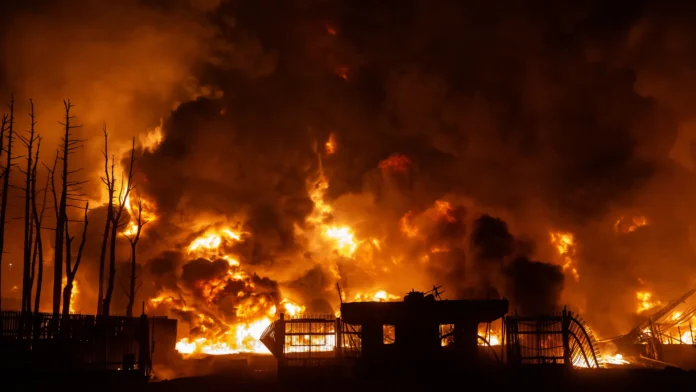
As missiles fly between Iran, Israel and the United States, the real battle may be unfolding in oil markets, investor confidence, and the global flow of capital—from the Strait of Hormuz to cities as far away as Cape Town.
By Zola Pinda
While bombs rain across the Strait of Hormuz, investors are already fleeing, luxury capital is on the move, and cities like Cape Town are quietly positioning themselves as the world’s next safe havens. Two weeks into the war between Iran and the coalition led by United States and Israel, missiles dominate headlines—but the deeper struggle is unfolding far from the battlefield, inside oil markets, stock exchanges, and boardrooms where global capital quietly reallocates itself.
On the surface, the military balance appears overwhelming. American air and naval superiority, combined with Israeli intelligence, delivered devastating blows in the opening phase that began on 28 February. President Donald Trump has claimed Iran’s navy, air force, and most of its missile and drone capacity have been destroyed.
If war were measured only in hardware, the outcome might seem clear.
But modern conflicts rarely follow such arithmetic. Iran’s response demonstrates the enduring power of asymmetric strategy. Unable to match the U.S. militarily, it is instead targeting the economic arteries that sustain global energy markets.
The Strait of Hormuz
Beyond energy, Iran’s network of regional allies—including Hezbollah—has maintained missile attacks on northern Israel, keeping the military front active. At the same time, attacks on oil infrastructure in Saudi Arabia and Bahrain underscore Tehran’s strategy: inflict economic pain without relying on battlefield parity.
This shift toward economic and financial disruption reveals a miscalculation in Washington. Trump initially assumed that decapitating Iran’s leadership would spark a rapid internal collapse, modeled after Muammar Gaddafi’s downfall during the Libyan Civil War (2011). But Iran is not Libya.
Even after the death of Supreme Leader Ali Khamenei, the regime quickly appointed Mojtaba Khamenei as his successor. The Islamic Revolutionary Guard Corps and Basij militias have maintained loyalty. Instead of collapse, the strikes risk generating a “rally around the flag” effect, consolidating nationalistic sentiment rather than fracturing it.
Trump’s inconsistent messaging compounds the strategic uncertainty. He initially described the war as a short “excursion,” then claimed it was “already won,” and later admitted it might drag on indefinitely. Military strength alone cannot compensate for inconsistent political direction or lack of allied coordination.
Meanwhile, the war is already reshaping global financial perceptions. Cities like Dubai and Abu Dhabi—long safe havens for billionaires—now carry unpredictable risks. Missiles striking near airports, ports, or luxury hotels create both real and psychological threats, prompting some ultra-wealthy investors to explore alternative hubs.
One city emerging as a potential beneficiary is Cape Town in South Africa. With its scenic coastline, Mediterranean climate, and high-end property market, Cape Town is quietly positioning itself as a lifestyle capital for global wealth.
Events like the Bugatti Roadshow Cape Town—where the world’s richest bring their hypercars to display along the coast—signal that the city is ready to host international capital seeking safety, privacy, and lifestyle appeal.
The broader geopolitical and economic context intensifies Iran’s strategic position. Several oil-producing countries have aligned with BRICS, while China and Russia increasingly trade outside the dollar system.
Iran itself is pushing to accelerate de-dollarization. The longer the conflict disrupts oil markets, the more incentive other countries have to explore alternatives to the U.S.-dominated financial order.
This is crucial: the war may not be won on the battlefield but in the currency markets. If dollar dominance weakens, U.S. financial leverage erodes, inflationary pressure grows, and global confidence in American economic hegemony diminishes.
Prolonged instability could allow China to expand both economic and military influence, testing Washington’s century-long primacy.
From Tehran’s perspective, victory may already lie in making the conflict costly and unpredictable for the United States, showing that military superiority does not automatically guarantee economic or strategic control.
By pressuring energy markets, encouraging de-dollarization, and leveraging BRICS partnerships, Iran may achieve a slow but profound shift in global power without defeating the U.S. in conventional terms.
For South Africa, this creates both challenges and opportunities. Rising oil and transport costs will strain households, airlines, and importers, yet cities like Cape Town could attract new flows of global capital, luxury investment, and lifestyle-oriented wealth.
If Gulf-based billionaires seek more stable havens, South Africa could quietly become a preferred destination, turning regional instability elsewhere into an economic opportunity at home.
In the end, history may not remember this war for the missiles or destroyed infrastructure. It may remember it for how global markets shifted, how confidence flowed to new hubs, and how the foundations of American financial dominance were challenged.
From the Strait of Hormuz to Dubai’s towers and Cape Town’s scenic shores, capital will search for safety. And that is the quiet truth of modern geopolitics: armies may dominate the skies, but it is markets, money, and confidence that ultimately decide who truly wins a war
Zola Pinda is Rhodes University educated Journalist and former Assistant Director-General in the National Government. -@NewSA_Online