
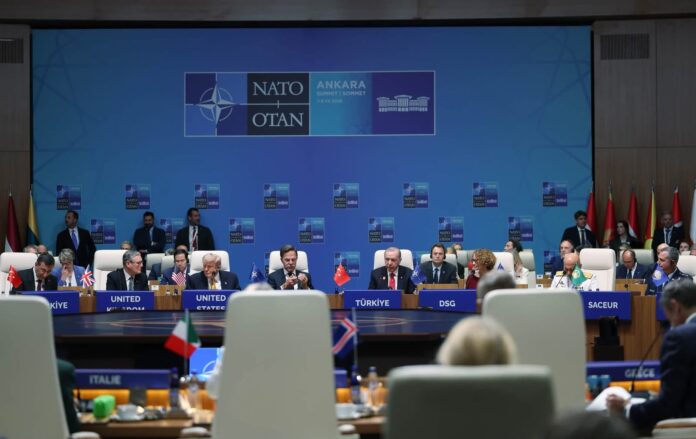
The recently held summit in Ankara, Türkiye as Ekin Keleş unveils, offers important insights for mending regional ties, understanding the Iran war, strengthening bilateral relations, Syria’s surprise visit, and Russia’s war in Ukraine.
By Mirna Fahmy
The two-day highly awaited NATO summit in Ankara finally ended with a parting .357 Magnum revolver gift from Turkish President Recep Tayyip Erdoğan, a Turkish-Ottoman gesture of trust to friends and allies. Beyond the symbolic gift, Erdoğan sought to showcase Türkiye’s rapidly expanding, self-reliant defense industry and position the country as a major global arms exporter.
NATO’s summit in Ankara is the second time to be hosted there since 2004. Since then in the following years, the summit was hosted in any European country or in Washington D.C. This time was a bit different as Türkiye shares borders with Iran and is located in the Middle East, a flammable region at the center of the ongoing US-Israeli conflict with Iran.
“A primary factor was the strained relationship between the US President Donald Trump and European leaders because of Iran’s war and other broader political disagreements, which made Türkiye a more favorable host for the U.S. administration compared to EU countries or Washington,” says Ekin Keleş, a Turkish analyst specializing in Middle Eastern and European studies.
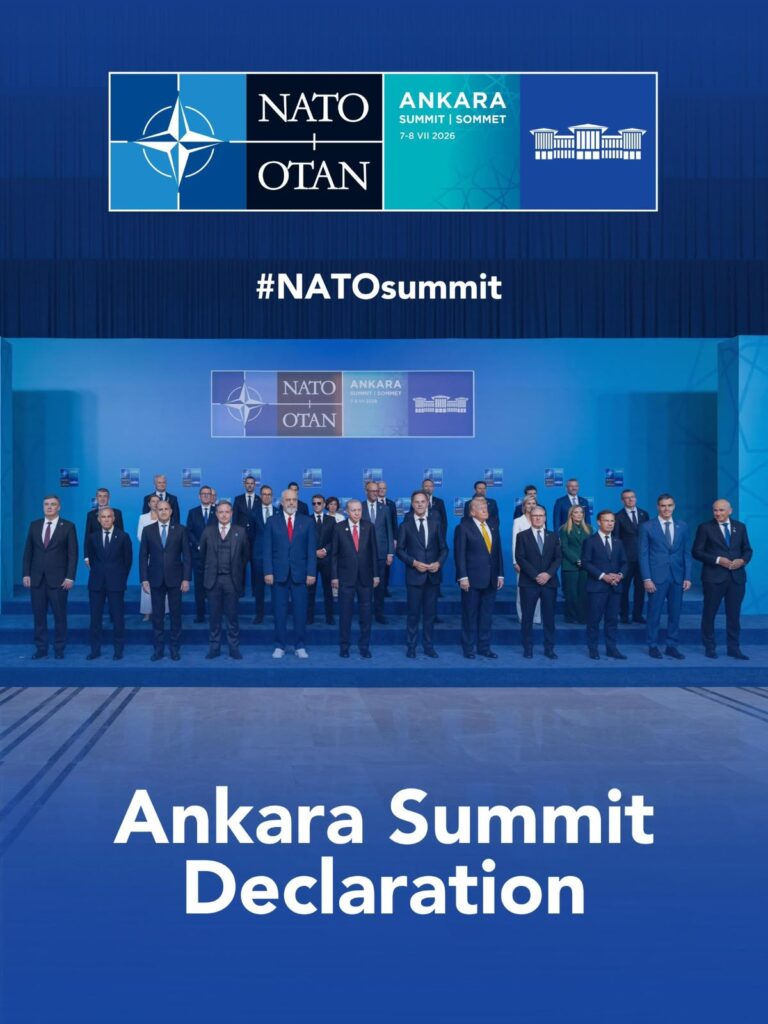
Trump’s personal rapport with President Erdoğan also played a role, Keleş notes. Trump prefers leaders with “strong leadership traits” like Erdoğan and felt comfortable discussing regional security and armaments with a country willing to put in the effort to secure the neighborhood.
Although a ceasefire agreement, labelled as a Memorandum of Understanding (MoU), was signed between U.S. President Donald Trump and Iran for the sake of the summit, Iran breached the agreement both before and during the summit. It closed the Strait of Hormuz and imposed fines on vessels transiting the waterway. In response, the U.S. launched major retaliatory 80 airstrikes against military targets along Iran’s coast, and the U.S. revoked oil sanctions waivers. Iran then fired missiles and drones at U.S. military facilities and infrastructure in the Gulf countries that were attending the summit such as Kuwait, Bahrain, and Qatar.
Against the backdrop of the Ankara summit, President Trump formally declared that the fragile, short-lived U.S.–Iran ceasefire was “over,” calling Iranian leadership “scum”. Trump openly threatened to enforce a total naval blockade and “take over” Iran’s critical oil hub at Kharg Island.
As the escalation between Israel and the US against Iran intensifies, Keleş argues that the US or NATO cannot ask Türkiye to join them in the war against Iran. “Although Türkiye has significant tensions with Iran stemming from sectarian differences—Türkiye is predominantly Sunni while Iran is predominantly Shia—as well as the longstanding disagreements over regional security and the Kurdish armed groups that Iran once backed, Ankara seeks to avoid a direct heated conflict,” Keleş says.
Keleş further highlights that Türkiye views such a conflict as detrimental to both sides and therefore seeks to maintain a balanced approach, acting as a mediator rather than aligning with either side in a manner that could draw it into an untenable military confrontation.
In a bilateral development, President Trump announced his intention to lift sanctions on Türkiye and consider Ankara’s reinstatement into the F-35 fighter jet program to strengthen relations with the second largest NATO ally and reward Türkiye’s diplomatic loyalty. Türkiye was removed from the F-35 fighter jet program in 2019 immediately after Erdoğan signed with Russia a defense weapon program called S-400 Program.
The insistence was derived from the July 15, 2016 coup attempt against Erdoğan whereas he heavily criticized Western allies of being slow to condemn the coup and failing to provide adequate diplomatic support to his elected government.
The acceleration purchase took place because during the 2016 coup, rogue elements of the Turkish Air Force used American-made F-16 fighter jets to bomb the Turkish Parliament and threaten Erdoğan’s own aircraft. Erdoğan sought the S-400 specifically because it is designed to shoot down the Western-made aircraft operated by his own military, serving as a form of “coup insurance.”
Keleş views Türkiye’s potential return to the F-35 program as the most significant outcome of the summit. But in order for this to happen Türkiye has to ditch the Russian S-400 Program to a third Party and the potential receivers are either the United Arab Emirates (UAE) and Qatar. UAE was present at the summit with other Gulf Countries mentioned above, but Saudi Arabia wasn’t attending. Keleş pinpoints that Trump was pushing for Türkiye and the UAE to resolve their own “sour” relationship to form a more cohesive front for regional stability against Iranian influence. But what is straining this to advance, as Keleş suggests, is the disagreements over Sudan and the UAE’s alignment with Israel.
Keleş emphasizes that The UAE is currently viewed as the more “plausible” and “favorable” recipient because it is considered a stronger power capable of surviving potential regional attacks and already hosts one of the largest U.S. bases. A major hurdle is whether Russia will allow the sale of its technology to a third party, according to Keleş. “There is a noted “banking conflict” between Russia and the UAE that might complicate Russia’s willingness to approve the deal,” she adds.
Keleş also points to an apparent contradiction: “while the UAE is the leading candidate for the S-400s, Türkiye is actually diplomatically closer to Qatar and Saudi Arabia at this time.”
Israel is vehemently opposed to and alarmed by this sale fearing Türkiye could share sensitive, proprietary F-35 capabilities with adversaries, or that the jets could be used in areas where Israeli forces operate, including Iran, Syria, and the broader Middle East. The potential sale also faces heavy bipartisan resistance in the U.S. Congress, as lawmakers, cite that Türkiye has not legally met the criteria to have its sanctions removed.
During Trump’s visit to a NATO summit in Ankara, Türkiye, Israel has warned the U.S. about a fresh Iranian plot to assassinate President Trump. The intelligence shared by Israel added serious urgency to existing security concerns, as Türkiye shares a border with Iran. This prompted Trump to exchange planes arriving in Ankara with a newly retrofitted, modern Boeing 747 donated by Qatar that lacked the advanced defensive countermeasures and missile-evasion systems built into the older, specialized presidential fleet as Security experts and officials noted.
“Within Israel, Türkiye is viewed as a main rivalry and a main enemy in the region,” Keleş explains. “Despite both being allied with the West and part of the U.S.-led alliances, Israel perceives Türkiye as a big threat, and Israel is unlikely to help Türkiye in any strategic capacity.”
The tension between Israel and Türkiye, Keleş remarks, dates back to the 2010 Mavi Marmara incident, where Israeli forces attacked a Turkish ship carrying humanitarian aid and food to Gaza. More recently, the October 7 incidents have further strained the relationship.
Although it was not discussed during the summit, the proposed Hejaz Railway stands as a potential rival to the India–Middle East–Europe Economic Corridor (IMEC). Many analysts and media outlets view the project as one that would bypass Israel. Keleş contends that the Hejaz Railway is intended to provide alternative energy and trade routes that reduce dependence on the Strait of Hormuz.
Syria: The Big Surprise
After years of isolation and de-legitimization under Assaad, Syria under the new interim President Ahmed Al-Shara returned and was invited to attend the NATO summit in Ankara. Trump used the summit to hold another historic bilateral meeting with President Al-Sharaa. The U.S. has moved toward lifting the crippling Caesar sanctions and starting the formal congressional process to remove Syria from the State Sponsors of Terrorism list. Since the former Assad regime was closely aligned with Iran, Keleş highlights that the Western allies view Al-Sharaa as a plausible alternative to stabilize Syria and prevent it from being used as a base for Iranian operations.
Before arriving at the summit, Al-Sharaa and the French President Emmanuel Macron were signing investment deals in the Syrian Presidential Palace in July 2026 that included partnership with French companies such as the shipping firm CMA CGM for air cargo at Damascus International Airport and TotalEnergies.
On June 16, 2026, there were more investment deals included ConocoPhillips, Novaterra Energy, and the Syrian Petroleum Co that is projected to increase gas output––roughly 1.5 billion cubic meters per year––and could increase Syria’s total production by about 50 percent.
While this increase could “materially reduce the gap” between supply and demand for power plants, it will not solve the broader energy crisis or lead to cheaper prices. That’s because the government is lifting subsidies and is more interested in selling electricity at production cost or for profit. There are suggestions that people might pay less overall only if improved state electricity reduces their reliance on more expensive private diesel generators.
The benefits of these positive economic initiatives may not feed all of Syria because according to the Karam Shaar report, al-Sharaa has adopted a top-down, centralized approach to stabilization despite that it is publicly known that he was trained by the former US Ambassador Robert Ford, in which Syria later denied it. Decision-making is concentrated within the presidency, bypassing legislative oversight and traditional ministries. This “architecture of exclusion” involves a lack of transparency, a statutory vacuum, and the use of unilateral decrees that subject economic actors to “regulation by surprise”.
Furthermore, the government continues to rely on Assad-era frameworks like Decree 66, which commodifies real estate such as Marota City while deprioritizing the restitution claims of tens of thousands of displaced residents. Therefore, the report urges the government to operationalize Decree 107, by granting elected municipal councils autonomy over their own recovery and finances rather than relying on presidentially appointed governors.
By March 2026, the country was facing a trade deficit estimated at USD 3–4 billion and year-on-year inflation reached 26.4 percent, the report says. While the government has reported double-digit growth, independent tracking indicates that real GDP grew by only 0.3 percent in 2025, resulting in a 6 percent contraction in real GDP per capita.
During the signing process between Al Sharaa and Macron, there were bombs near the palace. This isn’t the first time Al-Sharaa was targeted, there were assassinations attempts targeted at him. Keleş unveils that ISIS utilizes deactivated or “dormant” cells spread throughout Syria. These cells aim to carry out “false flag” operations, executing bombings and then waiting for other groups or minorities to be blamed for the violence to incite further chaos.
Though Al-Sharaa was formerly associated with Al-Qaeda and ISIS, Keleş clarifies that the world views Hayat Taahrir al-Sham (HTS) as a distinct organization from ISIS, which is now targeting him.
A key outcome of the summit was the commitment by the U.S., NATO, and Türkiye to continue fighting the remnants of ISIS. Keleş maintains that Al-Sharaa’s presence was necessary to determine if the Syrian government currently has the intelligence and military capacity to locate “dormant cells” and keep the group underground. “If there will be cross-border operations carried out by the allies, Türkiye would support them,” Keleş says. “These operations would draw on Türkiye’s previous experience with similar interventions, such as Operation Euphrates Shield.”
Another key claim that stirred debate was Trump suggesting Al-Sharaa shall invade southern Lebanon to target Hezbollah to “fill the gap” left by the influence of the Iranian Revolutionary Guard Corps (IRGC) within Syria itself. Keleş considers this highly unlikely, because Al-Sharaa does not seek any confrontations within the region, not merely because Syria lacks the capacity but it also wants to keep relations friendly.
Russian-Ukraine’s war:
Alongside the 32 NATO member states, and some of the Gulf states, official guest leaders included Ukraine’s Volodymyr Zelenskyy and South Korea’s Lee Jae-myung. Defense and foreign ministers from Australia, Japan, and New Zealand also attended.
Allies pledged EUR 70 billion in military equipment, assistance, and training for Ukraine to cover 2026 and 2027. This effort is comprised of a European Union loan program and contributions from NATO allies. The US and Ukraine reached an agreement allowing Ukraine to produce Patriot missile interceptors domestically. Ukraine finalized major joint-production and technology transfer “Drone Deal” framework agreements with Estonia, the Netherlands, and Denmark.
Allies reaffirmed their ironclad commitment to Article 5 and collective defense, while adopting a firm stance on regional stability, specifically calling on Iran to never acquire a nuclear weapon and to respect freedom of navigation in the Strait of Hormuz.
Türkiye is expected to contribute to NATO’s new $50 billion defense-industrial modernization initiative. Ankara is utilizing this by scaling up its domestic military production to act as a major hardware supplier for allied and Ukrainian needs.
Türkiye will continue executing its bilateral defense projects with Kyiv, which include transferring military technology and giving Ukraine access to the production of Turkish-designed Ada-class naval corvettes and advanced drones.
Before the NATO summit in Ankara, Russia reportedly hit Turkish vessels in the Black Sea. Not only this, but also Ukraine has attacked Turkish ships. Keleş characterizes these incidents as collateral attacks or wartime miscalculations rather than deliberate targeting.
Keleş does not anticipate any escalation between Russia and Türkiye. “Türkiye has maintained a consistent policy of balancing both sides rather than choosing one since the war began in 2022. While Türkiye sells drones to Ukraine, it simultaneously works to keep its relationship with Russia “warm,” Keleş says.
Just a month before the Ankara summit, Türkiye’s Foreign Minister was invited to Moscow to meet with Vladimir Putin. According to Keleş, this meeting was viewed as a high-level dialogue where Türkiye essentially notified Russia of what to expect at the NATO summit to manage regional expectations and maintain stability.
On one of the most frequently discussed questions about NATO’s future during Trump’s second term, Keleş suggests a fracture could occur if European Union countries decide to increase their defense spending and become independent of the U.S.
Concerns also persist over relations between Türkiye and Greece and NATO’s role in managing tensions between the two allies. Keleş doesn’t believe NATO “plays a great way in aligning or managing Turkish-Greece relationships.” The relationship has experienced many “ups and downs” dating back to the 1960s and 1970s. The most heated point of escalation in their history occurred during the 1970s, specifically when Türkiye entered Northern Cyprus.