
Several of Iran’s proxies and allies have been weakened, but expectations of regional de-escalation may be still premature. Speaking to Diplomatic Insider, Manish Rai sheds light on the fact that the Middle East remains volatile and that toppling down Iran’s IRGC is far more complex than many once imagined.
By Mirna Fahmy
The June 2026 Memorandum of Understanding (MoU) and the ceasefire agreement broke down after Iran targeted commercial shipping in the Strait of Hormuz, and even imposed fines on vessels transiting the waterway. In response, the U.S. Central Command (CENTCOM) launched an extensive military campaign that has continued for more than 13 consecutive nights, involving intensive inland and coastal bombardments. As of the publication of this article, the strikes remain ongoing, with no indication that negotiations will resume or that a new ceasefire agreement is likely in the near time.
CENTCOM has targeted hundreds of military sites across Iran, including command and control centers, drone and missile storage facilities, air defense systems, communication networks, and maritime and coastal surveillance installations. The initial focus was concentrated on Iran’s southern coastline and strategic islands in Hormozgan Province, including Qeshm and Kish. Then, the campaign quickly expanded to port cities and military hubs such as Bandar Abbas, Bandar Khamir, Ahvaz, Bushehr, Sirik, Konarak, and Chabahar.
The US strikes have extended beyond these coastal regions into Iran’s interior provinces, reaching provinces such as Kermanshah, including Kangawar, Kurdistan, and areas approaching Tehran and Semnan.
“The strikes were resumed because of the different interpretations of article 5 in MoU which concerns the Strait of Hormuz,” says Manish Rai, the geopolitical analyst and columnist for the Middle East and Af-Pak region.
“The U.S. argues that under any final agreement, the status quo of the Strait of Hormuz—meaning the situation as it existed before February 28—must be maintained to ensure freedom of navigation,” Rai continues. “Iran, however, sees that it should control the area, which has led to ongoing strikes despite the signing of the agreement.”
Contrary to the idea of a total eradication of the IRGC, Rai suggests that the primary goal of the current US air strikes is to weaken the IRGC’s capabilities and force them to negotiate on US terms from a position of strength. Although regime change was once considered a goal by both the U.S. and Israel, Rai contends that it is now regarded as “next to impossible” because the regime has deep roots in Iran based on an ideology and system established over four decades.
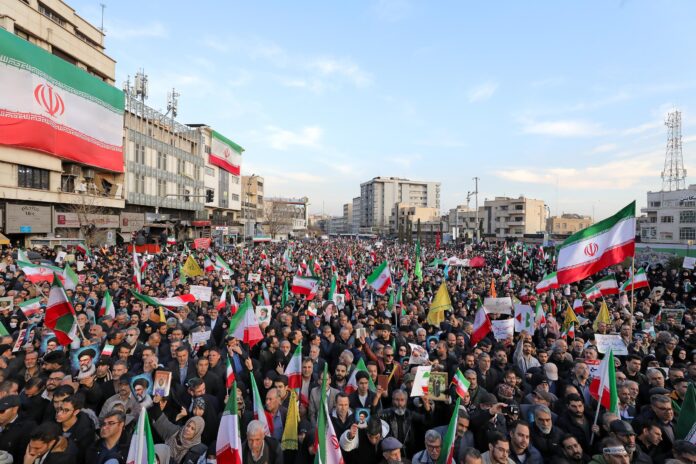
According to Rai, the collapse of the Iranian regime would require cocktails of three conditions. First, sustained and intense military pressure through continuous air and missile strikes would be necessary to weaken the state’s coercive capabilities. Second, these operations would need to be accompanied by extensive ground operations, a prospect that Rai considers highly unlikely given the absence of any international actor willing to undertake the immense costs and risks of such an intervention. Third, a large-scale internal uprising would be required to complement the external military campaign and challenge the regime from within. However, Rai argues that the prospects for such an uprising have diminished considerably. He maintains that both Washington and Tel Aviv missed a critical opportunity by failing to support the mass protests that erupted in January, creating what he describes as a “trust deficit” between the Iranian opposition and external powers. As a result, many opposition groups no longer believe that foreign governments would provide meaningful support in the event of another nationwide uprising.
The Mullah regime isn’t its current form. Rai explains that what has traditionally been described as Iran’s “Mullah regime”—a religious theocracy dominated by the clerical establishment—is already undergoing a fundamental transformation from within, in which the IRGC has become the country’s principal center of power. “The IRGC now exercises greater influence over state decision-making than the traditional religious establishment,” he says.
Rai portrays Supreme Leader Mujtaba Khamenei as an IRGC puppet, arguing the military, not clerics, now drives Iranian politics and security policy. He further points to figures such as Ahmad Vahidi, the Former Minister of Defense of Iran as representing the emerging power structure, suggesting that influential IRGC-linked officials now wield greater practical authority than many senior clerics.
Looking ahead, Rai does not foresee the rapid collapse or complete dismantling of the IRGC. Instead, he predicts a prolonged period of low-intensity conflict through intermittent escalations over the next one to two years.
Israel that has been known for its heavy infiltrations in the IRGC through deploying special members such as Esmail Qaani and former Iranian President Mahmoud Ahmadinejad as part of a regime-change plot alongside their high technology that excelled at locating Ali Khamanei’s place assassinating him, Rai emphasizes that these operations alone are insufficient to bring down the Iranian regime. He describes them as having primarily “nuisance value,” disrupting operations and imposing tactical costs without fundamentally shifting the balance of power. According to Rai, these activities serve as a supporting instrument rather than a decisive strategy for regime change. He adds that the IRGC has strengthened its internal security and command protection measures, making senior leaders increasingly difficult to target through intelligence operations.
In the coming months as the war intensifies, Rai states that the U.S. is expected to deploy high-caliber non-nuclear weapons, such as the MOAB (Mother of All Bombs) and bunker-buster ammunition, specifically designed to penetrate and deteriorate Iran’s underground nuclear facilities.
Rai dismisses the prospect of Kurdish forces opening a northern front against Iran. He says the Kurdistan Regional Government in Iraq has indicated it does not intend to take part in military action against Tehran, particularly after repeated IRGC bombardments along the border discouraged Kurdish involvement. While the U.S. continues discussions on strengthening the Iraqi Kurds’ air defenses, Rai sees Kurdish forces as partners in regional stability rather than a proxy force for an offensive against Iran.
Rai likewise considers the territorial division of Iran to be an unrealistic scenario. Though the minority groups, including the Kurds, Baluchis, and Arabs in Khuzestan, have longstanding grievances against the government, Rai says they lack the organization and sustained external backing needed to threaten Iran’s territorial integrity. Unlike Yemen or Sudan, he sees no broad political or social movement inside Iran seeking partition. In his view, internal discontent alone is unlikely to develop into a viable separatist movement.
The Gulf:
The IRGC and its regional proxies responded with an extensive wave of retaliatory missile and drone strikes targeting U.S. military bases, airports, oil tankers, and desalination plants across the Gulf, including Kuwait, Bahrain, and the United Arab Emirates (UAE), as well as Jordan and Iraq. The strikes aimed to pressure Washington into halting its attacks on Iran.
This time Israel wasn’t on Iran’s target list. Rai attributes this to the MoU framework, noting that Israel is an outside party to the agreement, igniting Iran to only focus its resources on U.S. and regional targets instead. However, he highlights that Israel remains interested in continuing the conflict until Iran’s nuclear ambitions are weakened or entirely abandoned.
The Gulf Cooperation Council (GCC) has struggled to present a unified position toward Iran. While Saudi Arabia seeks to lead the council, countries such as the UAE and Qatar increasingly pursue independent foreign policies. Saudi Arabia has avoided direct retaliation against Iran, describing the escalation as “not our war,” unlike the UAE, which has cooperated militarily with Israel through the Abraham Accords and responded with strikes inside Iran.
“Saudi Arabia is apprehensive about joining a wider coalition with the U.S. and Israel,” Rai says, “because they fear hurting the religious sentiments of their population and want to protect their status as the leader of the Sunni Ummah.”
The rivalry between Saudi Arabia and the UAE extends beyond the current conflict, appearing in disputes over oil production, Sudan, and Yemen. In Yemen, the UAE supports the Southern Transitional Council (STC), which seeks independence for southern Yemen, while Saudi Arabia backs a unified Yemeni state.
Saudi Arabia now faces growing pressure from the Houthis aka Ansar Allah, who have targeted oil infrastructure and Riyadh itself. During the war, the Houthis didn’t target the country at all until Saudi strikes on Sanaa airport, which the Houthis viewed as a red line attack on their delegation returning from Iran. Rai also points to Iran’s efforts to pressure Saudi Arabia by encouraging Houthi threats against the Bab al-Mandeb Strait and Saudi oil infrastructure, especially the “Petroline” (east-west pipeline), which was designed to bypass the Strait of Hormuz . Saudi Arabia also faces threats from Iranian-backed Shia militias in Iraq (Hashd al-Shaabi) that can reach Saudi territory with drones and tactical missiles.
Rai suggests Saudi patience is reaching its limit and that limited retaliatory strikes may become more likely, although Riyadh still seeks to avoid a wider regional war. Despite U.S. efforts and cornering to encourage Saudi-Israeli normalization through the Abraham Accords and a proposed nuclear agreement, the kingdom has delayed joining due to the Palestinian Cause and a growing “trust deficit” with Washington such as when Saudi Arabia denied the US Navy use of its bases for “Operation Project Freedom,” which aimed to ensure freedom of navigation in the Strait of Hormuz.
Kuwait and Bahrain, described by Rai as “satellite countries,” remain heavily dependent on Saudi and U.S. security support. Both face internal challenges alongside external threats, including Iranian-linked groups in Bahrain and political instability in Kuwait. Kuwait in particular as Rai notes, sees no benefit in joining a vulnerable Iraq and instead relies on Riyadh.
Sultanate Oman, traditionally viewed as the region’s mediator between Iran and the West, also faces increasing pressure as Iran seeks greater control over the Strait of Hormuz, while Muscat continues to support free navigation under international rules.
Lebanon:
During the post-MoU period, one notable development has been noticed is the absence of Hezbollah attacks. On June 26, 2026, Lebanon and Israel signed an initial US-brokered framework agreement establishing a pathway toward a comprehensive peace and security deal. The agreement outlines a phased Israeli withdrawal from southern Lebanon, the deployment of the Lebanese Armed Forces (LAF) to restore state sovereignty, and measures aimed at Hezbollah’s disarmament.
Rai maintains that Lebanon must free itself from Hezbollah’s influence to address its prolonged political, economic, and security crises, particularly while the group has gotten weaker than before. Although the government under President Joseph Aoun operates independently of Hezbollah, Rai believes it must also replace the group’s extensive social welfare network, which has long secured public loyalty. “If the U.S, Israel, and international organisations such as the United Nations provide sufficient funding for these services, public support could gradually shift from Hezbollah to the Lebanese state,” he explains.
Despite this opportunity, Rai cautions that Hezbollah cannot be dismantled quickly. He notes that the LAF has been infiltrated and lacks the capability to disarm the group independently. To tackle this, he points to an alternative scenario in which the United States coordinates with Syria’s interim president, Ahmed al-Shara, whose predominantly Sunni forces have a natural incentive to confront the Shiite militia. However, Rai also stresses that al-Shara remains politically weak, faces financial constraints, and commands a fragile coalition of militias rather than a cohesive national army.
Israel’s withdrawal from southern Lebanon is similarly shaped by both security and domestic political considerations. The Israeli forces have advanced beyond the Litani River (the yellow line) to the Zahrani River, making an immediate withdrawal unlikely, Rai notes. With elections approaching, he suggests that leaving now would be politically costly, as it could be portrayed as surrendering the Israel Defense Forces’ (IDF) military gains.
Over the longer term, however, Rai believes Israel is likely to withdraw because maintaining a military presence would become very costly and expose its forces to insurgent attacks, including roadside bombs. While he acknowledges that a portion of Israeli society supports the idea of a “Greater Israel,” he suggests that in Lebanon the practical costs of prolonged occupation are likely to outweigh ideological ambitions.
Iraq:
Iraqi Prime Minister Ali al-Zaidi met with U.S. President Donald Trump on July 14, 2026, at the White House during his first official multi-day trip to Washington after taking office in May 2026.
The visit didn’t revolve only around the economic bilateral deals that focused toward economic partnerships, boosting Iraq’s oil output, and signing dozens of agreements with American companies, but also the U.S. pressure on the new Iraqi government to move forward with plans to disarm Iranian-backed militias and place arms under state control.
Prime Minister al-Zaidi has set a firm deadline of September 30, 2026, for pro-Iran militias to disarm. This timeline coincides directly with the scheduled complete withdrawal of U.S. and coalition forces from Iraq. By pairing disarmament with the exit of foreign troops, the Iraqi government aims to strip hardline factions like Kataib Hezbollah of their primary pretext for maintaining independent arms.
Rai views that achieving this will be a very hard task. He underscores that Iranian-backed groups, particularly the Popular Mobilization Forces Hashd al-Shaabi, remain a formidable force with an estimated 100,000 to 125,000 fighters, including powerful factions such as Kata’ib Hezbollah and the Badr Organization. These groups are well armed, receive support from the IRGC, and continue to benefit from cross-border supply routes. Rai warns that any attempt to forcibly disarm them risks triggering a limited civil conflict, given Iraq’s deeply polarised political and sectarian landscape. He also highlights divisions within the Shiite camp, where factions such as Muqtada al-Sadr’s Saraya al-Salam favour bringing weapons under state control, while pro-Iran groups remain firmly opposed.
Rai proposes that disarmament must be a gradual process rather than a “knee-jerk operation”. It can only succeed if the supply routes from Iran are blocked and the militias are eventually integrated into the federal army.
Another major security concern is the continued threat posed by ISIS (Daesh) in Iraq. Rai calls the group a “time bomb” waiting to explode, particularly following the transfer of ISIS detainees from Syrian Democratic Forces (SDF) prisons to Iraqi custody in January 2026. The transfer was intended as a practical solution because the SDF could no longer securely detain them during the conflict in Syria, but Rai notes that several senior and mid-level commanders have already escaped. He demonstrates that these individuals are currently rebuilding their networks and resources, warning that Iraq is likely to face a renewed ISIS insurgency.
Rai attributes the group’s resilience to both ideological and structural factors. Even if ISIS suffers military setbacks, its ideology endures, allowing it to rebuild over time. He pinpoints to the fact that many of its members are former Iraqi Ba’ath military officers with extensive combat experience, posing difficulty to rehabilitate. He adds that the continued marginalisation of Sunni communities, particularly in Anbar province, creates fertile conditions for extremist recruitment.
As a solution, Rai advocates an exclusionary approach rather than reintegration. He maintains that committed ISIS members should be permanently removed from society through long-term imprisonment or expulsion, arguing that isolation is essential to preventing the group’s resurgence and protecting Iraq’s long-term security.
U.S. Special Presidential Envoy for Syria and Iraq Tom Barrack was the one behind Washington’s efforts to persuade Iraq’s new PM to dismantle Iranian-backed militias. Although many Kurds distrust Barrack, particularly over U.S. policy toward the Syrian Kurds, Rai ascertains the Kurdistan Region of Iraq (KRI) remains an indispensable security partner for Washington. He says the Iraqi Kurds hold greater geopolitical value than their Syrian counterparts because the U.S. can maintain close ties with both Baghdad and Erbil. Rai describes the KRI as a reliable ally in such an important region. He also says negotiations are underway to equip the KRI with integrated air defence systems to counter missile and drone attacks from Iran and its proxies. According to Rai, the Kurdish leadership has few viable alternatives for external protection and recognises that its long-term security depends on preserving its partnership with Washington.
Jordan, Gaza and Palestine:
King Abdullah II of Jordan visited the United Kingdom on July 21, 2026 to attend the Jordan–United Kingdom Business Forum to strengthen trade, investment, and economic cooperation. However, opposition figures interpreted the trip differently, claiming it reflected the King’s intention not to return to Jordan amid growing domestic and regional pressures.
Jordan’s security has become questionable following Iranian missile strikes, especially the attack on Muwaffaq Salti Air Base that killed three U.S. service members. The incident received criticism from the U.S. President Donald Trump, who questioned Jordan’s air defence capabilities and suggested that Iranian forces may have benefited from internal security lapses to accurately target American military installations. The strikes also revived speculation about Jordan’s future role in the Palestinian question, particularly as Prime Minister Benjamin Netanyahu and the Likud Party continue to reject a two-state solution. Some observers have therefore suggested that Jordan could become an alternative Palestinian state.
Rai dispels this possibility, because Jordan lacks economic resources to host a large influx of people. He points to the memories of Black September, when domestic stability was shaken. Jordanian society, he adds, has little appetite for absorbing another large refugee population after decades of supporting displaced Syrians, including those in camps such as Zaatari. Rai also doesn’t see any possibility of regime change, as such development would require substantial U.S. backing, which is currently absent.
Turning to Gaza, Rai labels Hamas as an Iranian ally of convenience rather than a natural proxy like Hezbollah because of its Sunni identity. Although he believes Hamas has been severely weakened by Israel’s military campaign, he argues that its ideology will endure due to persistent grievances and the humanitarian conditions in Gaza. Rai expects Israel to retain effective control over the territory while supporting rival local armed groups to eliminate the remaining Hamas and Palestinian Islamic Jihad networks. He further warns that the humanitarian situation is likely to deteriorate and notes that some within Israel favour policies that would encourage Gazans to leave voluntarily, advancing aspirations associated with a Greater Israel.
Egypt is pulled in
Egypt has insisted on its stance that it will not accept large numbers of Palestinian refugees within its borders. However, the country’s security concerns took a new shape following a drone strike on the U.S.-owned gas storage tanker at the Mediterranean port of Damietta on Wednesday July 29, 2026. Egyptian authorities initially described the incident as a contained fire, but after media reports linked the attack to drones similar to those used by the Houthis and Hezbollah, the Egyptian Cabinet confirmed the following day that the explosion had indeed been caused by a drone. The government has since faced growing pressure to identify those responsible, while Iranian Foreign Minister Abbas Araghchi has blamed Israel for the attack.
“It is likely for Iran to target Egypt as part of a broader strategy to expand the regional conflict,” Rai highlights. “Tehran’s objective would be to threaten the Suez Canal—one of the Middle East’s three major maritime choke points alongside the Strait of Hormuz and Bab el-Mandeb—thereby increasing the strategic and economic costs of regional engagement for both Egypt and the international community.”
Thus, he recommends that Egypt strengthen its integrated air defence systems, arguing that it is no longer insulated from Iranian military threats.
Rai suggests that Egypt’s stronger military capabilities and its 100 million -human capacity with fewer ideological constraints would make it a more likely participant in a regional security coalition if the conflict continues to escalate.
Far left:
In July, U.S. Secretary of State Marco Rubio and the Trump administration launched a global campaign against what they described as far-left extremism. They hosted an international summit in Washington with representatives from more than 60 countries to discuss the rise of transnational political violence. The administration also designated four Europe-based far-left groups as Foreign Terrorist Organizations (FTO) and introduced new visa restrictions targeting individuals linked to these groups and other networks involved in economic sabotage.
These developments have renewed attention to the long-discussed relationship between segments of the far left, Islamist movements, and the Muslim Brotherhood, often characterized by analysts as a “Red-Green Alliance” or an “alliance of convenience.” Although these movements are ideologically incompatible—with Islamists seeking religious governance and radical leftists advocating secular revolutionary politics—they have at times converged around shared opposition to Western institutions, capitalism, liberal democracy, and Zionism. Analysts frequently point to the 1979 Iranian Revolution as a historical example: leftist factions initially cooperated with Islamist forces in overthrowing the Shah, but after consolidating power, the new Islamic Republic marginalized and suppressed its former leftist allies. This episode is often cited as evidence that such alliances are tactical rather than enduring.
Also, Supreme Leader Ali Khamenei translated the works of Islamist thinkers, including Muslim Brotherhood founder Hassan al-Banna and Sayyid Qutb, into Persian, helping embed their ideas within the ideological foundations of the Islamic Republic despite doctrinal differences. Shared anti-imperialist narratives, particularly opposition to the U.S and Israel, have continued to provide common ground for cooperation between Islamist and far-left movements.
Rai suggests that Rubio’s announcement reflects a response to the growing collaboration between segments of the far left and Islamist movements that are part of Iran’s regime, which he argues has contributed to increased political tensions and efforts to influence public policy.
Rai further argues that these ideological movements have developed significant “intellectual capital” through their presence in specific institutions, particularly academia and journalism. He contends that their influence has shaped educational frameworks and affected narratives surrounding regional conflicts and broader political debates.
Rai predicts that as regional conflicts begin to ease, both far-left and Islamist groups will face increasing scrutiny from the international community. Yet he does not expect these movements to disappear entirely due to their established influence within powerful institutions, instead he believes their political impact will likely diminish in the near future.