
By Lesedi Sibiya-Diplomatic Insider
This was known as the Anti-Pass Campaign, which saw these women march, some carrying babies on their backs in order to demand that the pass laws be abolished. The march against the pass laws was organized by The Federation of South African Women or otherwise known as (FSAW).
The intention, strength and the might of 20,000 women from all walks of life and ethnicity with the common goal to march to the Union Buildings in Pretoria with a petition addressed to the Prime Minister at the time JG Strijdom.
The false notion that “women belong in the kitchen” is what these women challenged by saying “women belong everywhere”. Strijdom was not at the Union Buildings to accept the petition, however this did not discourage the resilience of these women.
They handed the petition to the secretary of the minister and sang the phrase “wathint’ abafazi, wathint’ imbokodo” , which translates (You strike a woman, you strike a rock!) a phrase that represents the resilience of South African women.
FSAW was founded by Ray Simons who brought in prominent figures such as Lilian Ngoyi, Helen Joseph, and Amina Cachalia who spearheaded the committee for the organization.
This organization had 146 delegates representing 230,000 women across the country when they attended the founding conference in 1954.
This founding conference was even where the “Women’s Charter” was written in which it called for men and women of all races to have equal job opportunities, equal rights regarding property, marriage and children and the removal of any and every law that prevented women from having these rights.
Now, today the world is faced with turmoil in every crevice of our global landscape with Congo, Sudan and Palestine ravaged by meaningless war and in South Africa the meaningless war against our women and children.
This month is the commemoration of the bold and resilient efforts of the women of South Africa of 1956 and the women of today.
President Cyril Ramaphosa addressed the men of South Africa to stand up against Gender-Based Violence (GBV) in his efforts to commemorate the women of 1956 who marched bravely to the Union Buildings where 20,000 women had gathered to petition against apartheid laws.
The conversation surrounding GBV has been a point of contention and has dominated not only around Women’s Day but all year round with Ramaphosa taking the opportunity to address the outline solutions which includes the creation of the National Council on GBV.
“Men and boys must step forward and say ‘Not in my name’. More and more men must stand forward and say, ‘I shall not lift a hand against any woman’. Said Ramaphosa in his address.
The commemoration event also took the opportunity to celebrate the achievements of women. “We find that women absorb education much more than men. But too few of them enter into engineering, into science, into technology. We want to see more and more women into the STEM disciplines.” said Ramaphosa.
The National Council on GBV was established under the National Council on Gender-Based Violence Act of 2024, in order to provide strategic leaderships on efforts to eliminate Gender-Based Violence and Femicide (GBVF) while simultaneously implementing of the National Strategic Plan (NSP) on GBVF across government and other sectors.
The President has appointed Dr Ramalepe Lebogang Mathibe as the chairperson of the council and Welheminah “Shoki” Tshabalala as deputy chairperson.
The council is also expected to strengthen coordination between the government, civil society, and communities while in tandem driving measures to prevent violence, improve support for survivors, strengthen law enforcement, and advance women economic empowerment.
“We’ve appointed the Gender-Based Violence Council to lead the process of ensuring that we bring down and eliminate Gender-Based Violence in our country,” said Ramaphosa.
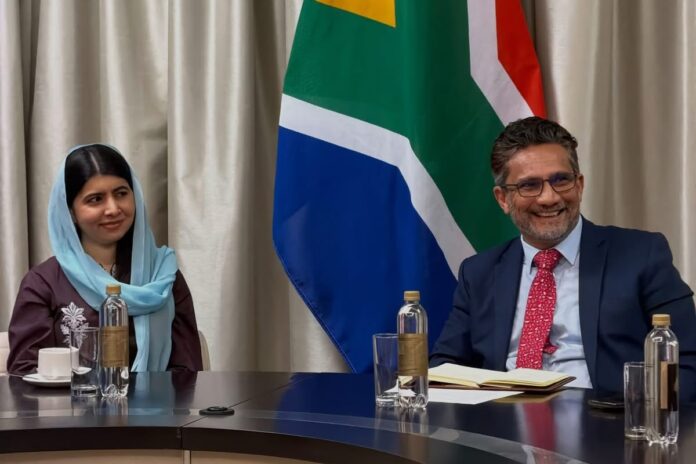
Nobel Peace Prize winner, Malala Yousafzai, was the guest speaker at the Women’s Day commemoration event. Yousafzai, was shot in the head by the Taliban when she was 15 for advocating that girls should be allowed to go to school, in the Swat Valley of Pakistan in 2012 and expressed that the women of 1956 had inspired her to stand up for the rights of others .
“It took incredible courage to speak out in 1956, four decades before the end of apartheid and the risks were greatest for black SA women, as they still are today, who faced not only the radical discrimination of apartheid but the added burdens of being a woman in a patriarchal society.
There were a plethora of activities around the city of Johannesburg where the spirit of Women’s Day was commemorated and celebrated such as the Basadi in Music Awards, the Pic n Pay food and wine festival, Women’s Day Dance and Fitness Event.