
*Thobile Jiwulane
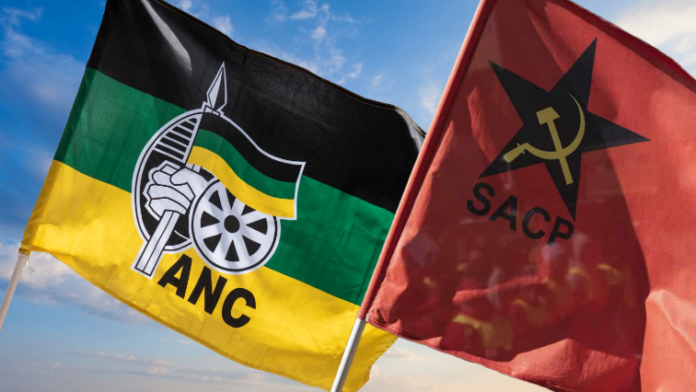
South Africa’s former ruling party, the ANC, now part of the multiparty Government of National Unity (GNU) is facing a future and a crucial election without one of its important allies, the left-leaning South African Communist Party (SACP).
The SACP has decided to split from Nelson Mandela’s ANC and to contest the November local government elections on its own. It previously contested under the ANC umbrella and shared elected public representatives (parliamentarians and councillors) with it. With the two allies set to face off in the polls, tensions have escalated and there is already a public spat among their leaders. It’s not surprising, though, because the SACP is hoping to recruit members and canvass votes from the ANC membership – an inevitable situation given the close proximity between the two parties.
It couldn’t have come at a worse time for the ANC, which has been shedding votes since 2009, when Jacob Zuma ran for president and succeeded Thabo Mbeki, a cadre groomed for leadership in exile by the late stalwart Oliver Tambo. As matters stand, it seems the battle lines are drawn. The ANC has focused on ensuring the SACP does not steal its members and voters, warning that disciplinary action would be taken against those who canvassed for the SACP.
The alliance is set to end in bitterness after decades in which the ANC and the SACP fought the anti-apartheid struggle together, won freedom together and ruled the country together under the ANC umbrella.
Although they differed ideologically, with the ANC following a centrist social-democratic path and the SACP a left-wing party aiming to achieve socialism, they agreed to fight a two-stage anti-apartheid struggle. The first stage was to achieve the National Democratic Revolution (NDR), which was about attaining freedom from apartheid and ensuring economic transformation from a white-dominated economy to an equal society. The second stage was to follow later, involving a swift move to a socialist state as envisioned in Marxist-Leninist doctrine.
Political analyst and a Marxist theorist Prof George Tsibani, describing the two stages, said: “The first stage is national democratic: the destruction of colonial and apartheid property relations, the transfer of the commanding heights of the economy to the ownership of the people as a whole, and the achievement of genuine national sovereignty. The second stage is socialist: the conscious construction of a classless society based on social ownership and planning. These stages are not arbitrary; they are grounded in the concrete balance of class forces, just as Piaget’s stages are grounded in biology and cognition, and each stage must be traversed in full before the next can be secured” (Tsibani, 2026).
However, given the relationship between the SACP and the ANC, the second stage appears to be pie in the sky, as under the GNU, the ANC is allied mainly with right-wing and liberal parties that opposed socialism. The SACP feels that the vision of a socialist society has been derailed by the ANC, which first agreed to pursue neoliberal policies, such as the Growth, Employment and Redistribution policy, dominated by white capital. The SACP’s point of departure is that the ANC works in cahoots with parties that pursue capitalism, such as the Democratic Alliance and its offshoots, including ActionSA, Rise Mzansi, and Build One South Africa, as well as right-leaning parties like the Freedom Front Plus, Inkatha Freedom Party, Patriotic Alliance, among others that serve in the GNU.
The SACP openly expressed mistrust of the ANC and its new path, claiming the party has betrayed the working class, who form the bulk of its electorate. This is what separates the two parties. According to SACP general secretary Solly Mapaila, the party would have preferred the ANC to cooperate with left-wing parties such as the Economic Freedom Fighters and the Umkhonto Wesizwe Party, which have radical left agendas.
Tsibani argues that the NDR is incomplete as it stands, and therefore, a leap to socialism was premature. He argues that the first stage (NDR) must be fully traversed, as was the case in China prior to the Chinese Revolution led by Chairman Mao Zedong and in the Soviet Union under Vladimir Lenin. He said no system would work without going the full circle, including the attempt by the Left to leap to socialism, the second stage in South Africa.
“To attempt to leap from colonial bondage to socialism without dismantling monopoly capital is ultra-left adventurism. That adventurism includes the tendency to dump the incomplete NDR and the Two-Stage Theory by leaving the ANC Alliance partners. To remain indefinitely in the first stage without advancing to socialisation is right opportunism and class betrayal,” Tsibani argues.
Theories aside, what matters now is how the ANC moves forward without the SACP, which has been its declared intellectual guide. Will the ANC carve its own path and abandon the dream of a socialist society once put on the agenda? The signs are there. Socialism path is already in the rocks, while capitalism still sends shivers down the spines of many formerly oppressed masses who form the base of South African voters.
Although the Two-Stage Theory debates motivated the anti-apartheid struggle in South Africa, many have forgotten about it, and indications are that it is on the way out. People are presently concerned with the bread-and-butter issues which either the ANC or the SACP must satisfy before they fight over a political system that must be implemented now or in the future.