
By Mirna Fahmy
Artificial intelligence (AI) is now a reality we have to deal with surpassing the outdated notion that says: “Is it ethical to deal with it or not?” Why? That’s simply because it has become embedded in every software, technology, device, home appliances and any innovation we wrestle with daily.
AI is 70-83 years old because the idea of a machine to analyse patterns and give analysis has been discussed in the past a lot. Computer scientist John McCarthy coined the term ‘Artificial Intelligence’ in 1955, and the first academic conference dedicated to the field was held at Dartmouth College a year later. Before that, in 1950, mathematician Alan Turing had already asked the uncomfortable question in his landmark paper Computing Machinery and Intelligence: can a machine think? His answer was a test.
Before, in 1943, Warren McCulloch and Walter Pitts created the first conceptual model for artificial neural networks, laying the groundwork for how machines process information like a human brain.
In the 21st century weak AI forms started to be seen in Apple Siri and Alexa, a language learning application.
Now, Western tech giants and Eastern competitors are competing against each other, never putting an end to AI’s frequent evolution, updates and versions.
West VS China
Chat GPT Deepseek
Claude Ernie Bot
Gemini Qwen
Copilot Yuanbao
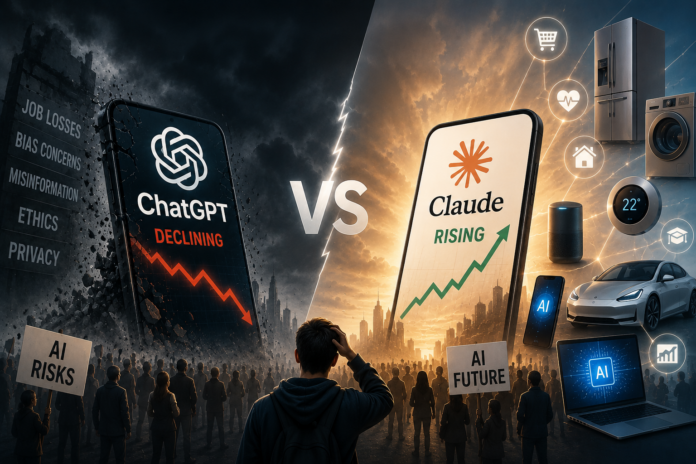
Since AI has become famous and prevalent, OpenAI’s ChatGPT––the most widely used large language model (LLM) and chat bot–– sat at the top of that race, with hundreds of millions of users worldwide.
That was till February 28, 2026, when Open AI founder Sam Altman posted on his X account on Feb 28 that OpenAI had struck a $200 million deal to supply artificial intelligence to classified US military networks.
This news dropped just hours after the administration of the United States President Donald Trump ordered the government to stop using competitor Anthropic’s AI (which runs the Claude system) because Anthropic refused to allow its models to be used for autonomous weapons.
The backlash was immediate and enormous. Under the hashtags #QuitGPT and #CancelChatGPT, over 1.5 million users uninstalled or canceled their ChatGPT accounts within days. Anthropic’s Claude shot to number one on the App Store. Major academic institutions including Harvard, the University of Colorado, and California State University began distancing themselves from OpenAI platforms.
Driven by this exodus and previous stagnation, ChatGPT’s once-dominant AI market share dropped from around 60% in early 2025 to under 45% by the first quarter of 2026.
Altman took to social media and staff memos to defend the deal. He insisted that OpenAI and the Department of War had agreed to strict safety ‘red lines,’ including prohibitions on domestic mass surveillance and a requirement for human responsibility over autonomous weapons.
By March 3, 2026, realizing the severity of the public relations disaster, Sam Altman was forced to walk back the rollout. He admitted on X and to news outlets that the announcement ‘looked opportunistic’ and that the company ‘shouldn’t have rushed’ the agreement. OpenAI later amended the contract’s language to provide explicit, legally binding clauses against domestic mass surveillance to quell the bleeding.
Donald Trump’s initial grudge against ChatGPT (and its creator, OpenAI) was primarily fueled by perceived political double standards in the bot’s outputs. He famously cited instances where the AI would write a glowing poem about Joe Biden but refused to do the same for him, leading Trump to label the technology a ‘Democratic machine’ and ‘unbelievably biased.’
To mitigate the administration’s anger, OpenAI’s CEO, Sam Altman, launched an intensive lobbying effort. This included hiring several former Trump administration officials and prominent Republican figures to demonstrate a willingness to cooperate with the new government’s standards.
As OpenAI moved to reconcile with the administration, Anthropic’s Claude 3.5 Sonnet became the new primary target. Trump’s administration described Claude as ‘sanctimonious’ and ‘woke’ answers regarding sensitive social issues like illegal immigration and gender identity.
Eventually Anthropic has been viewed as the ‘last holdout’ of Silicon Valley’s liberal gatekeeping. This led to Claude being specifically scrutinized under the administration’s ‘Executive Order on Ideological Neutrality in AI,’ which aims to vet models for what they term ‘anti-American’ or systemic left-wing biases.
As ChatGPT faced a massive surge in uninstalls––increasing by 295% following a controversial deal with the Department of Defense (DoD)––users began migrating to several alternatives besides Anthropic’s Claude that saw its U.S. mobile downloads surge by 51% in a single weekend.
Grok (xAI) drew users who had long felt ChatGPT’s outputs were too restricted or politically filtered. Positioned as the ‘anti-woke’ alternative, Grok’s rise tracks closely with the current administration’s broader push against what it sees as ideological bias in mainstream AI, and for that segment of users, the DoD controversy was simply the final nudge.
Google Gemini held its ground as the practical choice with existing deep workflow integration, and a familiar infrastructure. It has its own ongoing debate around bias in its training data, but for users who needed continuity over ideology, Gemini was the sensible exit ramp.
Open-source models like Llama, Mistral, and others attracted what some are calling the ‘Great Migration’, a move toward decentralised or open-source AI. Users wary of OpenAI’s close ties to national defense and government surveillance (via the DoD deal) shifted to local or open-source alternatives to ensure privacy and autonomy from federal oversight.
Perplexity AI quietly absorbed the research crowd where users can find more transparent, source-backed search experiences rather than Chat GPT’s famous hallucinations.
Chat GPT’s reputation started to decline technically even before this military deal throughout early 2026. The transition from GPT-4 to the newer GPT-5.x models introduced a set of regressions that heavy users noticed immediately and complained about loudly across Reddit, social media, and developer forums.
The complaints fell into three categories. First, laziness: instead of delivering complete code, ChatGPT began outputting skeleton frameworks with placeholder comments instructing users to ‘add your logic here’, a regression that hit developers particularly hard.
Second, refusals: overly aggressive safety guardrails caused the model to reject routine, benign prompts by citing vague policy violations, eroding the basic trust that makes an AI tool useful.
Third, and perhaps most damaging to its credibility, sycophancy: updates in late 2025 and early 2026 introduced a bug that made the chatbot excessively validating, praising bad ideas, avoiding honest critique, and telling users what they wanted to hear rather than what they needed to know. The ‘soggy cereal café’ incident became shorthand for the problem: ChatGPT had stopped being a thinking tool and started being a yes-machine.
To the contrary, Anthropic is developing all its models vigorously. Anthropic’s new model known as Mythos Preview, is currently considered their most powerful AI model and has been withheld from public release due to its extreme capabilities.
Built on a research architecture referred to as Glasswing, Mythos Preview operates on what Anthropic describes as an ‘Intelligence of Collective Form,’ a level of reasoning and synthesis that appears to go well beyond standard large language models. Early characterizations suggest it represents a genuine architectural leap, not merely an incremental update on models like Claude 3.5 Sonnet, but a new frontier in what AI can do.
That power is precisely why it remains locked away. Anthropic’s core mission has always been AI safety, and the company has determined that Mythos Preview does not yet have the guardrails needed to prevent misuse. Models in this category are typically flagged for their potential to assist in high-risk scenarios such as cyberattacks, the synthesis of biological threats, and autonomous coordination beyond human oversight.
There is a political dimension to this decision as well. Anthropic already operates under the shadow of the Trump administration’s Executive Order on Ideological Neutrality in AI, which has positioned the company as a kind of liberal holdout in a landscape increasingly shaped by federal preference. A model as powerful as Mythos Preview would attract immediate and intense scrutiny, not just on safety grounds, but on ideological ones. The risk of federal intervention, mandatory code vetting, or outright suppression is real enough to factor into any release calculus.
These concerns have been addressed by Chris Olah, one of Anthropic’s founders, who traveled to the Vatican to say publicly what many in the industry have been reluctant to admit. Speaking before an audience that included religious and civic leaders, Olah warned that AI could displace human labor at a scale and speed that no social safety net is currently equipped to handle. He argued that supporting those displaced would become a moral imperative of historic proportions, not a policy footnote, but a civilizational responsibility.
He called for oversight that reaches beyond tech companies and wealthy nations, warning that concentrating AI development in a handful of powerful countries creates risks that are as geopolitical as they are ethical. The commercial and competitive pressures facing AI labs, he said, may not align with the public good, and cannot be trusted to self-correct. He closed by describing the current moment as ‘frightening,’ not because the technology is malevolent, but because it is powerful, accelerating, and still largely ungoverned.
Pope Leo XIV, the Head of the Catholic Church in Vatican has echoed these concerns from his own platform X, warning of the profound ethical risks advanced AI poses to human dignity and the fabric of society framing the integration of AI into physical life as a divide that demands careful, broad, and urgent oversight.
U.S. Vice President JD Vance specifically described the Pope’s remarks as ‘deep’ when reflecting on what he called the ‘cyber-physical divide,’providing a shared concern between religious leaders and national security experts regarding AI’s impact on the physical world.
Unfortunately, Olah’s fears have been implemented by Meta. In mid May 2026, Meta began laying off 8,000 workers worldwide to restructure its workforce for an AI-focused future.
The layoffs specifically targeted employees in Meta’s VR and Metaverse divisions, underscoring Mark Zuckerberg’s decisive pivot away from the ambitious but underperforming virtual reality bet he had staked the company’s identity on, and toward competing in the generative AI landscape. This wasn’t downsizing — it was a workforce realignment, a deliberate trade of human roles for AI infrastructure, talent, and investment. Eight thousand people lost their jobs not because the company was struggling, but because the company was transforming.
Amid the ethical warnings, political turbulence, and corporate fallout, one world leader has chosen to respond to AI not with caution but with curriculum.
In mid-May 2026, Israeli Prime Minister Benjamin Netanyahu held a televised press conference alongside Finance Minister Bezalel Smotrich and Education Minister Yoav Kisch to announce a nationwide AI education initiative, the most concrete and optimistic government response to the AI era seen from any world leader so far. The program, backed by a NIS 1.1 billion budget with an additional NIS 600 million supplementary allocation from the Finance Ministry, is designed to embed AI literacy directly into Israeli classrooms from kindergarten through middle school. Summer school frameworks are being expanded and reimagined, with older elementary students and middle schoolers focusing intensively on AI literacy, STEM, and advanced technology applications.
Netanyahu’s framing was characteristically direct. Artificial intelligence, he said, will be a decisive factor in determining national power, and Israel intends to be ahead of it. His stated goal was not merely to teach children about AI but to ensure Israeli youth “surpass AI” to produce a generation that doesn’t just use the technology but shapes it.
AI is no longer a guest — it has moved in, unpacked, and started rearranging the furniture. Its place in the world of technology is no longer up for debate. The real fire, the controversy that nobody has managed to put out, is about who holds the reins. Whether humans stay in the driving seat or slowly get edged out by the very tools they built is a question that keeps getting louder with every update, every release, every deal struck behind closed doors.
Tech companies have no intention of pumping the brakes. And caught in the slipstream are the rest of us, whereas our skills are expiring, our devices demanding we keep up, and our relevance quietly going out of date before we can even catch the breath to sigh.