
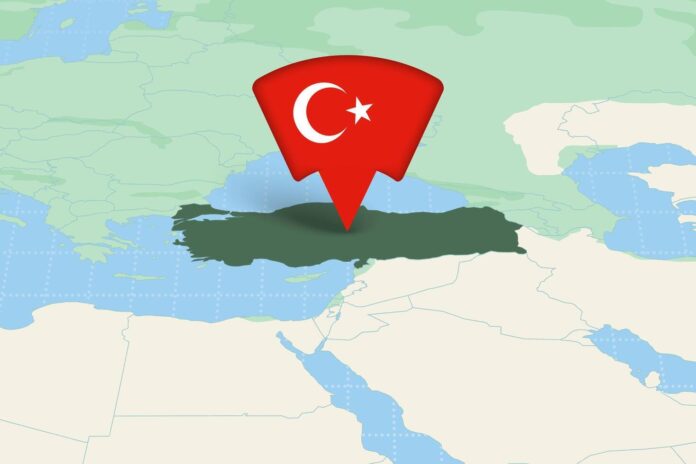
Türkiye is reshaping the Middle East through railways, alliances, and internal electoral manipulation, but Hadi Elis explores how the architecture of its ambition rests on contradictions it may not survive.
By Mirna Fahmy
Consumed by the U.S.-Israeli war on Iran, Turkish President Recep Tayyip Erdoğan has utilized regional instability as a strategic smokescreen to accelerate the dismantling of domestic opposition without facing international attention.
With the 2028 elections approaching, Erdoğan has shown no intention of relinquishing power. Instead, he is moving to rewrite Türkiye’s constitution, consolidating support among Turkish Islamists and ultra-nationalists while neutralizing any opposition. On May 21, 2026, a court ruling invalidated the 2023 leadership election of the Republican People’s Party (CHP), Türkiye’s main secular opposition. Shortly after, riot police stormed CHP headquarters in Ankara, using tear gas and rubber projectiles to clear party officials from the building.
The crackdown extended beyond the CHP. The government arrested several high-profile figures, most notably Istanbul Mayor Ekrem İmamoğlu, widely regarded as Erdoğan’s strongest potential challenger for the presidency. Elected Kurdish mayors have continued to be removed and replaced with state-appointed administrators known as Kayyum, while Kurdish political leader Selahattin Demirtaş remains imprisoned. Anti-terror laws have been broadly applied to silence critics across society, including academics, journalists, and civil servants.
For Erdogan to achieve his ambition, he has to rely on the votes of the Pro-Kurdish DEM party which commands between 7–10% of the national electorate, enough to determine the outcome of any close election. When the DEM Party sides with the CHP, Erdoğan loses.
However, the Sociologist, Kurdologist and Middle East analyst Hadi Elis draws attention to Huda-Par that Erdogan prefers because they align with his ideological project transforming Türkiye into a Sharia-influenced state or Islamic republic reviving neo-Ottomanist circle to unite Muslims and project Turkish power across former Ottoman territories like Syria, Lebanon, and Egypt.
“By playing Huda-Par against the DEM party, he attempts to find the necessary parliamentary support,” Elis notes.
Türkiye officially portrays DEM as the political front of the Kurdistan Workers’ Party (PKK), but Elis pushes back on this framing. The PKK has its own political front, which is banned in Türkiye. DEM functions as an intermediary, a legal channel operating between the Kurdish population and the state, not a direct extension of the PKK itself.
Erdoğan exploits this ambiguity. He controls access to imprisoned PKK leader Abdullah Öcalan, who has been held since 1999, and uses that as a bargaining chip. Elis describes his approach as seeking a ‘nice balance’: appearing to engage in peace talks while deliberately slowing the process, limiting Öcalan’s media access and contact with PKK leadership to prevent any momentum that could shift public opinion before the next election.
Last year in 2025, the PKK dissolved and its fighters began burning weapons. Yet thousands of former militants remain in camps in northern Iraq, waiting for a return-home law or amnesty that has not come. Erdoğan has withheld these legal frameworks, demanding unconditional verification before any reintegration. This stall serves a dual purpose whereas it keeps ultra-nationalists satisfied while leaving DEM politically dependent on him, dangling the promise of future reforms in exchange for their support on a constitutional amendment that could extend his rule indefinitely.
Elis warns that this prolonged limbo carries serious risks. He draws a parallel to the IRA’s fracture into dissident factions like the Real IRA. The PKK’s military commanders in the Qandil Mountains of northern Iraq were never fully convinced by the ceasefire, which Öcalan called from his prison cell on İmralı Island.
Continued Turkish military pressure on Kurdish positions in Iraq and Syria could push hardline elements to break away entirely. Erdoğan may not see this as a problem. Elis adds: “A single attack from a splinter faction would incite him to declare victory over the main organization while reigniting nationalist war rhetoric ahead of elections positioning himself as the indispensable guardian of Turkish security.”
Adding another layer of complexity is the Kurdistan Regional Government (KRG) in northern Iraq. As a semi-autonomous region within federal Iraq, the KRG has maintained military and intelligence cooperation with Türkiye against the PKK, and depends on Turkish pipelines to export its oil aligning with Ankara despite the shared ethnic ties with Türkiye’s Kurds.
The DEM Party’s primary objective, according to Elis, is aiming to achieve regional autonomy within Türkiye allowing the Kurdish population to govern itself internally. Elis describes DEM’s base as ‘normal people’ seeking political solutions, careful not to become too entangled with the PKK. There are indications that DEM may support Erdoğan’s bid for a third presidential term in exchange for constitutional guarantees on autonomy. But Elis flags a critical danger that Erdoğan may offer only the minimum constitutional concessions necessary that he could revoke at will, given what Elis likens to the unchecked authority of a dictator or caliph.
Securing a third presidential term through constitutional change while gambling on Kurdish support amid growing domestic opposition, carries serious risks, even for Erdoğan’s own base. Studies of the 2017 and 2018 Turkish elections found strong indicators of electoral malpractice, including ballot stuffing and voter manipulation. The opposition must therefore deploy volunteers to monitor polling stations and expose irregularities publicly though challenging results in court remains nearly impossible, Elis highlights, given that the judiciary is largely under Erdoğan’s control.
The threat is not only institutional. In June 2020, the Turkish parliament passed a controversial law granting the nightwatchmen (Bekçi) the same powers as the police, including carrying firearms, stopping and searching individuals, and detaining suspects. By 2026, the force reportedly had more than 28,000 members. Separately, reports describe another civilian paramilitary network allegedly led by Orhan Uzuner, the father-in-law of Erdoğan’s son, Bilal. Although the network publicly claims to focus on disaster preparedness and emergency communications, reports claim it operates training camps where participants receive instruction in combat, sabotage, and surveillance.
Yet repression has limits. Elis maintains that “when oppression becomes unbearable, when people can no longer feed their families and feel they have nothing left to lose, it paradoxically hardens resistance. That desperation is what drives people into the streets, into protest movements, and ultimately into direct confrontation with the state.”
Hejaz railway, its survival and India:
Beyond domestic consolidation, Türkiye is expanding its regional footprint. Infrastructure projects such as the Hejaz railway––long described as an Ottoman dream by Sultan Abdulhamid II in 1900–– and a deepened military presence in Syria and Libya. This to reinforce Erdoğan’s image and represent the most visible expression of his longer project which is the dismantling of the secular democratic order that Mustafa Kemal Atatürk––the first President of Türkiye and the founder of CHP–– established following the collapse of the Ottoman Empire.
Ankara’s ultimate geopolitical ambition is to turn Türkiye into an indispensable energy and logistics hub, blending and routing Russian, Caspian, Iranian, and Gulf energy through its territory before exporting it to Europe. In doing so, Ankara seeks to strip away the political baggage of rival states while forcing some regional powers to finance Türkiye’s rise to hegemony.
In April 2026, Türkiye, Syria, and Jordan signed an agreement to integrate their transportation systems, and in June 2026, Türkiye and Saudi Arabia signed two memorandums of understanding on railway cooperation, bringing Riyadh into the revival. The envisioned route runs from Istanbul to Medina through Syria and Jordan, with long-term plans extending as far as Oman and the Indian Ocean, connecting directly to the ‘Four Seas’ initiative, which aims to link the Persian Gulf, Mediterranean, Caspian, and Black Seas through a single integrated transportation and energy network.
The project is deliberately designed to bypass Israel. Trade Minister Ömer Bolat stated openly that the railway aims to reduce Israel’s regional influence while deepening solidarity among Türkiye’s southern neighbors. It is also a direct rival to the U.S.-Israeli-backed India-Middle East-Europe Economic Corridor (IMEC), which would connect India to Europe through the Israeli port of Haifa. The absence of Israeli-Saudi normalization reinforces this dynamic as Riyadh has always insisted on a Palestinian state, a precondition that the current Israeli government rejects.
“The modern project aims to create Turkish-Arab cooperation and share Islamic interpretations as tools to build a unified bloc that could counterbalance other regional powers,” Elis explains. “Türkiye would act as the leading military force, similar to the U.S. role in NATO, anchoring a security alliance spanning Syria, Jordan, Pakistan, Kuwait, and the Gulf states.”
Jerusalem sits at the ideological core of this posture. During a June 2026 speech, Interior Minister Mustafa Çiftçi expressed a desire to see Jerusalem come under Turkish dominion. The remarks aligned with Erdoğan’s long-standing rhetoric, describing Jerusalem as a sacred trust and warning that Türkiye would never accept U.S. or Israeli claims over the city. Israeli Defense Minister Israel Katz responded that the Ottoman Empire is finished and Jerusalem is Israel’s capital for 3000 years, while Prime Minister Benjamin Netanyahu called Erdoğan an antisemitic dictator committing genocide against the Kurds and the last person qualified to lecture Israel on morality.
Despite the ambition, Elis cautions that when accounting for military, water, and geopolitical complexities, this remains a 30-to-40-year project though he believes it could be achieved in 5 to 10 years under the right conditions. “Israel, Saudi Arabia, and Jordan view the railway as potentially beneficial, but only if they share both the profits and the security responsibilities.”
Water plays a role in this project. Türkiye controls water resources affecting Iraq, Syria, Iran, and Georgia, while Israel holds advanced desalination technology that most regional states lack. Control over water, alongside economic and military power, Elis emphasizes, is quietly reshaping the region’s geopolitical order.
Yet the project carries internal contradictions. “If economic and military dominance falls exclusively to Türkiye, it will bring Turkish nationalism into direct conflict with Arab nationalism. Even Islamic solidarity offers limited glue, as Arab and Turkish Islam interpret the faith differently,” Elis points out.
Regional diplomatic realignments could also complicate the project’s development. The U.S President Donald Trump’s push for Türkiye, Pakistan, Syria, Saudi Arabia, Qatar, Iran, Egypt and Jordan to sign the Abraham Accords amidst Iran negotiations would have forced those countries to confront issues that could obstruct railway investment. Though the Accords have been seen as weak, particularly after the U.S. signed a deal with Iran that sidelined Israel and the UAE, Elis portrays that the deal is illusional for geo-politics shifts and the Accords remain on the table and could be revived as a flashpoint, redirecting investment away from the Turkish-led corridor.
Now India’s membership in BRICS alongside its non-aligned status represents a serious geostrategic challenge to Türkiye. Through a doctrine of multi-alignment — building issue-based coalitions rather than fixed blocs — India has recently signed defense pacts with Israel, Greece, and Armenia, countries that sit in direct tension with Türkiye and its allies.
Given that Türkiye and Azerbaijan have consistently backed Pakistan on Kashmir forming the Türkiye-Pakistan-Azerbaijan TPA axis, India is practicing deterrence by strengthening Türkiye’s rivals rather than confronting Ankara directly. Defense deals with Armenia exceeding $1.5 billion and deep tech-sharing agreements with Greece through 2026, signal that India is rapidly evolving from a weapons importer into a major defense exporter, and a serious geopolitical counterforce to the Turkish-led regional vision.
Türkiye has been largely insulated from external criticism due to its strategic value to NATO as a partner in regional security, energy transit, and migration management. The U.S. has remained passive in response to Türkiye’s internal and external changes. When asked about Erdoğan’s threats toward Israel over its operations in Syria and Lebanon in 2026, Trump described him as a very good friend and suggested there would be no conflict between the two under his presidency — yet on June 24, Trump claimed in the Oval Office that Erdoğan had been a ‘prime candidate’ to join Iran against America and Israel, averted only by a personal phone call. Analysts were unconvinced. Rather than siding with Iran, Türkiye acted as a neutral mediator, condemned strikes from both sides, and came under Iranian fire when NATO defenses shot down an Iranian missile over Turkish airspace. But at the same time Erdoğan’s fierce opposition to Israel soared.
There are explanations that Türkiye’s real concern is self-preservation. It consumes 161 million cubic meters of natural gas daily, with up to 7.6 billion cubic meters coming from Iran. It already hosts 3.2 million Syrian refugees, and a destabilized Iran — 93 million people sharing a 348-mile border — could trigger an unmanageable refugee wave. Regional war does not serve Ankara; it threatens it. That calculus also explains why Erdoğan successfully pressured Trump to cancel plans to arm the PJAK, the Kurdish militia operating inside Iran keeping both the energy supply and the border stable serving Türkiye’s core interests.
Elis offers another interpretation of this dynamic. Drawing on political psychology, he argues that elevating a leader’s sense of power can ultimately make them more vulnerable. In his view, Western portrayals of Erdoğan as indispensable may have reinforced this perception. He extends this argument to Türkiye, suggesting that the country has been encouraged to see itself as a privileged Western partner in the Middle East. According to Elis, such expectations could make a future political transition easier if circumstances were to change.
Tom Barrack has played a central role in this architecture. Elis describes him as profiting personally from his ties to the Turkish regime — accused of taking bribes from Turkish and Syrian government contracts — while openly advocating for an authoritarian reordering of the Middle East. Barrack rejects liberal democracy and parliamentary systems as too slow and obstructive, arguing instead that the region should be governed by single rulers or monarchies: Türkiye as a monarchy, Syria under one-man rule. Now appointed in Iraq after being rejected in Syria by Lebanon, Israel, and the Kurds, Elis states that Barrack is using Turkish influence to pursue his agenda there, working to convince Iraq’s Shia majority to cut ties with Iran and join a Turkish-led Muslim NATO or economic union, while leveraging Turkish sway over the Kurdistan region and Sunni Arabs to keep Iraq unified under authoritarian influence.
NATO’s next Summit and its future:
The next NATO summit, scheduled for July 7–8 in Ankara, continues this pattern of glorifying Türkiye’s centrality. According to Elis, the meeting requires a temporary ceasefire in regional conflicts, particularly involving Iran, to ensure it can proceed without the threat of missile attacks.
The summit’s agenda is ambitious. Its primary goal is to advance the creation of a Turkish-led economic and military union of Muslim-majority countries. Beyond that, Elis unveils that Türkiye’s influence in Central Asia would be leveraged to encourage resource-rich republics to distance themselves from Russia, isolating Russian oil, gas, and minerals from broader markets.
The summit will also work , Elis adds, to establish timelines and dedicated leadership for managing specific tensions such as the ones between Türkiye and Israel, Türkiye and Greece, and Türkiye and India. Notably, Syria has been invited while Egypt and Saudi Arabia have not! “The aim being to help Damascus build a national army equipped with Turkish drones and missiles, potentially positioning Syria as a Turkish proxy in future conflicts,” Elis indicates.
Complicating the summit’s backdrop are recent attacks on Turkish shipping in the Black Sea. Reports have attributed these strikes, including drone attacks on a Turkish LNG tanker near the Romanian border and missile strikes on Turkish-flagged vessels in Ukrainian ports to Russia. Elis disputes this, arguing the attacks were carried out by NATO members and their intelligence agencies using false alert tactics like rebuilding captured Russian drones, or repurposing salvaged Turkish drones shot down in Ukraine, to make the strikes appear Russian in origin. The goal, he contends, is to manufacture friction between Ankara and Moscow.
Türkiye, Elis suggests, understands this is a trap, but finds it useful nonetheless. “By publicly implying Russian responsibility without definitively confirming it, Ankara gains leverage to pressure Moscow into softening its posture toward the Turkish regime.” Both governments, he argues, play along for the benefit of international audiences while the real dynamic stays hidden. The broader pattern, in Elis’ reading, reflects a European and NATO effort to test the limits of regional alliances and inch Russia toward wider confrontation.
Since the U.S. decided to withdraw its troops from Germany and other NATO member states, speculation about the alliance’s collapse has grown. Elis does not see NATO disintegrating in the short term, but its long-term survival depends on several converging factors. If Türkiye succeeds in establishing a Turkish-led Muslim NATO, it would likely exit the original alliance. If European members continue raising military spending toward 5% of GDP, the U.S. may choose to act independently or form a separate alliance of the Americas, leaving NATO to collapse or survive in drastically reduced form.
Underlying both scenarios is a larger question whether Washington decides to fundamentally realign its geopolitical posture in response to the growing influence of the BRICS bloc. Elis observes that if BRICS matures into a consolidated bloc with Russia and China at its center and India as a key partner, it would create a geopolitical alignment unfavorable to both Türkiye and its Western allies, significant enough to eventually force the West to reconfigure its own economic and military partnerships.