
By Dr. Mabutho Shangase*
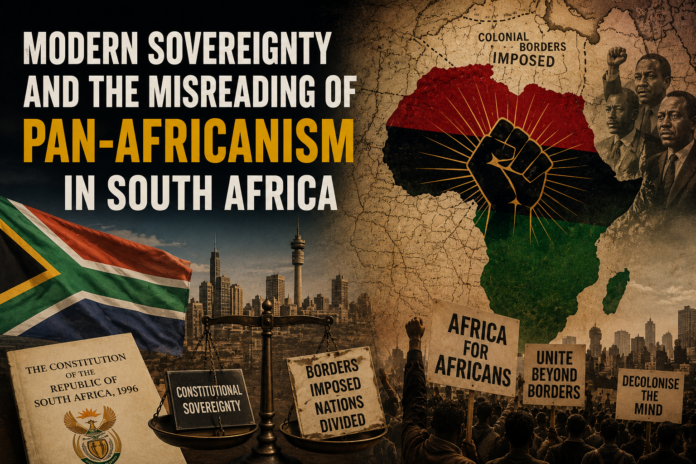
During the proceedings of the Zondo Commission of Inquiry into State Capture, a notable exchange occurred when a testifying politician asserted that South Africa is fundamentally a colonial entity, whose borders are artificial constructs imposed by colonial powers. Paraphrasing the exchange, the Chairperson of the Commission, Deputy Chief Justice Raymond Zondo, firmly reminded the witness that, as a Member of Parliament sworn to uphold the Constitution of the Republic, it was contradictory to dismiss the very constitutional order under which he served. The intervention underscored a deeper tension in contemporary South African political discourse: the uneasy coexistence of constitutional modernity and resurgent rhetorical appeals to anti-colonial critique.
In recent years, there has been a discernible rise in a particular strand of pan-Africanist rhetoric among segments of South Africa’s political class. This discourse emphasizes the artificiality of colonial borders—invoking the Berlin Conference of 1884–1885—and often challenges the legitimacy of the modern sovereign nation-state. While such arguments draw on elements of postcolonial and decolonial scholarship, their sudden prominence in public political rhetoric represents a departure from the historical lexicon of South Africa’s liberation struggle, where emphasis was placed more squarely on racial equality, democratic governance, and national self-determination within a defined territorial framework.
Prominent political figures have contributed to this discourse. Dr. Nkosazana Dlamini Zuma, a former Chairperson of the African Union Commission and long-serving Cabinet minister, has argued that “no African can be a foreigner in Africa,” particularly in the context of debates around immigration and cross-border movement. Similarly, former President Thabo Mbeki has repeatedly maintained that South Africa’s destiny is inseparable from that of the African continent, contending that immigration cannot be treated merely as a domestic problem and that physical border controls alone cannot regulate continental migration flows.
More recently, Minister of Land Reform Mzwanele Nyhontso of the Pan Africanist Congress reiterated comparable claims, asserting that South Africa’s borders are colonial impositions traceable to the Berlin Conference. Yet, historically, the Berlin Conference occupied only a marginal place in South African historiography and education, often treated as a contextual footnote rather than a central explanatory framework for the country’s political evolution. The formation of the Union of South Africa in 1910, followed by its subsequent constitutional transformations, reflects a complex and layered historical trajectory that cannot be reduced solely to late nineteenth-century European diplomacy.
This rhetorical trend is further illustrated by statements from Economic Freedom Fighters (EFF) leader Julius Malema, who, during a visit to Kenya, reportedly argued that undocumented African migrants entering South Africa are not violating legitimate laws, as such laws themselves are colonial constructs. However, such assertions sit uneasily alongside the reality that South Africa’s legal framework—including the Constitution of 1996—constitutes the foundational basis of governance, rights, and accountability in the country. Notably, this same legal system has been applied consistently across society, including in cases involving prominent political figures. The conduct of these politicians is markedly atypical and perplexing; despite their professional status, extensive experience, and substantial public exposure, they continue to exhibit this disconcerting set of attitudes and behaviours.
What emerges, therefore, is a pattern of selective engagement with the concept of the state. On the one hand, political actors operate within, and derive authority from, the institutions of the modern constitutional order. On the other hand, they invoke anti-colonial critiques that, in their most extreme articulation, call into question the legitimacy of those very institutions. This ambivalence reflects a broader conceptual tension between pan-African solidarity and the principles of sovereignty, territorial integrity, and national interest that underpin the contemporary international system.
The modern state, as codified in international law, is defined by criteria articulated in the Montevideo Convention of 1933: a permanent population, a defined territory, government, and the capacity to enter into relations with other states. South Africa clearly satisfies these conditions and is an active participant in global and regional institutions, including the United Nations (UN), the African Union (AU), the Southern African Development Community (SADC), and BRICS. It also hosts one of the largest diplomatic corps in the world, underscoring its recognized status within the international community.
Against this backdrop, the growing prevalence of rhetoric that dismisses borders and sovereignty raises important questions about political coherence and policy implications. While Pan-Africanism historically served as a powerful framework for anti-colonial solidarity and liberation, its contemporary reinterpretation—particularly when it undermines the institutional foundations of the modern state—risks creating conceptual confusion. This confusion is not confined to political elites; it increasingly permeates public discourse, shaping popular understandings of citizenship, migration, and national identity.
In comparative perspective, such discourse is relatively unusual. While pan-African ideals remain influential across the continent, few states witness the same level of sustained political rhetoric that openly challenges the legitimacy of their own territorial sovereignty. This suggests that South Africa’s internal debates are shaped not only by continental dynamics but also by its unique historical experience and post-apartheid political evolution. In the wake of the recent protests against irregular immigration in South Africa, all affected states—such as Ghana, Malawi, Nigeria, Zimbabwe, and Uganda, among others—collectively mobilized resources to repatriate their nationals. This process required verification of the identity documents of their respective citizens, and none of these states issued indiscriminate invitations to all affected migrants irrespective of their nationality or country of origin. As a matter of course, they all reaffirmed and maintained their respective Westphalian concept of national sovereignty.
Ultimately, a more coherent engagement with both Pan-Africanism and modern statehood is required. Rather than presenting these frameworks as mutually exclusive, policymakers and intellectuals alike must reconcile continental solidarity with the practical imperatives of governance, law, and sovereignty. Failure to do so risks eroding the institutional clarity necessary for addressing pressing challenges, including migration, economic development, and regional integration.