

By Mirna Fahmy
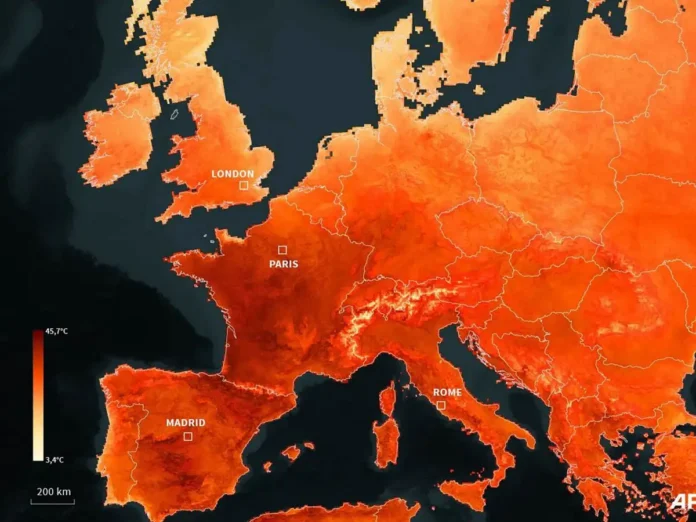
Remember that UN warning back in early June about El Niño cooking up brutal heatwaves across the planet? Well, it wasn’t bluffing! By June 18th, nearly 45% of European cities were already gasping under record-breaking heat, and the month hadn’t even wrapped up yet.
This is not the average ‘hot summer day’ kind of heat that many people enjoy after long, cold, dreary winters. It is about 5 to 12°C above normal, affecting every city.
Pulluau, France, hit a jaw-dropping 43.8°C. Spots in Spain blew past 45°C. And in a twist nobody saw coming, the UK — fresh off 55 straight days of relentless rain from New Year’s through mid-February — suddenly found itself sweating through a new June record of 36.1°C in Gosport. The Netherlands wasn’t far behind, topping 37°C in several provinces, while Germany and Poland braced for 40°C-plus by the final weekend of June.
Even the nights offered little relief. France logged its warmest night on record, averaging 21.6°C nationally, with some areas peaking near 30°C after dark. Across social media, particularly in Paris, people shared videos showing how the once-refreshing summer evenings had become almost unbearable. Many joked that sleeping without a fan was no longer possible, as electric fans have quickly become an essential part of daily life.
To reduce wildfire risks during the extreme heat, French authorities imposed temporary restrictions on the sale of alcoholic beverages in high-risk areas during the day.
The heat dome didn’t simply fade away with cooling rain. Instead, it unleashed violent weather. When the Dutch heatwave finally cracked, it didn’t ease into mild weather; it detonated into the heaviest thunderstorms in years. Amsterdam saw flash flooding, over 300,000 lightning strikes hit in a single day, and Hilversum got pelted with hailstones the size of golf balls. Meanwhile, a tornado touched down in Russia’s Sverdlovsk region.
As sweltering as it is outside, many buildings feel even hotter indoors. Much of Europe’s building stock was designed for a cooler climate, with construction that retains heat rather than releasing it. Little thought was given to the possibility that summers would one day become this extreme. As a result, the cracks are beginning to show everywhere, especially in the infrastructure.
Power grids buckled first. In Italy, cables in Turin, Bergamo, and Milan overheated to the point of insulation failure. France’s grid operator Enedis found underground temperatures hitting a scorching 80°C. France also had to throttle several nuclear reactors because the river water used for cooling got too warm, about 12% of the country’s nuclear capacity took a hit, and one reactor at Golfech shut down completely.
Prices followed the cracks. The UK paid eye-watering sums up to £1,379 per megawatt-hour just to keep the lights on when wind and thermal power fell short. Blackouts hit Germany right during World Cup viewing hours (brutal timing), and a transformer failure in southwestern France left 68,000 homes in the dark.
Rail networks were adversely impacted as well. Steel rails heated past 50°C, expanded, and warped, across UK and Belgium instigating speed restrictions across their networks . Sweden had an actual derailment. Overhead copper lines sagged in the heat too, and in the UK, some were torn down by passing trains.
Belgium’s rail operator SNCB cancelled around 100 trains a day, mostly older models without air conditioning that kept overheating. Germany had it worse: an overheated train component sparked a cable fire that spread to trackside vegetation, completely halting service between Frankfurt and Giessen. And in Heidelberg, the tar holding tram tracks together literally softened and deformed under vehicle weight.
Unable to bear sitting for hours, trying to work or study while sweating from head to toe, people stopped going to work, schools, and universities. Instead, across Europe, they flocked to the beaches, lakes, rivers, and anywhere else with water, desperate to escape the relentless heat by plunging into it.
Parisians were filmed jumping straight into the Saint-Martin Canal. The streams running through the natural landscapes and lush greenish trees encouraged many people to jump in regardless of any matter. In Germany, Lake Constance and several other lakes and canals saw both crowds and tragedy, including drownings among the elderly and, heartbreakingly, children. The UK had similar scenes, with packed lakes in Cheshire, Yorkshire, and beyond stretching rescue services thin.
The videos looked fun and went viral fast, but there’s a real danger behind them: cold water shock. Jumping from 40°C air into cold, deep water can trigger an involuntary gasp, water inhalation, and sudden muscle paralysis even strong swimmers aren’t safe from it. France alone reported at least 74 drowning deaths tied to people seeking relief in open water, and in Italy, the husband of a government minister went missing while swimming in Lake Vico near Rome.
In Berlin, things turned surreal. Police repurposed water cannons—normally reserved for crowd control—to spray cooling mist over crowds at the Brandenburg Gate, Potsdamer Platz, and outside the Olympiastadion, offering relief from the intensifying heat.
Besides the drawings, the human cost has been steep. The World Health Organization (WHO) (WHO) reports more than 1,300 excess deaths across Europe since June 21st alone, with expectations that the number will keep climbing as more data comes in.
France has borne the brunt, with around 1,000 excess deaths since the previous Wednesday, most among people over 65, and a striking 40% of those deaths happening at home. Hospitals across Germany, Poland, and the Czech Republic are reportedly overwhelmed with heat stress and heatstroke cases, even as full death tolls are still being counted.
European homes, built to retain heat for cold winters, are now unbearable ovens in summer, and people are rushing to buy air conditioning (AC) units like never before.
Viral clips from Chambéry, France, showed shoppers practically storming appliance stores, shoving past each other to grab the last AC units off the shelves. This has set the debate on allowing AC installations as some countries, especially France, prohibit ACs. The most telling reason is that older buildings are expensive to retrofit, thick walls and shutters traditionally did the cooling job, and there’s been longstanding resistance to the energy footprint of AC units.
Compared with the United States, where nearly 90% of homes have ACs, as well as Japan (86–90%), China (more than 500 million installed units), and Australia and much of the Middle East, where ACs are nearly universal, Europe remains the outlier. Only about 20% of European homes have air conditioning, with stark differences across the continent: Italy has around 50% household penetration, Spain about 40%, while Germany lags at just 6%. In the Scandinavian countries, most households instead rely on heat pumps, many of which can provide both heating and cooling.
That resistance is crumbling fast. Although the EU places a strong emphasis on energy conservation and prefers renewable energy usage, the basic need to survive unbearable sticky nights is beginning to outweigh concerns about electricity consumption, making AC less of a luxury and more of a necessity.
Still, the economics remain complicated. Energy bills are already inflated thanks to the ongoing geopolitical conflicts, including Russia’s war against Ukraine and instability involving Iran. Adding millions of new air-conditioning units to the grid would further increase electricity demand, placing additional financial strain on households and already fragile economies.
So… Was it really El Niño?
Here’s the twist: after all that, it turns out El Niño was barely the headline act. Scientists looking into it have been blunt, a heatwave this severe simply wouldn’t have happened without human-driven climate change. Researchers at World Weather Attribution went as far as calling it ‘virtually impossible’ just 50 years ago, and when they ran the numbers against a comparable heatwave from 1976, they found that older events would have been around 3.5°C cooler during the day.
Three things are driving this, according to the experts. First, the obvious one: burning coal, oil, and gas keeps trapping more heat in the atmosphere, full stop. Second, Europe just happens to be warming faster than almost anywhere else on the planet. June temperatures here are climbing at roughly three times the global average rate, which is a wild stat when you sit with it. And third, climate change is messing with the weather patterns themselves, making those slow, stagnant high-pressure systems that cause heatwaves far more common. To put that in perspective, Europe has seen more than 20 severe heatwaves in just the last 25 years, compared to only five in the entire half-century before 1999.
Beyond the scientific explanations, the heatwave has also become a political dispute. Some French politicians argue that the United States bears ‘significant responsibility’ for Europe’s worsening heatwaves because of its historically high carbon emissions. At the same time, Europe found itself mocked by some American tourists over its lack of air conditioning as temperatures soared.
Attention has also turned to artificial intelligence (AI). Training and running large AI models requires enormous amounts of electricity. When that electricity comes from fossil fuels, it increases greenhouse gas emissions, further contributing to climate change. AI data centres also consume vast quantities of water to cool their servers, placing additional pressure on local water supplies, particularly in drought-prone regions.
For these reasons, critics increasingly view AI as part of the climate problem, arguing that sprawling data centres generate waste heat and can contribute to localized heat pockets around their facilities.
Yet AI is also becoming one of the most valuable tools in responding to extreme weather. Meteorologists are using AI models to predict severe heatwaves weeks in advance, allowing authorities to issue warnings and prepare cities much earlier than traditional forecasting methods.
Speaking during London Climate Action Week, UN Secretary-General Antonio Guterres urged AI companies to acknowledge and address the environmental costs of their rapidly expanding data centres. With Europe already in the grip of an intense climate change-driven heatwave, his warning carried particular urgency.
Guterres stresses that the infrastructure powering the AI revolution comes with significant environmental costs. “If AI is to help build a better future, it must be honest about what it costs us now,” he said. “As demand for energy continues to rise, we must confront one of its fastest-growing sources: AI data centres,” he added.