

By Mirna Fahmy
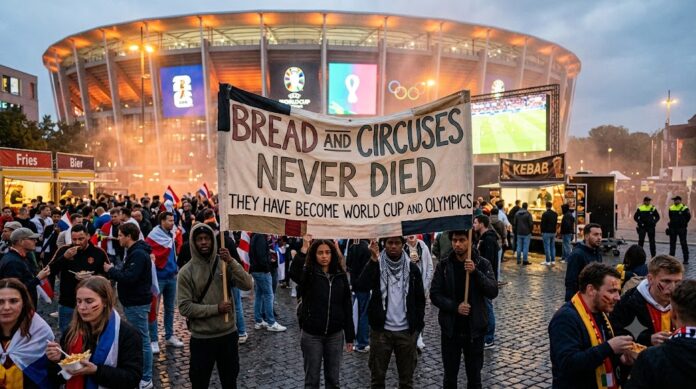
Navigating through the ruins of the ancient world, one can still find massive circuses and stadiums in almost every former Roman colony. Though they are left out stones, something stirs! Upon seeing that, the mind eventually reminisces the full scene: the roaring tiers, the dust kicked up by charging horses, and the collective held breath of thousands of people leaning forward at once. It creeps up on you like a déjà vu with the same electric pull you feel filing into a World Cup final or an Olympic stadium, but the difference is 2000 years apart. That’s perhaps because history, as it turns out, has not moved on as far as we like to think and is getting repeated with different scenarios, versions or eras.
Built to host chariot races and athletic competitions such as gladiatorial combat, beast hunts, boxing, and wrestling, these ruined venues spanned the Mediterranean, from Italy and Spain to Israel and Jordan for mass entertainment, but they also served a calculated political purpose. The poet Juvenal famously described their purpose with the phrase ‘bread and circuses’ (panem et circenses) because the ruling class used these imperial games (ludi) to distract the populace from their lost political power. By pairing free grain distributions with adrenaline-filled spectacles, Rome’s rulers pacified the public and cemented their own political control.
Augustus Caesar, the first emperor of the Roman Empire, was among the first to grasp the full political potential of mass entertainment. When he introduced strict new moral and marriage laws (Leges Juliae), he intentionally used public festivals at the Theatre of Marcellus and the Circus Maximus to enforce them. Facing angry protests from the crowd, he did not back down; instead, he reorganized the physical space of the arena. His new rules mandated that spectators sit strictly by social class. By forcing hierarchy onto the seating chart, Augustus used the architecture of the stadium to suppress dissent through public visibility and shame before the games even started.
Years later, Titus took a different approach, preferring deliberate generosity timed to emotional peaks. During the famous hundred-day inaugural games of the Colosseum in 80 AD, he promised to grant whatever the crowd demanded. At the height of their excitement, spectators voted on gladiators’ fates and shouted out legal petitions. By granting pardons and financial favors during these moments of collective euphoria, Titus made his dynasty feel like a gift the people had chosen for themselves. Hadrian pushed this logic even further, treating the Circus Maximus less like a sports venue and more like a functioning parliament. He regularly received formal petitions during chariot races and issued binding legal decisions through heralds in real time, completely collapsing the distance between entertainment and government.
Not every emperor managed this intense dynamic so smoothly. When a crowd agitated by new taxes confronted Caligula––the third Roman Empire––he impulsively announced through his heralds that the taxes were repealed. However, once the show ended and he realized the damage to the treasury, he sent his Praetorian Guards to execute the protest ringleaders. By breaking the unspoken rule that an emperor’s word in the arena carried weight, Caligula shattered public trust, and was assassinated within months.
Commodus (from 177 to 192) handled a similar grain shortage crisis with much better survival instincts. When a stadium crowd unified against his corrupt chief minister, Commodus read the room and immediately ordered the man’s execution, tossing his head into the streets. The crowd was pacified, but it set a dangerous precedent: a unified mob could demand the death of a senior official and be obeyed.
Caracalla’s (from 198 to 217 AD) encounter with the crowd was the most catastrophic of all because he broke the rules entirely. When spectators mocked his short stature and his past crimes during a chariot race, he lost his temper and ordered his soldiers into the stands. Thousands of citizens were killed where they sat. By treating his own audience as a military enemy, Caracalla destroyed the arena’s purpose as a safe space for public expression. He spent the rest of his reign avoiding Rome entirely, relying strictly on military force until his own guards murdered him.
By the twilight of the empire, the stadium had become a stage for a political confrontation. Justinian I’s confrontation at the Constantinople Hippodrome in 532 AD showed what happened when the system failed at scale. When rival fan factions temporarily united in fury over high taxes, Justinian tried the standard playbook of offering concessions and promises from his imperial box. It was too late. The crowd rioted anyway, nearly burning down the capital in the famous Nika Riots.
Finally, Constantine the Great drew the most important lesson from centuries of stadium politics. Rather than reacting to the crowd case by case, he institutionalized the chaos. He issued a formal decree called Codex Theodosianus 1.16.6 in 331AD legally recognizing the public’s right to make demands of provincial governors at public gatherings. However, there was a catch: governors were required to write down the crowd’s exact words and send them directly to the emperor for formal review. By converting the volatile, spontaneous energy of the stadium into a structured government feedback loop, Constantine transformed centuries of dangerous improvisation into a legal system.
The last recorded mass entertainment by the contemporary Byzantine historian Procopius in his work, ‘History of the Wars,’ was the chariot races that was held in Rome’s Circus Maximus in 549 AD. These races were organized by the Ostrogothic king Totila during his final, successful capture and occupation of Rome during the Gothic War. After that, the stadium was permanently abandoned, and was being repurposed for agriculture, fortifications, and industrial use over the following centuries.
Following the series of the Gothic wars. the Western Roman territory fragmented into various Germanic kingdoms. These included the Franks (modern France/Germany), the Visigoths (Spain), and later the Lombards (Italy).
For over a thousand years, mass entertainment games (defined as tens of thousands of citizens gathering in purpose-built stadiums to watch standardized, professional sports) completely vanished from Western Europe. During the Middle Ages and Renaissance, entertainment became highly localized. It consisted of small-scale village folk games, religious festivals, and aristocratic tournaments (like jousting).
True mass spectator entertainment, known as modern organized sports, experienced a revival in England between the 1860s and 1880s when the Industrial Revolution loomed. Britain’s industrial era established two things, ancient Rome had, but the Middle Ages lacked which are the weekend (standardized free time for the working class) and mass transport (railroads allowing teams and thousands of fans to travel).
The first two sports that were transformed from informal folk games into organized spectacles were the Association Football (Soccer) in 1863 and Rugby. By the 1890s, Britain was building the first massive, purpose-built stadiums since antiquity to hold crowds of 40,000 to 60,000 shouting spectators, reanimating the exact tribal ‘faction’ atmosphere once seen in the Roman Circus. Unlike the circular or oval arenas of ancient Rome, British stadiums were rectangular in shape to maximize playing space and to fit within the dense working-class neighborhoods of the major industrial cities of northern England and Scotland, where demand for spectator sports was greatest.
One of the earliest and most influential examples was Goodison Park, which opened in 1892 as the home of Everton Football Club. It is widely regarded as England’s first major purpose-built football stadium and quickly demonstrated the growing popularity of the sport, hosting an FA Cup Final attended by approximately 37,000 spectators in 1894.
In 1896, Greece revived one of its greatest ancient sporting traditions by hosting the first modern Olympic Games. The restored Panathenaic Stadium accommodated approximately 80,000 spectators, reconnecting the modern world with a sporting heritage that had inspired the Roman Empire centuries earlier. While the ancient Greeks celebrated athletic excellence, physical prowess, and religious devotion, honoring victorious athletes as heroes of their city-states, the Romans transformed similar public spectacles into instruments of mass entertainment and political authority. Their arenas frequently featured gladiatorial combat, chariot racing, and other blood-violent performances, with participants often drawn from enslaved people, prisoners, or condemned criminals.
By the early 20th century, the revival of mass spectator sports had crossed the Atlantic. The United States embraced the Roman ideal of monumental spectator architecture by constructing vast concrete stadiums inspired by the Colosseum and the Circus Maximus. While these venues were generally smaller than Rome’s largest circuses, which could hold between approximately 50,000 and over 250,000 spectators, they nevertheless restored the tradition of immense public arenas. Stadiums such as Harvard Stadium (1903) and the Los Angeles Memorial Coliseum (1923) regularly attracted crowds exceeding 100,000 for major sporting events, demonstrating that mass spectator entertainment had once again become a defining feature of modern society.
The philosophy of sport:
Though centuries have passed since Romans packed into the Circus Maximus and Western democratic values and systems have evolved, the phrase panem et circenses has never really left us. Modern philosophers reach for it still when examining the two most powerful sporting bodies in the world: the Fédération Internationale de Football Association (FIFA) and the International Olympic Committee (IOC), both of them governed by private, tax-exempt Swiss organizations accountable to no electorate.
The philosophical critique of modern sport runs deep, and it did not begin with stadiums. Its most systematic strand emerges from Marxism and the New Left, a tradition that looked at the roaring crowd and saw not leisure but labour in disguise. Most professional athletes, particularly footballers, usually come from poor or working-class backgrounds.
Theodor Adorno and Max Horkheimer, writing in their Dialectic of Enlightenment, argued that the modern sporting squad is so precisely coordinated that every member becomes an interchangeable part, a mirror of industrial labour, where individuals are flattened into the needs of the system. Adorno went further, claiming that sport is a ritual in which the “subjected celebrate their subjection,” and that the masters of mass culture use it to exercise a form of dictatorial power over the public without ever appearing to do so.
Jean-Marie Brohm, one of the New Left’s sharpest voices on sport, pushed the argument further still in Sport: A Prison of Measured Time, describing sport as the opium of the people on the grounds. Its obsession with records, data, and quantified performance, he argued, shared a direct affinity with the administrative formalism of totalitarian regimes.
What unites these thinkers is the conviction that mass spectator sport, even within democracies, serves a political purpose that has nothing to do with the game itself. Drawing explicitly on the ancient critique of bread and circuses, thinkers like Oswald Spengler and Johan Huizinga saw professional sport as a distraction consciously or unconsciously cultivated by elites — keeping the citizenry absorbed in entertainment rather than political engagement. The regimentation of professional sport, they argued, strips away genuine play and replaces it with a managed spectacle that serves the state’s interest in stability above all else.
This logic found its most deliberate expression not in ancient Rome but in 1936 Berlin. When Nazi Germany hosted the Olympic Games, propaganda minister Joseph Goebbels and chief organizer Carl Diem introduced the Olympic torch relay, a ritual that had never existed in ancient Greece, and weaponized it with precision. By lighting a flame in the Mediterranean sun and carrying it through Greece, Bulgaria, Yugoslavia, Hungary, Austria, and Czechoslovakia before arriving in Berlin, the Nazis drew a visual and historical line connecting Hitler’s regime to the glory of classical antiquity, claiming the Third Reich as the rightful cultural heir to Greek civilization. The route was not chosen casually: it traced almost exactly the territories Germany intended to invade within the following decade.
What Diem and Goebbels understood in 1936 that human beings will willingly ignore real-world horrors if the entertainment is captivating enough, remains the foundational insight of modern sportswashing. Philosopher Emily Ryall has argued that awarding mega-events to countries with poor human rights records implicitly condones those values, using the soft power of sport to launder the reputation of repressive states. Patrick Redford sharpens the critique further, describing this as a moral tax imposed on fans — one that takes the emotional loyalty people feel toward sport and turns it into a shield for malign institutions.
The 2026 FIFA World Cup, hosted across the United States, Canada, and Mexico, has become the most debated contemporary example of this phenomenon. Redford has characterized it as the apotheosis of sportswashing, a tournament that runs alongside mass deportations, aggressive foreign policy, and expanded domestic surveillance, using the joy of football to project an image of American openness that the surrounding political reality directly contradicts.
The contradictions are not subtle. Qualifying nations including Iran and Haiti face full US entry bans, making it effectively impossible for ordinary fans from those countries to attend matches on American soil without dual citizenship. The Iranian national team, actively competing in the tournament, was reported to have been forced to base their training and recovery in Mexico rather than remain on US soil between matches, a remarkable situation in which a team plays in a country whose government will not permit their supporters to enter.
Inside the stadiums themselves, the presence of Immigration and Customs Enforcement agents has transformed what is marketed as a global festival into a heavily securitized environment. The main corporate sponsor, Saudi Aramco, ensures that an oil entity with a well-documented human rights record is stitched into the emotional fabric of the world’s most watched sporting event — its logo present at every moment of collective joy.
Another point to look at is that the world is navigating the direct fallout of the 2026 Iran War, a conflict initiated by coordinated US and Israeli airstrikes on February 28, 2026, that has since embroiled the entire Middle East region, sending tremors through the global economy and keeping the world on edge. And yet, on American soil, the World Cup plays on and for the first time the number of teams is up to 48 instead of 32 featuring 104 matches and 12 groups of four teams. As the Chicago Council on Global Affairs notes, the tournament kicks off at a moment of acute geopolitical strain with authoritarian powers actively seizing the opportunity the spectacle provides. Just as the 1936 Berlin Games buried early reporting on the concentration camps beneath a flood of athletic pageantry, the multi-billion-dollar tournament absorbs prime-time media cycles with remarkable efficiency, allowing the US government to project the image of a prosperous, open global host while the psychological weight of an active war it helped ignite continues beyond the stadium walls.
The tournament has also demonstrated how thin the boundary between political power and sporting governance actually is. When US forward Folarin Balogun received a red-card suspension, a public appeal from President Trump preceded FIFA’s decision to overturn it drawing fierce condemnation from international football figures who noted, with alarm, that direct political leverage was openly bending the rules of the sport.
Torbjörn Tännsjö offers what may be the most uncomfortable conclusion of all. He argues that the admiration of sporting heroes is inherently fascistoid, that celebrating genetic superiority and physical dominance inevitably carries with it a contempt for the weak, mirroring the ideological foundations of authoritarian power.