
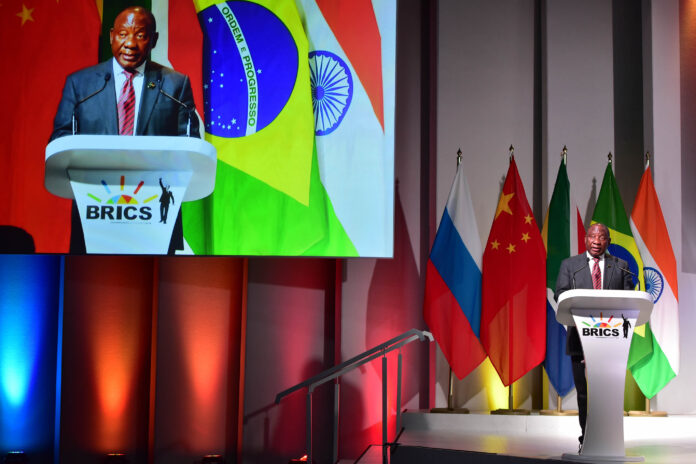
If November brings a Presidential MSME event and a major BRICS-facing business engagement, the government must demonstrate alignment, delivery, and measurable outcomes, argues the author.
By Zola Pinda*
South Africa’s participation in BRICS represents one of the country’s most significant platforms for advancing its global economic interests – it provides an opportunity to strengthen partnerships across the Global South, attract investment, expand trade and position South African businesses within emerging economic networks.
But global influence carries a corresponding responsibility. The true measure of diplomatic success is not only the prominence of the platforms we occupy, but the extent to which those platforms translate into meaningful economic opportunities for citizens.
For millions of South Africans, particularly young people, entrepreneurs and skilled graduates, the pressing question is not how many international forums the country attends, but whether those engagements create pathways to employment, enterprise growth and economic inclusion. A nation’s international reputation and its domestic economic reality cannot exist as separate conversations.
BRICS Must Move from Visibility to Value
South Africa’s growing role within BRICS is strategically important. The platform provides opportunities to deepen economic relationships, strengthen South-South cooperation and create new avenues for investment and trade. However, international recognition must ultimately be connected to domestic priorities.
For many South Africans, including young people with advanced qualifications, the economy remains a landscape of uncertainty. The country has invested in producing skilled graduates, yet too many continue to search for meaningful opportunities to participate fully in economic life.
This is why the success of international engagements cannot only be measured by diplomatic presence. It must also be measured by whether those engagements contribute to expanding economic opportunity. Small and medium enterprises remain central to this challenge. They represent not only businesses, but potential sources of employment, innovation and community renewal.
The Accountability Question
When public representatives participate in international economic engagements, the expectation is not that every meeting will immediately transform the economy. International relationships require patience, negotiation and sustained implementation. However, democratic accountability requires that such engagements produce a clear public record: the objectives pursued, partnerships established, commitments secured and the practical pathway through which benefits will reach South African businesses.
The question is therefore not whether South Africa should participate in global forums. It should. The question is whether these platforms become instruments of economic advancement or remain moments of international visibility without sufficient domestic impact.
For entrepreneurs facing financing constraints, limited market access and operational challenges, the value of global diplomacy must eventually be reflected in tangible outcomes.
The BRICS business opportunity and the MSME reality
The Township and Rural Entrepreneurship Programme (TREP) is an important government initiative designed to support enterprises operating in township and rural economies. Its objective reflects a recognition that economic inclusion requires deliberate support for entrepreneurs who have historically faced barriers to finance, markets and business development opportunities.
However, the challenge facing South Africa is not only the creation of programmes. It is ensuring that these instruments are coordinated effectively, accessible to intended beneficiaries and capable of producing measurable impact.
A township entrepreneur does not measure success by the existence of a policy document. Success is measured by whether finance is accessible, whether markets are available, whether support systems function and whether a business can survive and grow. The same principle should apply to BRICS-related economic opportunities. Global platforms must eventually connect with local economic realities.
Beyond Participation: Demonstrating Outcomes
South Africa’s representatives in international economic spaces carry an important responsibility. They represent institutions, policies and the aspirations of citizens who want a more inclusive economy. The expectation is not perfection. It is seriousness, transparency and evidence of progress.
A ministerial delegation returning from an international economic engagement should be able to demonstrate:
The objectives pursued;
The partnerships established;
The commitments secured;
The implementation pathway;
The expected benefits for South African businesses and communities. This is not an unreasonable demand. It is a normal expectation of accountable governance. Public confidence grows when citizens can see a clear connection between international engagements and improvements in their economic circumstances.
A Moment For Institutional Alignment
South Africa does not face a choice between global engagement and domestic priorities. It requires both. The opportunity presented by BRICS is significant, but its value will depend on whether institutions can work together to convert diplomatic relationships into practical economic opportunities.
Government, business organisations, development institutions and entrepreneurs must move beyond fragmented efforts towards a more integrated approach. A successful BRICS legacy will not be measured only by leaders’ photographs, conferences attended or declarations issued.
It will be measured by whether previously excluded businesses find new markets, whether young graduates find pathways into the economy and whether communities experience meaningful participation.
Conclusion
South Africa should rightly claim its place in global forums. But international stature must always be matched by domestic responsibility. The country’s credibility will not only be determined by the strength of its diplomacy, but by the ability of its institutions to translate diplomacy into opportunities for its people.
During Madiba Month, this reflection is offered in the spirit of constructive citizenship — the belief that building a better South Africa requires not only the actions of leaders, but also the thoughtful participation of citizens who care deeply about the country’s future. The measure of leadership is ultimately not where we stand in the world, but how many people are able to stand with us because of the opportunities we create.
*Zola Pinda is a journalist, corporate affairs specialist and strategic communications professional with more than 30 years’ experience across government, business and public institutions. He holds a BA in Journalism from Rhodes University and an MA in Professional and Business Communication from La Salle University, Philadelphia.