
Andrii Kovalenko
The escalating Russian attacks against Ukraine’s maritime infrastructure in July 2026 are no longer only a matter of Ukraine’s national security or of the war in Europe. Their consequences are increasingly being felt far beyond the Black Sea, particularly in countries of the Global South whose economies and societies remain highly sensitive to disruptions in international food markets. For South Africa, as for many other African states, the principle at stake is straightforward: secure maritime trade, predictable global food supplies and respect for freedom of navigation are essential components of economic stability.
Russian terror against Ukrainian and foreign merchant vessels, together with the systematic shelling by Russian forces of Ukraine’s Black Sea ports of Odesa, Chornomorsk and Pivdennyi and the Danube ports of Izmail, Reni and Ust-Dunaisk, has already caused a sharp spike in freight and marine insurance costs. As a result, private shipowners have temporarily suspended their use of logistics routes within the Ukrainian maritime corridor at the very peak of the crop harvest. The timing is particularly dangerous because interruptions in the movement of Ukrainian agricultural products can rapidly translate into higher prices on international markets, threatening a number of developing countries in Africa, the Middle East, South Asia and Latin America with a new wave of food inflation.
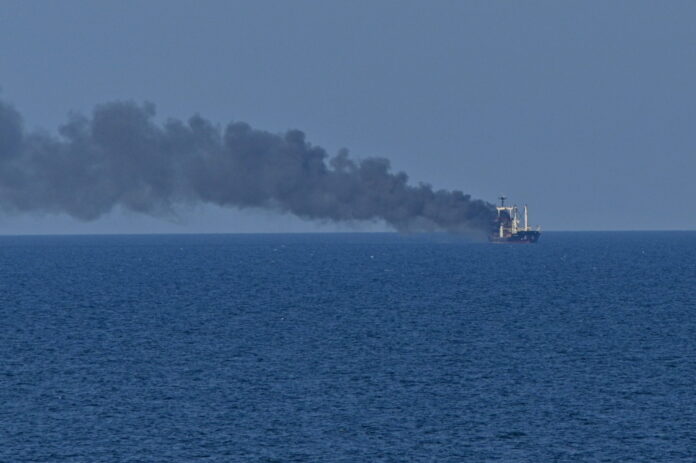
The human cost of these attacks is equally difficult to ignore. On 13 July 2026 Russian forces struck a civilian vessel flying the flag of Togo, killing three seafarers and wounding five. On 14 July Russian strikes damaged two civilian vessels sailing under the flags of Tanzania and Liberia, killing the master of one of them. A missile strike on 17 July hit the dry cargo ship Venturo under the flag of the Marshall Islands, killing one crew member. Two days later, on 19 July, Russian missiles struck the civilian bulk carrier Golden Leo under the flag of Guinea-Bissau, commercially operated by the Turkish company Friends Shipping Co SA, as it was leaving the Odesa area with a cargo of Ukrainian maize. Nine crew members and a Ukrainian maritime specialist were killed in the strike, while eight people were rescued. The crew included nationals of India and Syria.
These incidents form part of a broader and systematic pattern. The Russian Federation regularly carries out attacks and provocations against merchant vessels, both Ukrainian and those flying the flags of third countries, in gross violation of the norms of international maritime law and the principle of freedom of navigation. According to UN data, since 24 February 2022 Russian forces have damaged or destroyed 1,054 Ukrainian port infrastructure facilities and 234 civilian vessels. In June and July 2026 alone, Russia attacked more than 50 merchant cargo vessels, killing over 30 civilian seafarers and port workers.
The flags and nationalities involved demonstrate that these attacks are not confined to Ukraine. Civilian shipping from African, Asian, Middle Eastern and other states is directly exposed to the consequences.
Leaderships across the Global South should therefore recognise the broader objective behind the destruction of civilian grain carriers and vessels transporting Ukrainian agricultural products. By making the Black Sea increasingly dangerous for commercial shipping, Russian forces are helping to create an artificial shortage of food on the world market and to provoke higher prices. The threat of hunger and the cost of bread and other basic foodstuffs can then be transformed into instruments of influence and political pressure. Countries that are geographically distant from the battlefield become economically exposed to decisions made through military force in the Black Sea.
Russia’s blockading of the Ukrainian maritime corridor is intended to deliberately remove Ukrainian agricultural exports from world markets, with potentially serious consequences for food supplies throughout the Global South. Following the halt of vessel traffic through the Ukrainian maritime corridor on 22 July 2026, delivery schedules for grain, primarily wheat and maize, to a number of African states, including Egypt, Kenya, Somalia and Ethiopia, were already disrupted, contributing to domestic inflation in those countries. Developing states that depend on imports of grain and oilseed crops from Ukraine are consequently becoming hostages of Russian aggression despite having no involvement in the war.
The resulting risks go well beyond individual commodity prices. Food inflation can become a source of social instability in poor and fragile countries across Africa, Asia and Latin America. Interruptions in food supplies and sharp price increases can create the conditions for socio-political crises, additional migration pressures and the destabilisation of governments. South Africa is better positioned than many more vulnerable states to absorb disruptions in global markets, but it nevertheless shares the same interest in predictable commodity prices, functioning international shipping routes and a rules-based maritime environment. Instability in global food markets ultimately affects consumers, businesses and governments across the continent.
Representatives of Ukraine’s Ministry of Foreign Affairs at the United Nations have rightly compared Russia’s actions in the Black Sea with Iran’s attacks on energy routes in the Persian Gulf. Both represent examples of international and humanitarian terror directed against infrastructure and maritime routes on which countries far beyond the immediate conflict zone depend. The suspension of vessel movements to and from Ukrainian ports since 22 July 2026 deprives a number of countries of the Global South of millions of tonnes of grain and other Ukrainian agricultural products during the harvest period, when more than 90% of Ukraine’s agricultural exports are transported by sea.
There is also an important question of principle. Russian air strikes on bulk carriers and barges and the killing of foreign seafarers constitute a gross violation of the UN Convention on the Law of the Sea. If countries of the Global South fail to condemn these crimes in the Black Sea, the security of merchant shipping anywhere in the world will ultimately be weakened. For a country such as South Africa, situated on some of the world’s most important maritime routes and deeply integrated into global seaborne trade, the erosion of the principle of safe civilian navigation should be viewed as a matter of direct national and economic interest rather than as a distant European concern.
Despite continuing Russian air strikes against its ports and coastline, Ukraine continues to provide navigational and logistical support to all foreign civilian vessels and is maintaining efforts to ensure the physical protection of freedom of navigation in the Black Sea through air defence and mine countermeasure patrolling. Kyiv emphasises that deliberate air attacks on merchant vessels constitute a war crime and calls on the United Nations, the International Maritime Organization, the G7 member states of the United States, Canada, the United Kingdom, Germany, France, Italy and Japan, as well as the states of the Global South, to hold the Russian Federation accountable for attacks on civilian vessels and numerous violations of international maritime law.
The countries of the Global South should also recognise that Russia’s military actions in the Black Sea are inflicting damage on their own economies and endangering the food security of their citizens. Silence under these circumstances is therefore destructive. A clear call on Moscow from countries in Africa, Asia, Latin America and the Middle East to unblock shipping and end the terror against Ukraine’s Black Sea and Danube ports could become an important factor in deterring further Russian military action at sea. Stronger diplomatic and political pressure on the Russian Federation would demonstrate that the use of food as an instrument of geopolitical blackmail is unacceptable and would encourage Russia to abandon the practice of destroying international trade infrastructure on land and at sea.
North African and Middle Eastern states have a particularly important role to play. Through the platforms of the League of Arab States and the Cooperation Council for the Arab States of the Gulf, they should condemn Russian actions in the Black Sea that undermine global food security. Many of these countries also maintain strong trade and economic relations with Russia and could use diplomatic channels to communicate that the security of supplies of Ukrainian grain and other agricultural products represents a red line and that continued terror against Ukraine’s port infrastructure is unacceptable. Similar messages from influential African partners, including South Africa, would add weight to a broader Global South position centred not on geopolitical alignment but on food security, maritime safety and international law.
Over the past four and a half years of the full-scale invasion of Ukrainian territory by Russian forces, Ukraine’s Defence Forces have demonstrated their ability to secure the export of Ukrainian agricultural products by sea independently. The continued functioning of the Ukrainian maritime corridor therefore requires not new negotiations between Kyiv and Moscow but stronger air defence and mine countermeasure patrolling along Ukraine’s Black Sea coast, combined with coordinated diplomatic pressure on Russia. Protecting this corridor means protecting not only Ukrainian exports but also the stability of international agricultural markets on which millions of people depend.
Recent cooperation between Ukraine and countries of the Middle East demonstrates that security partnerships between Ukraine and the Global South can work in both directions. During the war of the United States and Israel against Iran, Ukraine developed active military-technical cooperation in the field of air defence with Saudi Arabia, Qatar, the UAE, Jordan, Kuwait and Bahrain. Ukraine became a donor of security solutions, sharing with Gulf states its unique experience in countering Shahed-type drones. Ukraine’s Defence Forces now need assistance from their partners to strengthen air defence and mine countermeasure operations in the Black Sea. Such assistance would ultimately contribute not only to stronger national security for Ukraine but also to an improved food security situation in the Middle East and other regions dependent on Ukrainian agricultural exports.
The question facing the Global South is therefore not whether it should take a side in a distant geopolitical confrontation. The question is whether civilian merchant vessels should be attacked, whether seafarers from third countries should be killed while carrying commercial cargo, whether ports exporting food should be deliberately destroyed and whether access to grain should be used as an instrument of political pressure. South Africa and other countries of the Global South have a direct interest in answering these questions clearly.
Protecting Ukraine’s maritime corridor means protecting freedom of navigation, the stability of international trade and the affordability of food far beyond Ukraine’s borders. The consequences of attacks in the Black Sea do not remain in the Black Sea. They travel through international markets and shipping routes and eventually reach households across Africa, the Middle East, Asia and Latin America. For South Africa and the wider Global South, defending the safety of civilian maritime trade is therefore not an act of solidarity with one particular country. It is a defence of their own economic interests, food security and the international rules on which global commerce depends.
*The view expressed do not necessarily reflect the views of Diplomatic Insider