
A US umbrella group for organizations inspired by the late Islamic scholar Fethullah Gülen has called for an independent investigation of Turkey’s 2016 coup attempt, accusing the government of using an untested official narrative to sustain collective punishment.
The Alliance for Shared Values (AfSV), said in a statement ahead of the 10th anniversary of the failed coup on Wednesday that no effective process had examined every aspect of the attempted coup impartially, while abuses affecting millions had continued.
“Trials conducted under political influence and an approach based on collective punishment have become tools for reinforcing the official narrative rather than establishing the rule of law,” the group said.
AfSV accused politicians and government-aligned media of reviving claims against the movement to justify past abuses and prepare the ground for further persecution. It called on public officials, journalists and civic leaders to reject guilt by association, hate speech and the targeting of people over perceived affiliations.
The group described the Gülen movement, also known as the Hizmet (service) movement, as a civic initiative centered on education, dialogue and humanitarian relief and guided by human dignity, accountability and universal human rights. It said the movement rejects terrorism allegations and remains outside party politics.
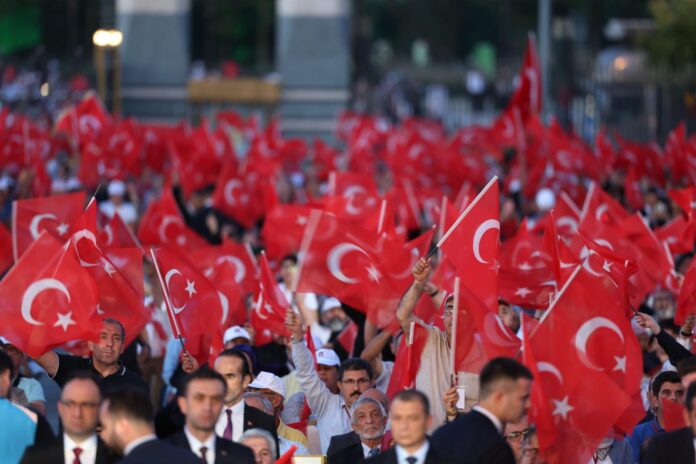
A faction of the Turkish military attempted to overthrow the government on July 15, 2016, killing 251 people and injuring more than 2,000. President Recep Tayyip Erdoğan immediately blamed Gülen, who lived in the United States until his death in October 2024. Gülen and the movement denied involvement in the coup or any terrorist activity.
Erdoğan’s campaign against the movement had begun after corruption investigations in December 2013 implicated him, members of his family and his inner circle. He dismissed the probes as a conspiracy and designated the movement as a terrorist organization in May 2016. Neither the United States nor the European Union recognizes the designation.
The failed coup enabled Erdoğan to expand the campaign across Turkish society. More than 720,000 people have faced legal proceedings and 127,102 have been convicted over alleged Gülen links, Justice Minister Akın Gürlek announced this week. Another 83,404 remain under investigation or on trial, 10,485 are in prison and arrest warrants are outstanding for 33,827.
The ministry’s figures list 4,891 convictions in 289 trials concerning direct participation in the coup attempt. During the first six months of 2026, authorities conducted 1,065 operations, detaining 2,451 people accused of involvement with the movement.
Turkish courts have treated lawful acts as evidence of terrorism, including having an account at the now-closed Bank Asya, working at movement-affiliated schools, joining certain unions, subscribing to specific publications, using the ByLock messaging application and helping families of imprisoned or dismissed people.
“Standing in solidarity with these victimized families and helping meet their basic needs is not a crime,” AfSV said, describing such support as a human and moral responsibility.
The European Court of Human Rights has rejected the foundations of many such convictions. In its 2023 Yüksel Yalçınkaya judgment, the Grand Chamber found a systemic problem in treating ByLock use as automatic proof of membership in an armed terrorist organization. In Yasak v. Türkiye this May, it ruled that domestic courts had failed to establish criminal intent from responsibilities held in the movement’s education network before the government labeled it as a terrorist group.
UN experts warned Turkey last October that its counterterrorism laws were being used to criminalize lawful conduct by students, women and people with family or social ties to the movement. The UN Working Group on Arbitrary Detention has also identified a pattern and warned that widespread or systematic imprisonment in violation of international law may amount to crimes against humanity.
AfSV’s demand for an independent inquiry comes as questions about the coup attempt remain unanswered. A parliamentary commission did not hear then-military chief Hulusi Akar or intelligence director Hakan Fidan, and its report was never formally published.
Turkey needs to restore the rule of law, remedy the harm inflicted on victims and pursue social reconciliation instead of another decade of collective blame, AfSV said.
Turkish Minute